


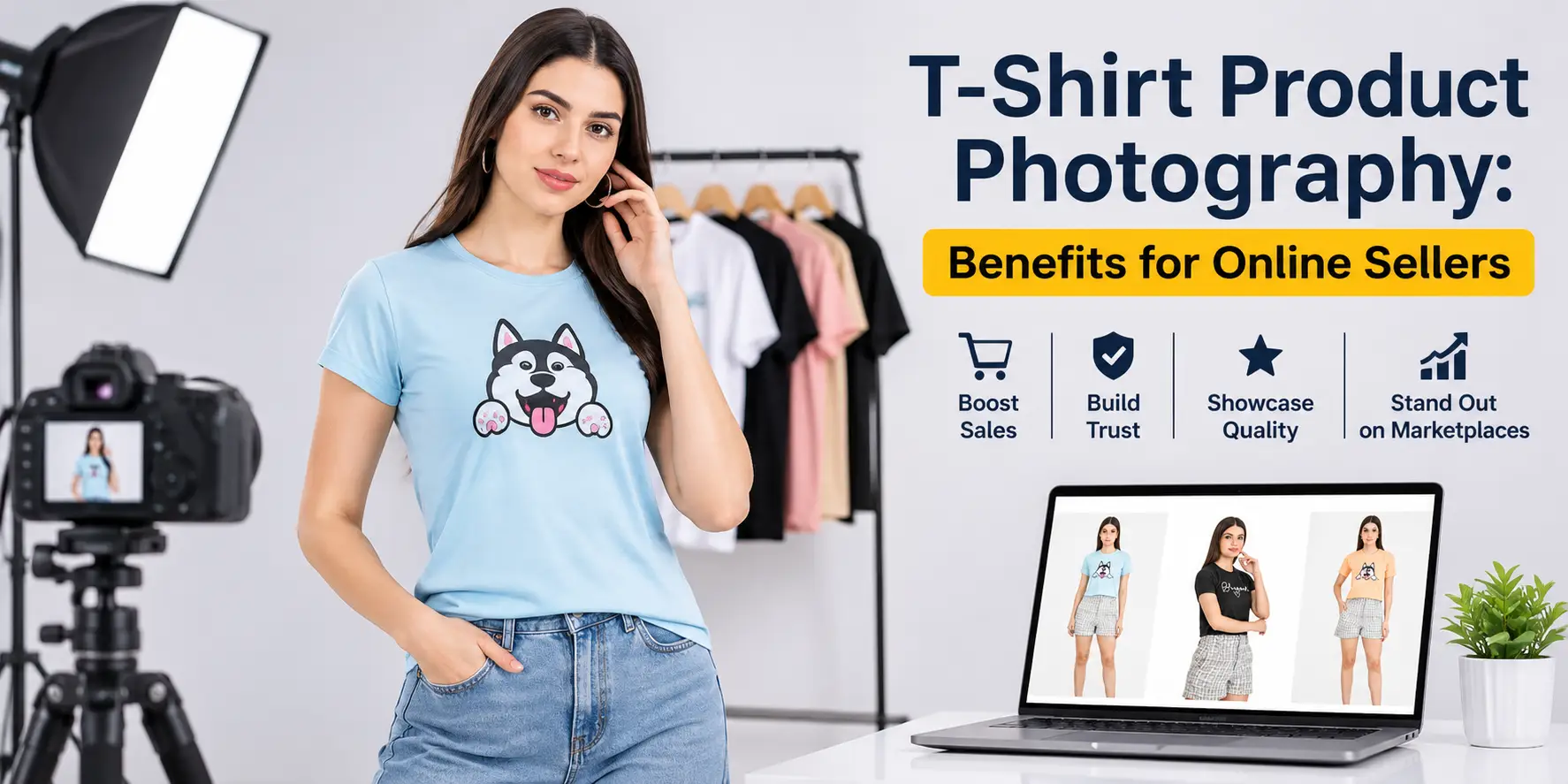
Professional T-shirt product photography helps online sellers because buyers cannot touch the fabric or try the fit. Clear, colour-accurate images that show the front, back, print, neckline, and fit give shoppers the information they need to decide. That builds trust, supports marketplace requirements, keeps your catalogue consistent, and can reduce purchase doubt.
Why T-Shirt Images Carry So Much Weight
T-shirts are one of the most crowded categories in online fashion. Many listings share the same basic shape, similar prices, and similar fabric claims. When products look alike on paper, the images do most of the differentiating.
A buyer scrolling a marketplace results page decides in a moment whether to open your listing. Once inside, they are looking for proof: does the print look sharp, does the fit match what is described, is the colour what they expect? Professional T-shirt product photography is how you answer those questions before the customer has to ask them.
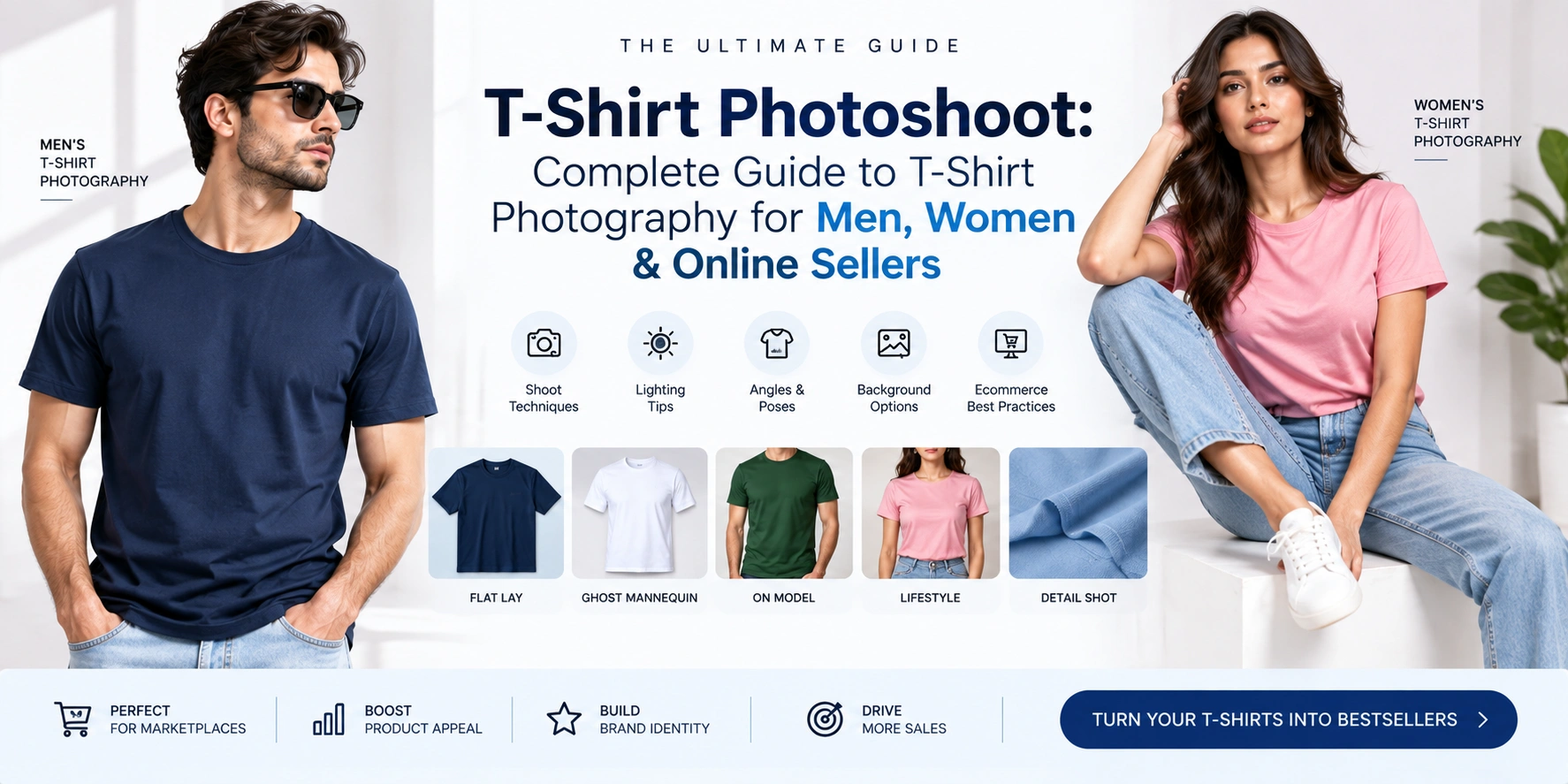
If you are planning the shoot itself (poses, model choice and shot planning), our detailed T-shirt photoshoot guide for men, women and online sellers covers that. This article focuses on what professional photography does for your business and what it costs.
7 Ways Professional T-Shirt Product Photography Helps Online Sellers
1. It Lets Buyers Judge Fit, Fabric and Print Without Touching the Product
The biggest barrier in online apparel is uncertainty. A professional shoot reduces it by showing the details a phone photo usually hides: how the fabric falls, where the print sits, how thick the collar ribbing is, and whether the stitching looks clean. Close-ups and a back view often answer questions that would otherwise become customer messages or returns.
2. It Wins the First Impression at Thumbnail Size
Most shoppers meet your product as a small image in a grid. Clean framing, even lighting, and a clear silhouette make the T-shirt readable at that size. Cluttered or dim images are easy to scroll past, even when the product is good.
3. It Builds Trust
Sharp, consistent images signal that the seller is serious and that the product matches the listing. For a newer brand without many reviews, image quality is one of the few trust signals you fully control. Our post on five signs your clothing photos are losing you sales shows what to look for in your current images.
4. It Keeps Colour Accurate
Colour mismatch is a common reason a buyer feels let down. Controlled lighting, correct white balance, and careful editing help the colour on screen stay close to the real garment. This matters most for whites, navies, blacks and pastels, where small shifts are easy to notice.
5. It Helps You Meet Marketplace Image Requirements
Every marketplace has its own rules for backgrounds, image counts, sizes, and crops, and those rules change. A studio that shoots for these platforms regularly can deliver files in the right formats, which saves rework and avoids avoidable listing rejections. For the numbers by platform, see our guide on how many product images to upload to each marketplace. Always confirm the current rules in the seller portal before you upload.
6. It Keeps Your Whole Catalogue Consistent
If you sell dozens of designs, mismatched backgrounds, angles, and colour tones make the catalogue feel scattered and make comparing products harder. A professional shoot uses one lighting setup, one framing standard and one editing style across every SKU, so the store looks like one brand.
7. It Gives You Assets You Can Reuse
One well-planned shoot can supply marketplace images, website banners, social posts, and ad creatives. That is more efficient than reshooting for each channel, and it keeps your brand look steady across all of them.
Men's vs Women's T-Shirts: What Changes in Photography
The approach is the same (clean lighting, accurate colour, clear detail), but the fit story is different. Men's tees often need shoulder width, sleeve length, and body length to be clear, especially for oversized and boxy cuts. Women's tees often need the silhouette to be clear, such as fitted, cropped, or relaxed. For pose-by-pose guidance, see our full T-shirt photography guide. To see how we shoot each category, explore our men's wear and women's clothing photoshoot pages.
What T-Shirt Photography Services Usually Include
Scope varies by studio, so compare what is actually in the quote, not just the headline rate.
|
Deliverable |
What it shows |
Why it helps the seller |
|---|---|---|
|
Flat-lay or ghost mannequin images |
Shape, neckline, sleeves, print placement |
Clear catalogue-style view of the garment |
|
On-model images |
Fit, drape, proportions |
Helps buyers imagine wearing it |
|
Detail close-ups |
Print quality, fabric texture, stitching |
Answers quality questions upfront |
|
Colour variant images |
Each colourway shot consistently |
Easier comparison, fewer colour doubts |
|
Retouching and colour correction |
Clean, accurate final images |
Looks professional without changing the product |
|
Marketplace-ready sizes and file naming |
Correct dimensions and organised files |
Faster uploads and fewer rejections |
If you want to understand how the pieces fit together, our minimum shot list every garment photo needs is a useful free checklist.
DIY vs Professional T-Shirt Photography
Phone shoots can work for early testing. They tend to struggle when the catalogue grows.
|
Factor |
DIY |
Professional |
|---|---|---|
|
Lighting |
Varies with room and time of day |
Controlled and repeatable |
|
Colour accuracy |
Often inconsistent |
Calibrated and checked |
|
Consistency across SKUs |
Hard to maintain |
Built into the process |
|
Model and styling |
Limited |
Models, styling and garment prep handled |
|
Marketplace-ready delivery |
Manual editing and resizing |
Delivered in the required formats |
|
Time |
Your time, spread over days |
Planned and batched |
A hybrid approach is common: professional images for hero products and best sellers, simpler shots for long-tail designs.
T-Shirt Photography Price: What Affects the Cost
There is no single price, because the scope differs from shoot to shoot. These are the factors that move the quote most:
- Number of SKUs and colour variants: More designs mean more setups and more editing.
- Product-only vs on-model: Model shoots add model fees, styling, and more time per garment.
- Images per SKU: A front, back, and detail set costs less than a set with lifestyle shots as well.
- Retouching level: Basic clean-up differs from detailed colour matching and print correction.
- Deliverables: Extra crops and sizes for several marketplaces add work.
- Timelines: Rush delivery usually costs more than a planned schedule.
Studios usually price per photo, per SKU, or per project. Lohar Studio's pricing starts from ₹69 per photo, and the final quote depends on the factors above. You can see more on our product photography pricing page. If you are comparing a studio with a freelancer, our breakdown of freelance photographer vs studio costs explains where the real differences show up. Smaller brands can also read how to plan a catalogue shoot on a budget.
How to Tell If Better Photography Is Working
Photography is only one factor alongside price, reviews, sizing, delivery, and brand reputation, so measure it carefully:
- Click-through rate on listings or ads after changing the main image.
- Conversion rate on listings with the new image set compared with the old one.
- Return rate and return reasons, especially "colour different" or "fit not as expected".
- Customer questions about fabric, print or fit, which should fall when images answer them.
- Time on page and add-to-cart rate on your own website.
Test on a small group of products first, change only the images, and compare over a similar period. Our post on how an ecommerce shoot impacts your listing's conversion rate goes deeper on this.
How to Choose a T-Shirt Photography Service
- Look at past apparel work, not only general product shots.
- Check consistency: do different products in their portfolio look like they belong together?
- Ask what is included: models, garment steaming, retouching, marketplace sizes, and file naming.
- Confirm the timeline and how revisions are handled.
- Ask about marketplaces: a studio that knows your platform's rules saves you rework.
- Get an itemised quote so you can compare like with like.
If you are in Delhi NCR, our clothing photographer in Delhi page explains how we plan apparel shoots.
Frequently Asked Questions
1. What is T-shirt product photography?
T-shirt product photography is the process of capturing a T-shirt in clear, controlled images so buyers can judge its shape, fit, fabric, and print. It typically includes flat-lay or ghost mannequin shots, on-model images, close-ups of details, and colour-accurate editing for online listings.
2. How does professional T-shirt photography help online sellers?
It helps buyers understand the product without touching it, which builds trust and reduces purchase doubt. Professional images also keep colours accurate, meet marketplace requirements, keep a catalogue consistent, and can be reused across your website, ads, and social media.
3. How much does T-shirt photography cost?
Cost depends on the number of SKUs, whether you need on-model shots, how many images per product, the retouching level, and the timeline. Lohar Studio's pricing starts from ₹69 per photo, with the final quote based on your scope. Ask any studio for an itemised quote.
4. What do T-shirt photography services include?
Typical services include garment preparation, controlled lighting, flat-lay or on-model photography, detail close-ups, colour correction, retouching, and delivery in marketplace-ready sizes. Scope varies, so confirm each item in the quote before booking.
5. Is T-shirt photography priced per photo or per SKU?
Both models exist. Some studios charge per final image, others per SKU with a set number of views, and some quote per project. Per-photo pricing is easy to compare for simple product shots, while per-SKU or project pricing can suit larger catalogues.
6. Can professional photos reduce returns?
They may help. Accurate colour, clear fit, and visible detail can reduce returns caused by mismatched expectations. Returns also depend on sizing charts, fabric quality, and delivery, so track your return reasons before and after a new image set to see the effect.
7. How do I know my T-shirt photos are hurting sales?
Warning signs include low click-through, many questions about fit or fabric, returns citing colour or print, and images that look different from competitors at thumbnail size. Review your images against a checklist, then test a revised main image on a few products.
8. Is professional photography worth it for a small T-shirt brand?
It is often worth it for your best sellers and new launches, where images carry the most weight. Small brands can start with a limited set of hero products, then expand. A planned, batched shoot is usually more cost-effective than many small reshoots.
9. How do I choose a T-shirt photography service?
Review their apparel portfolio for consistency, confirm what is included in the price, ask about models and editing, check that they know your marketplace's image rules, and get an itemised quote. Prefer a clear process and timeline over the lowest headline rate.
10. How long does a T-shirt product shoot take?
It depends on the number of SKUs, colour variants, images per product, and whether models are used. A small batch can be completed in a day, while larger catalogues take longer. Ask the studio for a shoot and delivery timeline, and see our studio timelines explained.
Final Thoughts
For online sellers, T-shirt images do the work of the shop counter: they show the fit, the fabric and the finish. Professional photography makes that work reliable, from the first thumbnail to the detail close-up, across every product you sell. Start with your best sellers, measure the change in clicks, conversion, and returns, and expand from there.
Pricing and marketplace requirements change. Please confirm current details before booking or uploading.
If you're looking to enhance your brand’s presence on leading e-commerce platforms like Amazon, Flipkart, Myntra, Meesho, TataCliQ, Snapdeal, and Ajio, Lohar Studio is your go-to destination. Our team specializes in delivering high-quality images for fashion items, footwear, automotive products, medical photography, business headshots, and corporate shoots. We serve Delhi, Noida, Gurgaon, Faridabad, and Ghaziabad, offering professional results that boost conversions and elevate your brand’s image. Get in touch today at +91-9312070458 or visit us at A1/58, 1st Floor, Sector 6, Rohini, Delhi-110085, to schedule your next shoot!
Written from hands-on experience shooting for 4000+ brands - practical, field-tested photography advice, not just theory.