


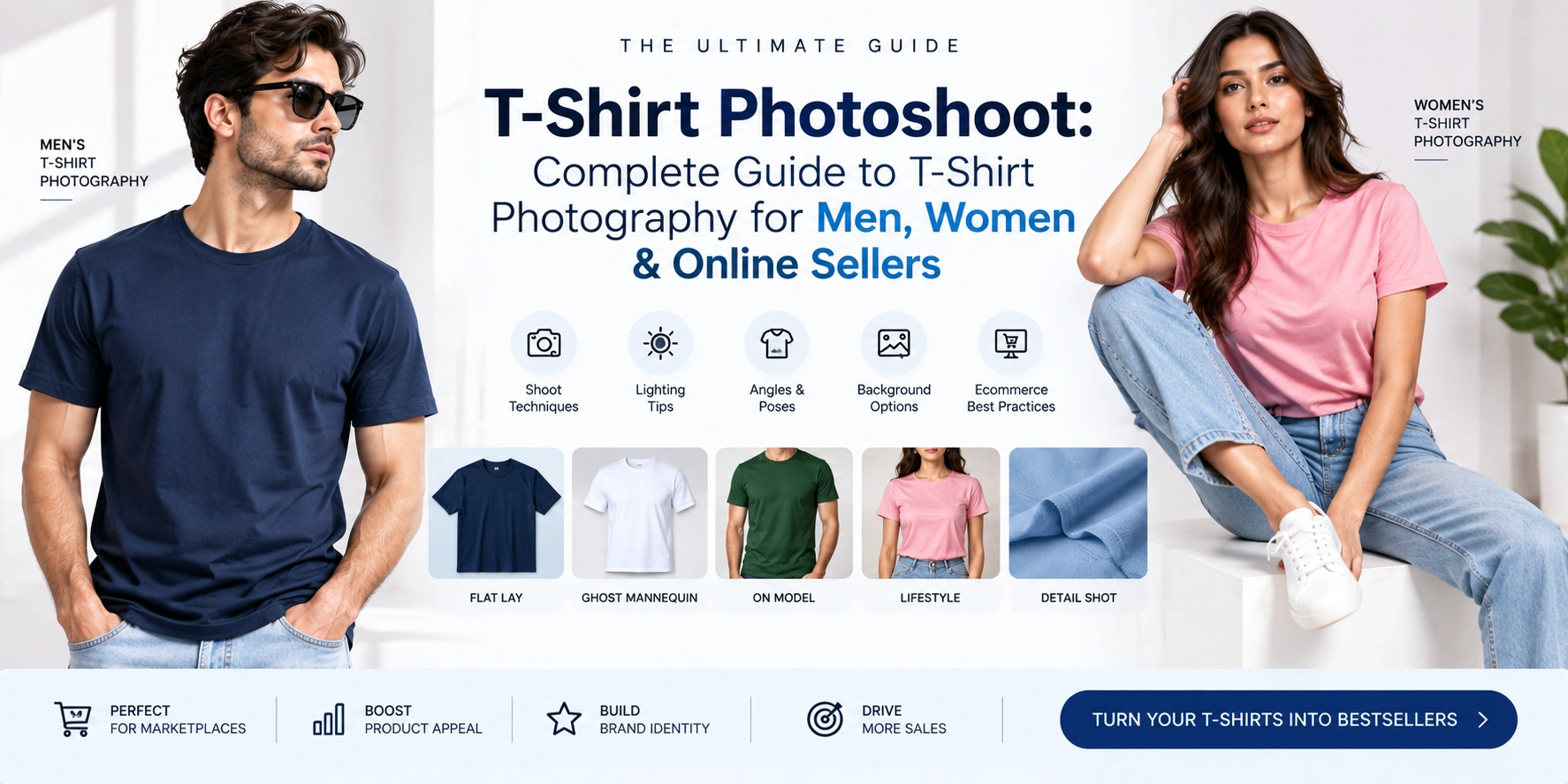
T-shirts are one of the most competitive products in online fashion. Whether you sell oversized T-shirts, graphic tees, plain cotton T-shirts, women's fitted styles, or premium streetwear, your product images influence how customers perceive the design, fit, fabric, and overall value.
A well-planned T-shirt photoshoot does more than create attractive pictures. It helps customers understand what they are buying, supports your ecommerce product listing, and creates a consistent visual identity for your clothing brand.
But what makes a good T-shirt photoshoot? Should you use a male or female model? Is flat-lay photography enough? Which poses work best? How many images should you create for each SKU? And how can you prepare photos for Amazon, Flipkart, Myntra, Meesho, or your own website?
This guide answers these questions and explains how to plan professional T-shirt photography for online selling.
What Is a T-Shirt Photoshoot?
A T-shirt photoshoot is a planned photography session that captures a T-shirt through product images, model images, or lifestyle photographs. The purpose may be to showcase the garment's design, communicate its fit, create an online catalogue, or produce marketing content for a fashion brand.
The photography approach depends on the product and its intended use.
For example:
- A plain white T-shirt may need clean product photography and detailed fabric shots.
- An oversized streetwear T-shirt may benefit from relaxed model poses and lifestyle images.
- A women's fitted T-shirt may require front, side, and back views to communicate the silhouette.
- A premium graphic T-shirt may need close-ups that show print quality and fabric texture.
The strongest image set combines visual appeal with useful product information.
Why T-Shirt Photography Matters for Online Sellers
Customers shopping online cannot physically touch the fabric, try on the garment, or inspect its stitching. They depend on images and product information to estimate whether the T-shirt is suitable for them.
Effective T-shirt photography helps answer several purchase questions:
- What does the T-shirt look like from the front and back?
- Is the fit regular, relaxed, oversized, or slim?
- How does the fabric fall on the body?
- What does the print or embroidery look like up close?
- Is the colour represented accurately?
- How does the garment look when styled?
These details make the listing more informative and help reduce uncertainty.
Product Presentation and Conversion
Photography is not the only factor affecting sales. Price, reviews, sizing, fabric quality, shipping, and brand reputation also matter. However, images are among the first things a customer evaluates when browsing a fashion listing.
A useful image sequence should therefore communicate the product quickly at thumbnail size and remain informative when the buyer opens the full listing.
Consistent Brand Identity
If you sell multiple T-shirt designs, inconsistent images can make your catalogue look unprofessional. Different backgrounds, camera angles, colour tones, and model styling may distract customers from comparing products.
A consistent photography system creates a recognisable brand appearance across your website, marketplace listings, social media, and advertising.
Types of T-Shirt Photoshoots
There is no single correct photography style for every T-shirt brand. The following formats serve different purposes.
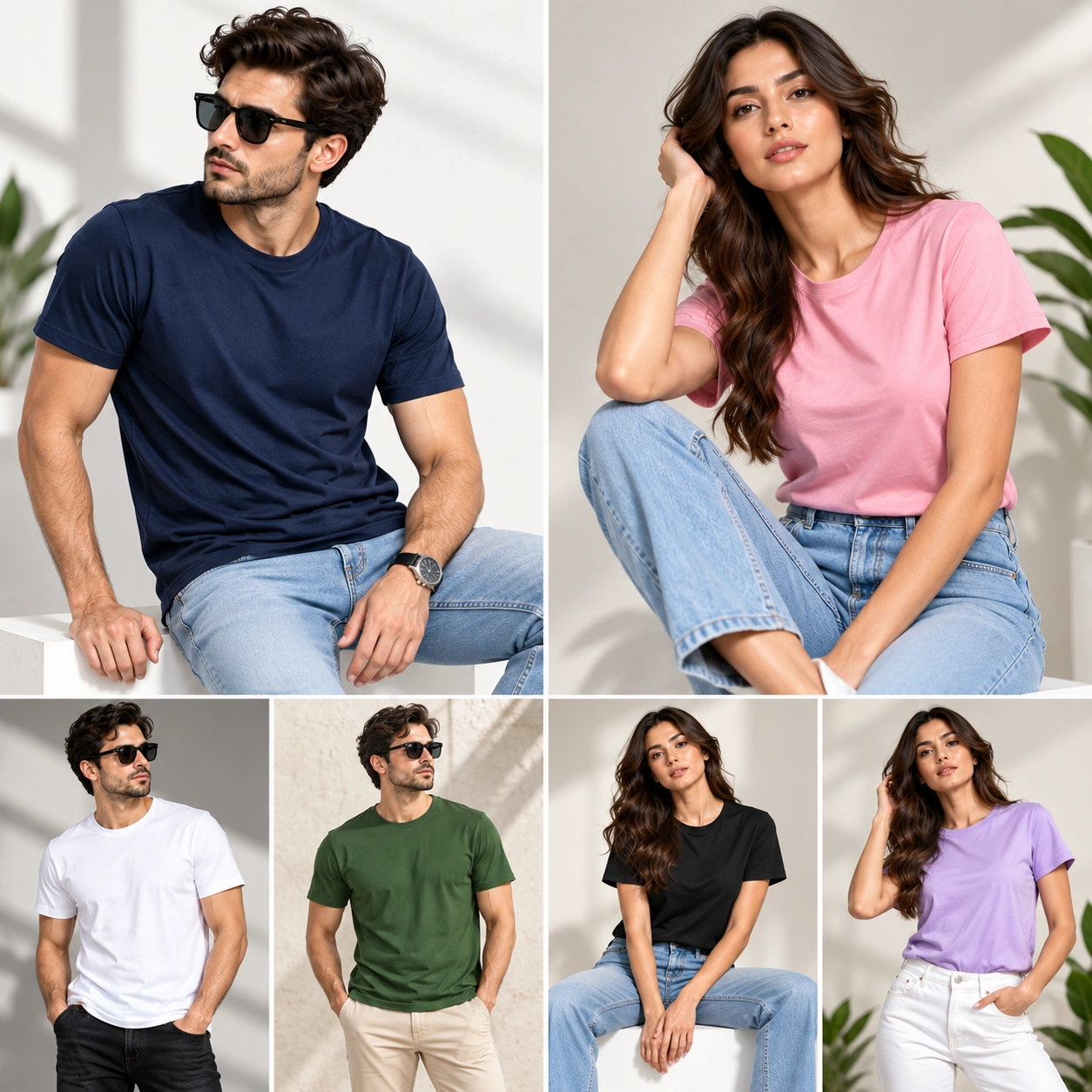
1. T-Shirt Product Photography
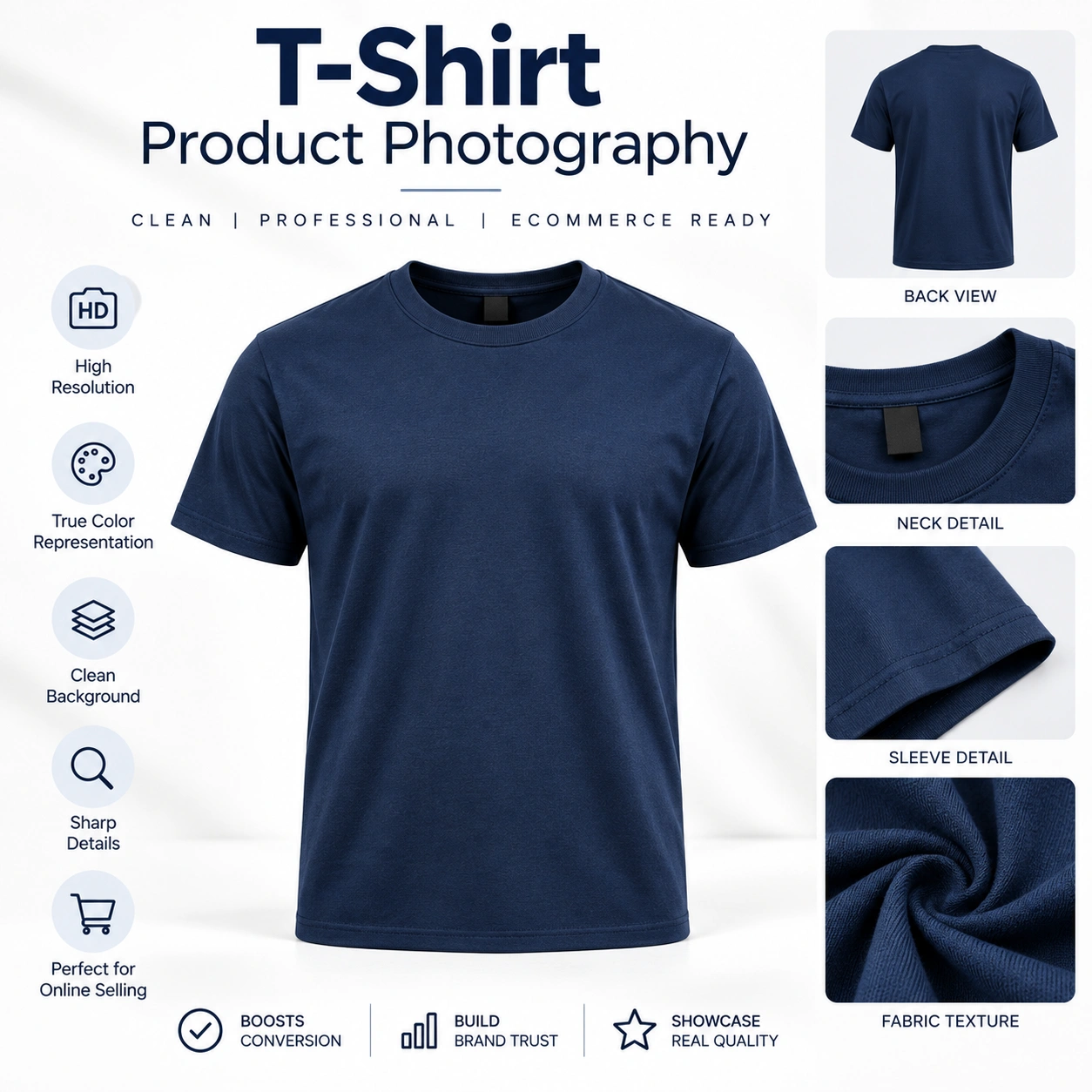
Product photography focuses on the garment itself. It commonly includes clean-background images, flat-lay photographs, ghost mannequin images, and close-ups.
This approach is useful for showing:
- T-shirt shape and construction
- Neckline and sleeves
- Fabric texture
- Print placement
- Stitching and finishing
- Front and back design
Product images are particularly valuable when the seller needs clear, catalogue-style visuals.
2. T-Shirt Model Photoshoot
A model photoshoot shows the T-shirt being worn by a person. It helps communicate fit, drape, styling, and proportions.
A model image can answer questions that a flat-lay image cannot fully resolve, such as how an oversized T-shirt falls around the shoulders or how a fitted women's T-shirt follows the body.
3. T-Shirt Catalogue Photoshoot
A catalogue shoot is planned around a collection of products rather than one individual garment. The goal is to create a uniform image set for multiple SKUs.
.webp)
Male Model Photography in Delhi
Lohar Studio provides professional male model photography in Delhi for garment and apparel businesses that need catalog-ready imag...
Explore Male Model Photography in DelhiA catalogue may include:
- One or more models
- Standardised poses
- Consistent lighting
- Multiple colour variants
- Front and back views
- Product detail images
- Selected lifestyle photographs
This is useful for brands launching seasonal collections or expanding their online inventory.
4. Lifestyle and Fashion Photography
Lifestyle photography places the T-shirt in a styled environment, such as a streetwear setting, casual indoor location, studio set, or outdoor urban scene.
These images are often useful for brand storytelling, social media, website banners, and secondary ecommerce images where permitted.
T-Shirt Photoshoot for Men
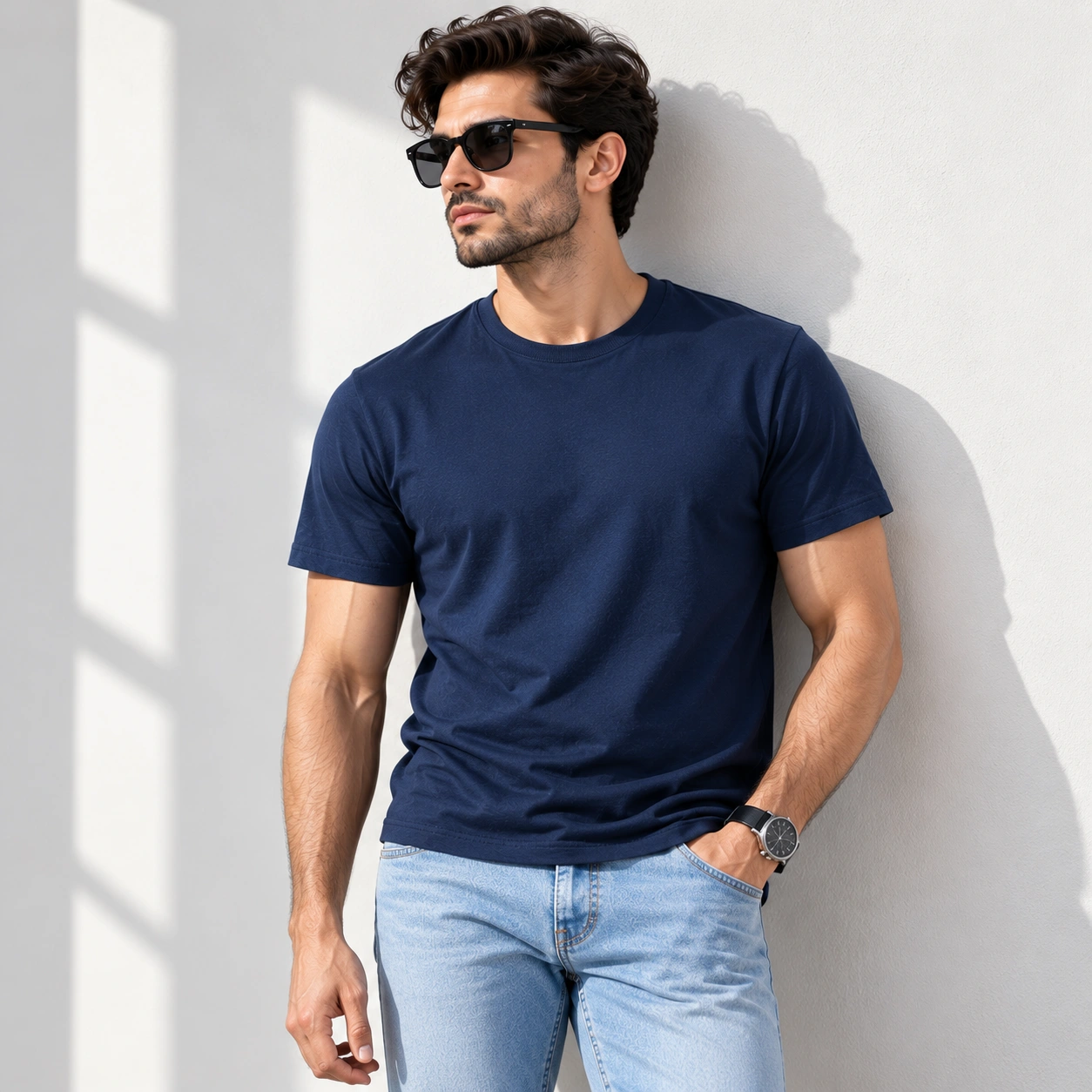
Men's T-shirt photography should communicate the garment's fit, silhouette, and styling without allowing the model's pose or accessories to overpower the product.
Choosing the Right Male Model
The model should suit the brand's target customer and the intended fit of the garment. A streetwear brand may choose a relaxed styling approach, while a premium basics brand may prefer a clean and understated appearance.
Consider:
- Body proportions relevant to the target audience
- Hair and grooming
- Model size and garment size
- Brand personality
- Skin tone and colour contrast
- Comfort and natural movement
The purpose is not to make every product look identical on every person. It is to present the intended fit consistently and honestly.
Useful Men's T-Shirt Shots
A practical men's T-shirt image set can include:
- Straight front view
- Back view
- Three-quarter angle
- Side profile
- Relaxed standing pose
- Detail close-up of the neckline or print
- Lifestyle image, if required
For oversized T-shirts, include a pose that shows shoulder width and overall length. For slim-fit T-shirts, use a natural posture that makes the fit visible without excessive body twisting.
T-Shirt Photoshoot for Women
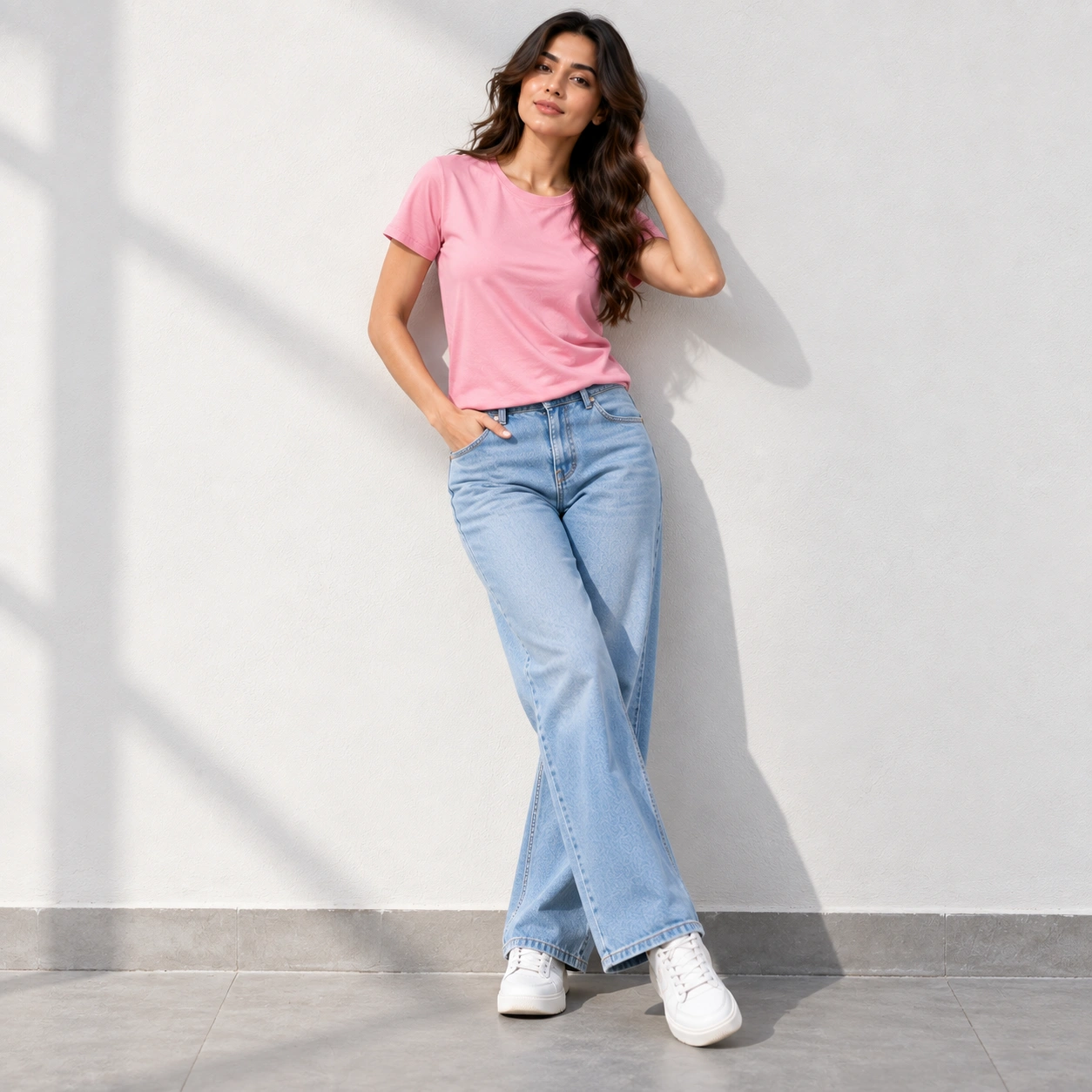
Women's T-shirt photography should highlight the intended silhouette, styling, and construction of the garment. The shoot must represent the product accurately rather than relying only on an attractive pose.
Model and Styling Selection
The model's proportions, styling, and garment size should be selected according to the brand's target customer. A women's casualwear collection may use minimal styling, while a fashion-led collection may incorporate coordinated accessories or layered outfits.
For fitted, cropped, oversized, and relaxed T-shirts, the photography should make the intended shape easy to understand.
Important Women's T-Shirt Shots
A useful women's T-shirt photoshoot may include:
- Full front view
- Back view
- Three-quarter pose
- Side view
- Natural standing pose
- Sleeve and neckline close-up
- Styled outfit photograph
For cropped T-shirts, ensure the crop length is clearly visible. For oversized designs, include a view that communicates the intended loose silhouette.
T-Shirt Photoshoot Poses and Ideas
The best T-shirt photoshoot poses are those that show the garment naturally while maintaining a clear product focus.
1. Straight Standing Pose
The model faces the camera with a relaxed posture. This is a dependable pose for the primary front image because it makes the T-shirt's shape, print, and neckline easy to see.
2. Three-Quarter Pose
The model turns slightly to one side. This adds visual variety and helps communicate the garment's drape and side silhouette.
3. Back View Pose
.webp)
Best Fashion Photographer in Delhi
Your fashion images are doing a job — selling a product, building a portfolio, running a campaign. If they are not doing tha...
Explore Best Fashion Photographer in DelhiThe model turns away from the camera. It is particularly useful for T-shirts with back prints, labels, seam details, or distinctive construction.
4. Relaxed Hands-in-Pockets Pose
This pose works well for casualwear and streetwear. The model should avoid pulling or bunching the T-shirt in a way that changes its apparent fit.
5. Walking Pose
A natural walking pose can show how the fabric moves. It is better suited to lifestyle or secondary images than to a primary product view when movement obscures the garment.
6. Seated Pose
A seated pose creates a more editorial look and can be useful for social media or brand campaigns. However, it may distort the T-shirt's length and fit, so it should complement rather than replace clear standing views.
7. Layered Styling Pose
A T-shirt worn with an open shirt, jacket, or coordinated bottoms can demonstrate styling possibilities. Keep the layering simple enough that the featured T-shirt remains identifiable.
8. Close-Up Detail Pose
A close-up can focus on the graphic print, fabric weave, embroidery, collar ribbing, or stitching. Use this to communicate details that are difficult to evaluate in a full-length image.
T-Shirt Product Photography for Ecommerce
Ecommerce photography needs to balance visual quality, technical consistency, and marketplace requirements.
Primary and Secondary Images
Many fashion listings benefit from separating the image set into two functions.
Primary image: The clearest presentation of the product, designed to identify the garment immediately.
Secondary images: Additional views that explain the product, including back views, close-ups, alternate angles, and styling photographs.
The exact rules for primary images, backgrounds, aspect ratios, and image counts vary by marketplace and category. Sellers should verify the current requirements in the relevant seller portal before finalising the shoot.
For example, Amazon's fashion photography guidance emphasises clean primary images, product visibility, and suitable supporting views. Myntra-focused photography guidance also highlights the importance of front, back, detail, and styled images for apparel presentation. These are useful planning principles, but they should not be treated as universal rules for every platform. [1][2]
Image Resolution and Aspect Ratio
Shoot at a sufficiently high resolution to allow cropping and final delivery without losing important details. The final dimensions should be selected according to the destination platform.
For a multi-channel seller, it is often practical to capture a master image with enough surrounding space for different crops. A square crop may be useful for one marketplace, while a portrait crop may suit another.
Do not crop the image so tightly that the sleeves, hemline, or important print details are cut off.
Colour Accuracy
Colour accuracy is essential for apparel. A customer who orders a navy T-shirt but receives a garment that appears substantially different may be dissatisfied.
To improve consistency:
- Use controlled lighting.
- Set a reliable white balance.
- Avoid strong coloured light sources.
- Check the product against a physical reference when possible.
- Review the final images on more than one screen.
Editing should enhance clarity without changing the actual product colour.
How to Plan a T-Shirt Catalogue Photoshoot
A catalogue shoot becomes more efficient when the planning is completed before the camera session.
Step 1: Prepare the SKU List
Create a spreadsheet containing the product name, SKU, colour, size, design, and required image types.
For example:
| SKU | Product | Colour | Required views |
|---|---|---|---|
| TS001 | Oversized T-shirt | Black | Front, back, side, detail |
| TS002 | Regular-fit T-shirt | White | Front, back, detail |
| TS003 | Graphic T-shirt | Green | Front, back, print close-up |
This prevents products from being missed during the shoot.
Step 2: Decide the Photography Style
.webp)
Model Photography in Delhi
Two very different people search for "model photography in Delhi." One is a model — someone building a portfolio to sub...
Explore Model Photography in DelhiChoose whether the collection needs product-only images, model photography, lifestyle images, or a combination.
A basic product catalogue may prioritise consistency and speed. A fashion brand launch may require more creative styling and campaign images.
Step 3: Select the Model and Garment Sizes
The model should wear the correct size for the intended presentation. Avoid using a garment size that creates an inaccurate impression of fit.
Prepare backup sizes when the collection includes multiple silhouettes.
Step 4: Prepare the Garments
Before shooting, inspect each T-shirt for:
- Wrinkles
- Loose threads
- Dust or lint
- Print defects
- Incorrect labels
- Folding marks
- Stains
Steam or iron the garments as appropriate for the fabric. A small preparation issue can become highly visible in a high-resolution photograph.
Step 5: Create a Shot List
A shot list establishes the required angles and prevents unnecessary duplication.
A practical starting point for each SKU might be:
- Front view
- Back view
- Three-quarter view
- Detail close-up
- Optional lifestyle image
The exact number depends on the marketplace, product complexity, and the seller's content strategy.
Step 6: Review Images During the Shoot
Check focus, garment alignment, exposure, print visibility, and model posture before moving to the next SKU.
This is much more efficient than discovering missing views or blurred details during post-production.
Lighting, Styling, and Background Selection
Lighting
Soft, controlled lighting is generally suitable for T-shirt photography because it reveals fabric texture while reducing harsh shadows.
For clean product images, even illumination helps maintain consistent colour and background appearance. For editorial fashion images, directional lighting may be used to create a particular mood, but it should not hide important garment details.
Background
The background should match the purpose of the image.
- Clean white or neutral backgrounds support catalogue presentation.
- Simple studio backgrounds can work for brand campaigns.
- Lifestyle settings can add context to secondary images.
Avoid backgrounds that compete with the T-shirt's colour, print, or silhouette.
Styling
Styling should support the product. Accessories, shoes, trousers, jackets, and props should be selected according to the brand's identity.
For a product-focused listing, excessive styling can distract from the garment. For a campaign, more creative styling may be appropriate.
Common T-Shirt Photography Mistakes
1. Showing Only One Front Image
A single front image may not communicate the back design, fit, fabric, or finishing details. Add relevant supporting views.
2. Using Incorrect Garment Sizes
A T-shirt worn in an unsuitable size can create a misleading impression of the product's fit.
3. Overediting the Product
Excessive retouching, colour changes, or smoothing can make the image look attractive but misrepresent the actual garment.
Lookbook Fashion Catalogue Photoshoot Services
Lookbook Fashion Photography plays a crucial role in shaping how your fashion brand is perceived. Whether you are launching a new...
Explore Lookbook Fashion Catalogue Photoshoot Services4. Inconsistent Image Composition
If every SKU has a different crop, camera height, or model position, the catalogue becomes difficult to compare.
5. Ignoring the Print and Fabric Details
Graphic T-shirts and premium cotton garments often need close-up images. Without them, buyers may struggle to assess print sharpness, weave, and finishing.
6. Using Creative Images as the Only Listing Images
Lifestyle photography is useful, but it should not replace clear product views when customers need to inspect the garment.
7. Failing to Check Marketplace Specifications
Image rules can change by platform and category. A seller should confirm current requirements instead of assuming that one format works everywhere.
T-Shirt Photoshoot in Delhi
Delhi is a major apparel and manufacturing market, making it a practical location for brands, wholesalers, private-label sellers, and ecommerce businesses planning T-shirt photography.
A professional studio can help sellers organise model coordination, garment preparation, controlled lighting, product photography, image editing, and catalogue consistency.
When evaluating a t shirt photoshoot studio in Delhi, consider the following:
- Experience with apparel and ecommerce photography
- Availability of male and female models
- Ability to photograph multiple SKUs consistently
- Studio lighting and garment preparation
- Product-focused and lifestyle photography options
- Image editing and colour correction
- Delivery format and file organisation
- Understanding of the marketplace requirements relevant to your listings
Lohar Studio in Rohini, Delhi, provides a suitable starting point for sellers seeking professional fashion & model photography for their T-shirt collections. Discuss the product category, required image styles, number of SKUs, and intended sales platforms before finalising the shoot plan.
Frequently Asked Questions
1. What is the best photography style for T-shirts?
The best style depends on the objective. Clean product photography is useful for catalogue clarity, while model photography helps communicate fit and styling. Many online sellers benefit from using both.
2. How many photos should I take for each T-shirt?
There is no universal number. A practical starting point is front, back, three-quarter, and one or more detail images. Add lifestyle photographs when they support the brand or listing.
3. Is a model necessary for T-shirt ecommerce photography?
Not always. Product-only images can show the garment's construction and design. A model is useful when fit, drape, and styling are important to the buying decision.
4. Should men's and women's T-shirts be photographed differently?
Yes, the styling, model selection, garment fit, and pose selection should reflect the intended product. However, both should maintain consistent lighting and clear product presentation.
5. Can I use the same T-shirt photos on Amazon, Flipkart, and Myntra?
The same original photographs may be adapted for multiple platforms, but the final image dimensions, aspect ratio, background, and other requirements may differ. Verify each marketplace's current guidelines before uploading.
6. What should I prepare before a T-shirt photoshoot?
Prepare the SKU list, clean and steam garments, confirm sizes, select models, decide the image style, and create a shot list. This reduces delays and improves consistency.
7. How can I make my T-shirt photos look professional?
Use controlled lighting, accurate colours, suitable garment preparation, natural poses, clean backgrounds, and consistent framing. Professional editing should improve clarity without changing the product's appearance.
8. What is the difference between a T-shirt catalogue shoot and a fashion shoot?
A catalogue shoot prioritises consistent product presentation across multiple SKUs. A fashion shoot focuses more on styling, creative direction, and brand storytelling. A brand may use both for different marketing purposes.
Conclusion
A successful T-shirt photoshoot combines product clarity, accurate fit presentation, attractive styling, and a well-organised image workflow. Whether you are selling men's T-shirts, women's T-shirts, oversized streetwear, or premium basics, the right photography approach can help customers understand your products more confidently.
Start with a clear SKU list, select the appropriate photography format, plan useful poses and angles, and prepare images for the platforms where you sell. With a consistent visual system, your T-shirt catalogue can look more professional across ecommerce listings, websites, and marketing campaigns.
For sellers planning professional T-shirt photography in Delhi, Lohar Studio can help you evaluate the required shoot style and image deliverables for your collection.
If you're looking to enhance your brand’s presence on leading e-commerce platforms like Amazon, Flipkart, Myntra, Meesho, TataCliQ, Snapdeal, and Ajio, Lohar Studio is your go-to destination. Our team specializes in delivering high-quality images for fashion items, footwear, automotive products, medical photography, business headshots, and corporate shoots. We serve Delhi, Noida, Gurgaon, Faridabad, and Ghaziabad, offering professional results that boost conversions and elevate your brand’s image. Get in touch today at +91 9312070458 or visit us at A1/58, 1st Floor, Sector 6 Rd, Pocket 1, Sector 6A, Rohini, Delhi, 110085, to schedule your next shoot!

Written from hands-on experience shooting for 4000+ brands - practical, field-tested photography advice, not just theory.