


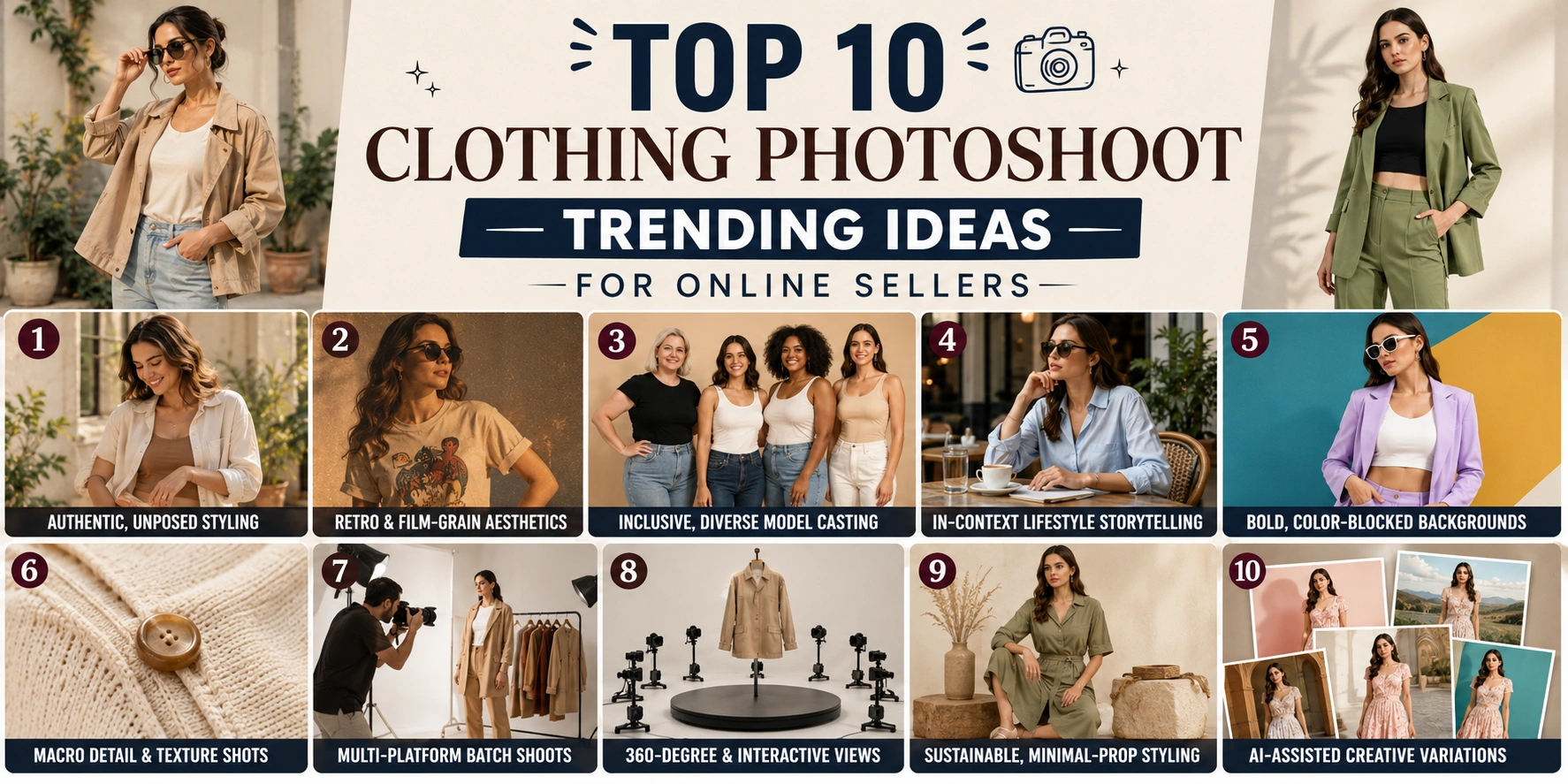
The clothing photography trends shaping 2026 move away from stiff, overly-posed studio shots toward authentic styling, bold color, inclusive casting, and content built to work across multiple platforms from a single shoot. The sellers gaining the most traction are combining foundational formats (ghost mannequin, white background) with newer additions like macro detail shots, 360-degree views, and AI-assisted creative variations — not replacing the basics, but layering trend-driven content on top of them.
If you're planning your next catalog or campaign shoot, here are the 10 ideas actually driving engagement and conversions for online sellers this year.
Quick Overview: 2026's Top Clothing Photoshoot Trends
| # | Trend | Best For |
|---|---|---|
| 1 | Authentic, unposed styling | Social content, D2C brand pages |
| 2 | Retro and film-grain aesthetics | Brand campaigns, seasonal drops |
| 3 | Inclusive, diverse model casting | All platforms, especially D2C and Myntra |
| 4 | In-context lifestyle storytelling | Website banners, campaign content |
| 5 | Bold, color-blocked backgrounds | Social media, category pages |
| 6 | Macro detail and texture shots | Premium, embellished, or fabric-focused products |
| 7 | Multi-platform batch shoots | Sellers listing across marketplaces and social |
| 8 | 360-degree and interactive views | High-value or structured garments |
| 9 | Sustainable, minimal-prop styling | Brands with an eco-conscious positioning |
| 10 | AI-assisted creative variations | Scaling campaign content from one core shoot |
1. Authentic, Unposed "Real-Life" Styling
The stiff, overly-perfected studio pose is losing ground to a more candid, natural styling approach — models adjusting a jacket mid-shot, glancing away from the camera, or caught in a relaxed, in-between moment rather than a locked, formal stance. This shift is a direct response to shopper fatigue with content that feels performed rather than real.
Why it works: Buyers increasingly associate over-polished imagery with generic stock photography, while candid-style shots read as more trustworthy and closer to how the product will actually look in daily use.
How to execute it: Direct models to move naturally between poses rather than holding a single frozen position, and capture the in-between moments — adjusting a strap, mid-laugh, mid-step — alongside your standard clean shots.
Best for: Social media content, D2C website imagery, and campaign visuals rather than strict marketplace primary listings, which still require more standardized framing.
2. Retro and Film-Grain Aesthetics
Nostalgic visual textures — grainy film looks, softer contrast, warm 90s-style flash lighting — are appearing more frequently in fashion campaign content, offering a deliberate contrast to the ultra-clean, digital-perfect look most ecommerce photography defaults to.
Why it works: Retro styling creates a distinct visual identity that stands out in a crowded, similar-looking marketplace feed, and it often signals a brand's cultural relevance rather than just its catalog completeness.
How to execute it: Reserve this look for campaign and social content rather than primary marketplace listings — most platforms still require clean, accurate color representation for compliance, so retro treatments work best as a secondary content layer.
Best for: Seasonal campaigns, Instagram and Pinterest content, brand storytelling pages.
3. Inclusive, Diverse Model Casting
Casting is diversifying meaningfully across body type, age, and presentation — not as a one-off campaign gesture, but as a standard part of how brands plan their model shoots. This reflects both genuine market demand and a practical business reality: buyers are far more likely to trust fit and sizing information when they see it represented on a range of body types close to their own.
Clothing Photography in Delhi
Lohar Studio provides professional clothing photography in Delhi for fashion brands, garment sellers, e-commerce businesses, expor...
Explore Clothing Photography in DelhiWhy it works: Representation directly affects buyer confidence in sizing decisions, which is one of the biggest drivers of both conversion and return rates in apparel ecommerce.
How to execute it: Plan casting diversity into your shot list from the start — this means booking more than one model type for key SKUs, particularly for sizing-sensitive categories.
Best for: Every platform, but especially impactful for D2C brands and marketplaces like Myntra where model imagery is mandatory.
4. In-Context Lifestyle Storytelling Shots
Rather than showing a garment in isolation, in-context shots place the product within a lived-in scene — a café, a street, a specific mood or setting — that helps a buyer imagine the item as part of their own life, not just as a standalone product.
Why it works: Product shots inform; lifestyle shots inspire. A buyer who sees a garment styled convincingly within a relatable scene is buying more than the item itself — they're buying into the identity or mood the image represents.
How to execute it: Plan a small set of lifestyle shots alongside your standard catalog shoot, using locations or settings that match your specific brand positioning rather than a generic backdrop.
Best for: Website homepages, campaign pages, and social content — not primary marketplace listing images, which need cleaner backgrounds.
5. Bold, Color-Blocked Backgrounds
Moving beyond plain white or neutral backgrounds, more brands are using bold, saturated color blocks for secondary and social content — a background color chosen to complement or contrast the garment for visual impact.
Why it works: In a scrolling feed or category grid full of similar white-background thumbnails, a bold color background stops the scroll and creates stronger brand recall.
How to execute it: Reserve bold backgrounds for secondary images and social content, keeping your primary marketplace listing image compliant with platform-required white or neutral backgrounds.
Best for: Social media, secondary product images, seasonal campaign content.
6. Macro Detail and Texture Shots
Close-up shots highlighting fabric texture, stitching, embroidery, hardware, and trim details are becoming a standard part of a complete image set, not just an optional extra — especially for premium or detail-rich garments.
Why it works: Buyers can't touch the fabric before purchasing, so a well-executed macro shot does the job a physical store visit normally would — building confidence in quality and justifying a higher price point.
Lookbook Fashion Catalogue Photoshoot Services
Lookbook Fashion Photography plays a crucial role in shaping how your fashion brand is perceived. Whether you are launching a new...
Explore Lookbook Fashion Catalogue Photoshoot ServicesHow to execute it: Plan at least one close-up detail shot per SKU highlighting the specific feature that matters most for that product — embroidery for ethnic wear, stitching for structured pieces, texture for knitwear.
Best for: Premium and embellished categories especially, but valuable across nearly every apparel type.
7. Multi-Platform Batch Shoots
Rather than shooting separately for Instagram, marketplace listings, and website banners, more sellers are planning a single shoot session designed to capture multiple aspect ratios and formats at once — square for marketplaces, vertical for social, and wide for banners — all from the same setup.
Why it works: This approach dramatically reduces cost and turnaround time compared to running separate shoots per platform, while keeping visual consistency across every channel.
How to execute it: Share your full platform list with your studio before the shoot, so poses, framing, and crop points are planned to work across every format you need from day one.
Best for: Any seller listing across multiple marketplaces and social platforms simultaneously — which describes most growing ecommerce brands today.
8. 360-Degree and Interactive Product Views
Interactive, rotatable 360-degree product views are becoming more common, particularly for higher-value or structured garments where a buyer benefits from seeing the product from every angle rather than a fixed set of static shots.
Why it works: This format directly reduces the uncertainty that leads to size and fit-related returns, since buyers can inspect construction and silhouette far more thoroughly than static images allow.
How to execute it: Prioritize 360-degree shoots for your highest-value or most detail-rich SKUs first, rather than applying this format uniformly across your entire catalog, since it takes more time per product than standard photography.
Best for: Premium garments, structured outerwear, and any product where construction detail is a key part of the buying decision.
9. Sustainable, Minimal-Prop Styling
As sustainability becomes a bigger factor in how brands position themselves, photography styling is following suit — simpler sets, natural materials as props, and a cleaner, less cluttered visual approach that avoids excessive styling elements.
Why it works: For brands building an eco-conscious identity, styling choices reinforce brand values consistently across every touchpoint, including product photography — inconsistency here can undercut an otherwise strong sustainability message.
Fashion / Model Photography for Flipkart
Lohar Studio provides professional Flipkart fashion & model photography for sellers and brands listing on Flipkart India. If y...
Explore Fashion / Model Photography for FlipkartHow to execute it: Choose natural, simple props (wood, linen, stone) over synthetic or heavily processed styling elements, and favor clean, uncluttered compositions over busy, prop-heavy sets.
Best for: Brands with an explicit sustainability or natural-materials positioning.
10. AI-Assisted Creative Variations
AI tools are increasingly used to extend the value of a single photoshoot — generating background variations, seasonal campaign adaptations, or additional creative angles from a core set of real, live-shot images, rather than replacing the original photography entirely.
Why it works: This approach keeps the core product truth — fit, fabric, construction — accurate, since it's based on real photography, while still allowing brands to scale content variety without booking an entirely new shoot for every campaign need.
How to execute it: Treat AI-assisted variation as an extension of your core shoot, not a replacement for it — plan for a solid base of real, accurate product photography first, then use AI tools selectively for background swaps or campaign adaptations built from that foundation.
Best for: Brands needing to scale campaign content quickly without a full reshoot for every seasonal update.
How to Bring These Trends Into Your Next Shoot
- Don't chase every trend at once — pick two or three that fit your brand positioning and product category most naturally
- Keep your marketplace-compliant primary images (white background, required model or flat lay format) as your foundation, and layer trend-driven content on top as secondary and campaign assets
- Plan for multi-platform use from the start of your shoot, since this is one of the most cost-effective trends to adopt regardless of your specific aesthetic direction
FAQs
1. What are the biggest clothing photography trends for 2026?
Authentic, unposed styling, inclusive casting, in-context lifestyle shots, bold color backgrounds, and multi-platform batch shooting are among the most impactful trends for online sellers this year.
2. Should I replace my white background product shots with trendy styled images?
No — most marketplaces still require compliant white or neutral background primary images. Trend-driven content works best as secondary and campaign imagery layered on top of your compliant base shots.
3. Is retro or film-style photography suitable for marketplace listings?
Generally not for primary listing images, since marketplaces require accurate color representation. Retro styling works best for campaign content and social media.
.webp)
Best Fashion Photographer in Delhi
Your fashion images are doing a job — selling a product, building a portfolio, running a campaign. If they are not doing tha...
Explore Best Fashion Photographer in Delhi4. Does diverse model casting actually improve conversion?
Yes — representation across body types helps buyers judge fit and sizing more confidently, which directly affects both conversion and return rates.
5. What's the easiest trend for a small brand to start with?
Multi-platform batch shooting is one of the most cost-effective trends to adopt, since it simply means planning your existing shoot to capture multiple formats in one session.
6. Are 360-degree product views worth the extra cost?
For high-value or structured garments, yes — they reduce return-driving uncertainty around fit and construction, though they're best prioritized for key SKUs rather than an entire catalog.
7. How does AI fit into clothing photoshoot trends without replacing real photography?
AI is best used to extend a real, live-shot photoshoot — generating background variations or campaign adaptations from accurate original images, rather than replacing core product photography.
8. What's the benefit of macro detail shots for clothing?
They build buyer confidence in quality and craftsmanship by showing fabric, stitching, and embellishment detail that static full-body shots often miss.
9. Can I combine multiple trends in a single photoshoot?
Yes — most sellers combine two or three trends (for example, multi-platform batch shooting plus macro detail shots) rather than adopting every trend at once.
10. Do these trends apply to every clothing category equally?
Not uniformly — casting diversity and lifestyle storytelling apply broadly, while trends like 360-degree views and macro detail shots deliver the most value for premium, structured, or detail-rich categories specifically.
Ready to bring these trends into your next shoot?
[Plan your 2026 shoot with Lohar Studio] — tell us your product category and target platforms, and we'll help you build a shot list that blends compliant marketplace essentials with the trends that fit your brand.
If you're looking to enhance your brand’s presence on leading e-commerce platforms like Amazon, Flipkart, Myntra, Meesho, TataCliQ, Snapdeal, and Ajio, Lohar Studio is your go-to destination. Our team specializes in delivering high-quality images for fashion items, footwear, automotive products, medical photography, business headshots, and corporate shoots. We serve Delhi, Noida, Gurgaon, Faridabad, and Ghaziabad, offering professional results that boost conversions and elevate your brand’s image. Get in touch today at +91 9312070458 or visit us at A1/58, 1st Floor, Sector 6 Rd, Pocket 1, Sector 6A, Rohini, Delhi, 110085, to schedule your next shoot!

Written from hands-on experience shooting for 4000+ brands - practical, field-tested photography advice, not just theory.