


Most garment sellers get the shot list wrong in one of two directions. Either they undershoot — one front-facing image per SKU, and every genuine question a buyer has (fit, back detail, fabric close-up) goes unanswered. Or they overshoot — sixteen near-identical angles per piece because nobody defined what was actually needed, which burns studio time and editing hours on redundant images that add almost nothing to conversion.
Neither mistake is really about creativity. It's a planning problem. A shot list decided before the clothing photoshoot — not improvised piece by piece during it — is what separates a catalogue that answers a buyer's real questions from one that either under-informs or wastes budget on repetition.
This is the minimum shot list Lohar Studio actually works from: a base list every garment needs, category-specific additions depending on whether the garment is structured or draped, and platform-specific requirements for Amazon, Myntra, Flipkart, and Meesho. Copy whichever section applies to your catalogue.
Why a Shot List Matters More for Clothing Than Almost Any Other Category
For most product categories, a buyer's questions are fairly narrow: does it work, is it the right size, does it look like the photo. For clothing, the list of genuine unknowns is longer — fit, drape, fabric texture, true colour, back and side detail, how it moves, whether it runs true-to-size — and a flat single-angle image can only answer one of those at a time.
The goal of a shot list isn't "more images." It's coverage of the specific unknowns that actually drive purchase hesitation and returns for that garment. A structured blazer and a flowy chiffon dupatta have almost nothing in common in terms of what a buyer needs to see, which is exactly why a single generic "5 photos per product" rule fails — it either under-serves the dupatta or wastes a shot on the blazer.
The Universal Minimum: Every Garment, No Exceptions
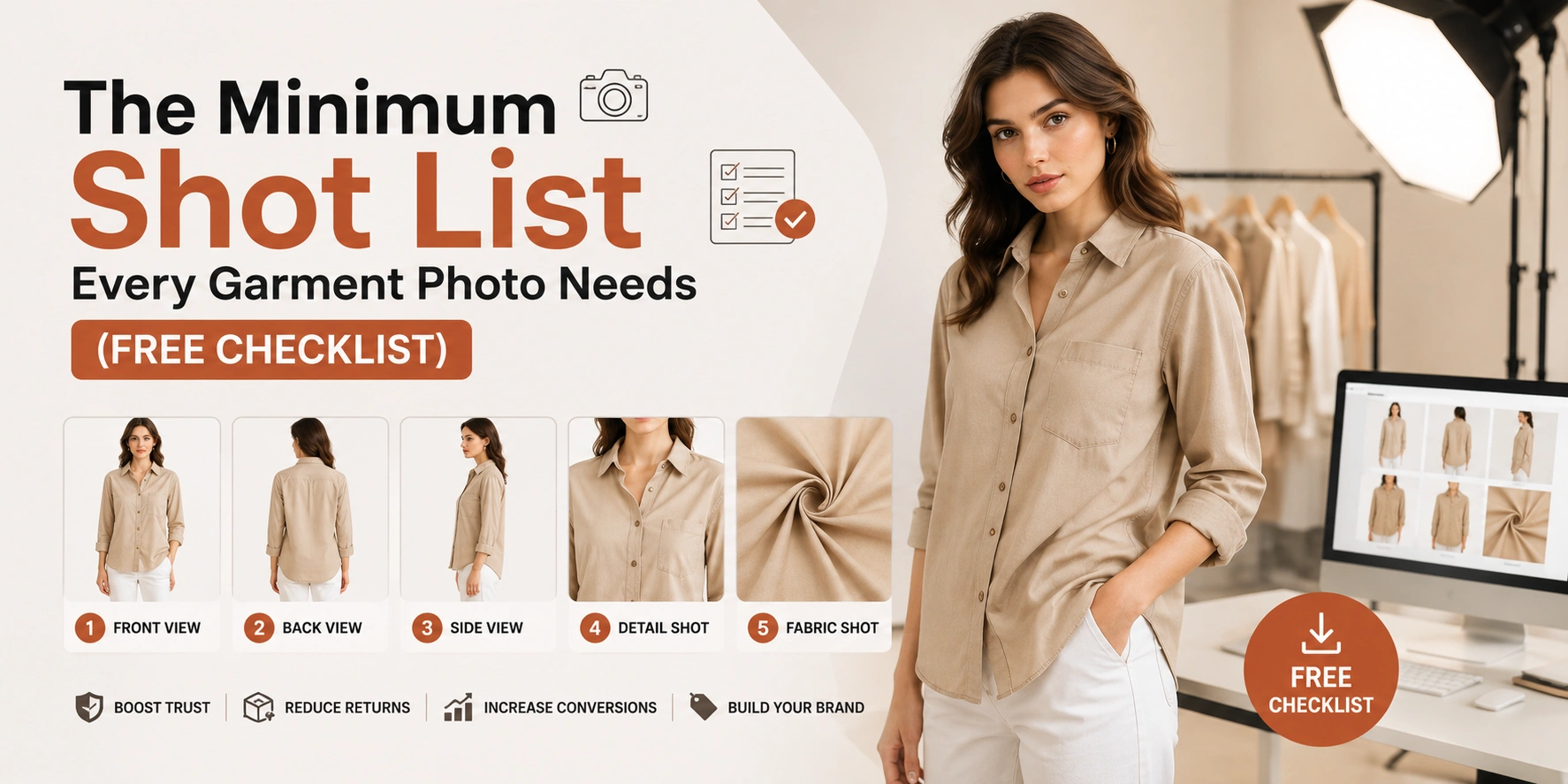
Regardless of category, these four shots are the non-negotiable floor for any garment going on a marketplace or brand store listing:
- Front view — the hero image, evenly lit, on the background your platform requires (white for most marketplaces).
- Back view — closures, prints, cuts, and back-neck detail are one of the most commonly missing shots, and one of the most commonly asked about in reviews and messages.
- One genuine fabric/detail close-up — stitching, weave, embroidery, print texture, or a functional detail like a zip or button — not a repeat of the front shot cropped tighter.
- One fit-context shot — a model shot, or ghost mannequin for structured pieces, showing how the garment actually holds its shape or falls on a body.
If a listing has fewer than these four, it's under-informing the buyer on something they will eventually ask about anyway — either in a review, a return reason, or a pre-purchase message that costs you a support reply.
The Minimum Shot List by Garment Type
1. Structured / Tailored Garments
Shirts, blazers, jackets, structured kurtas, waistcoats, formal trousers
- Front (white background, hero image)
- Back
- Ghost mannequin composite — this is where structured garments earn their shape without a model, and it's usually faster and cheaper than a full model shoot
- Close-up of collar, cuff, or closure detail (buttons, zips)
- Fabric/texture macro shot
- Optional: 3/4 side angle to show tailoring and fit line
Clothing Photography in Delhi
Lohar Studio provides professional clothing photography in Delhi for fashion brands, garment sellers, e-commerce businesses, expor...
Explore Clothing Photography in Delhi2. Draped / Flowy Garments
Sarees, dupattas, flowy dresses, palazzo sets, lehengas, chiffon and georgette pieces
- Front on a model — this category loses the most value of any garment type when shot flat, because drape and movement are the entire selling point
- Back
- A "movement" shot — mid-walk, mid-turn, or with a slight breeze/drape captured, showing how the fabric actually falls
- Fabric close-up showing weave, print, or embroidery detail
- Flat lay as a secondary/supporting image only, never as the sole image
3. Basic Everyday Wear
T-shirts, casual shirts, shorts, joggers, basic dresses
- Front (white background)
- Back
- One detail shot (print, logo placement, or fabric texture)
- Model or ghost mannequin shot — basics still benefit from fit context, even though the drape stakes are lower than ethnic wear
- Optional: flat lay for social/lifestyle use rather than the primary listing image
4. Innerwear and Foundation Garments
Bras, panties, camisoles, sportswear
- Front (white background, platform-compliant)
- Back, showing strap and closure detail
- Fabric/elastic close-up
- Model shot where the platform and brand guidelines permit it — fit is the single biggest purchase concern in this category, more than most others
- Where model shots aren't used, a well-lit ghost mannequin or form shot is the next-best substitute for showing shape
5. Sets and Multi-Piece Outfits
Co-ord sets, suits with dupatta, matching separates
- Full set front view, worn together
- Each piece shot separately (a buyer comparing sizes across pieces needs to see them apart, not only combined)
- One styled/lifestyle shot showing the set worn as intended
- Fabric close-up for at least the dominant piece
The Minimum Shot List by Marketplace
.webp)
Best Fashion Photographer in Delhi
Your fashion images are doing a job — selling a product, building a portfolio, running a campaign. If they are not doing tha...
Explore Best Fashion Photographer in DelhiShot lists don't just depend on the garment — they depend on where it's being sold. Each platform has its own minimum expectations, and missing them isn't a creative choice; it's a compliance problem that can get a listing rejected or buried in search.
Amazon — White background main image, minimum resolution well above the platform's stated floor (higher resolution holds up better under zoom), and model images strongly recommended for apparel since they consistently outperform flat-lay-only listings in this category on Amazon's own search ranking.
Myntra and Ajio — Model images are not optional here; both platforms mandate model shots for apparel listings with specific pose, background, and crop-ratio guidelines. A flat lay or ghost-mannequin-only submission for a category that requires model images will simply be rejected at the listing stage.
Flipkart — Accepts both model and non-model images depending on category, but consistent image quality across all image slots is required for Flipkart Assured eligibility, which makes a defined shot list (rather than an inconsistent one) a ranking factor, not just an aesthetic choice.
Meesho — Images get forwarded and shared outside the platform far more than on other marketplaces, so shots need to survive heavy compression and still read clearly on a small phone screen — which usually means simpler, higher-contrast compositions rather than subtle styling that gets lost at low resolution.
Shopify / D2C stores — No platform-mandated shot list, which is exactly why an internal one matters most here — without a marketplace's rules forcing consistency, brand stores are the most common place catalogues drift into the "shot by five different people" inconsistency problem.
What Not to Shoot: Avoiding the Over-Shooting Trap
A longer shot list isn't automatically a better one. Common over-shooting patterns that add cost without adding conversion value:
- Multiple near-identical front angles differing only by a few degrees
- Repeating the same detail shot at two different zoom levels
- Full styled/lifestyle shoots for every SKU when only hero pieces need that level of production
- Shooting every colourway from scratch when a colour-variant image can be produced from one base shoot in post-production
The right question for every additional shot isn't "would this look nice" — it's "does this answer a question the previous shots left open."
Free Checklist: Copy This List Before Your Next Shoot
Every garment, minimum:
- Front (platform-compliant background)
- Back
- One fabric/detail close-up
- One fit-context shot (model or ghost mannequin)
Lookbook Fashion Catalogue Photoshoot Services
Lookbook Fashion Photography plays a crucial role in shaping how your fashion brand is perceived. Whether you are launching a new...
Explore Lookbook Fashion Catalogue Photoshoot ServicesAdd based on garment type:
- Structured garment → ghost mannequin + closure/collar detail
- Draped/flowy garment → model movement shot
- Innerwear → strap/closure detail + fit-focused model shot
- Set/multi-piece → individual piece shots + one combined styled shot
Add based on platform:
- Amazon → white background hero + model image
- Myntra/Ajio → mandatory model shot, platform crop ratio
- Flipkart → consistent quality across all slots for Assured eligibility
- Meesho → high-contrast, compression-resistant composition
How Lohar Studio Plans a Shot List Before the Camera Comes Out
At Lohar Studio, the shot list is finalised during the requirement brief — before the garments even arrive at the studio — based on the category, the platforms you're selling on, and whether the piece is structured or drape-heavy. That single planning step is what keeps a 400-piece catalogue shoot consistent from the first garment to the last, without wasting time re-deciding coverage for every individual piece.
FAQs
1. How many photos does one garment actually need?
There's no single universal number, but four is the practical floor for any listing: front, back, one fabric/detail close-up, and one fit-context shot. Beyond that, add shots only where they answer a genuine unanswered question for that specific garment type.
2. Is a flat lay ever enough on its own?
For basic, non-drape-sensitive items, it can work as a supporting image, but it should rarely be the only image — buyers still need fit and scale information a flat lay alone can't provide, and several marketplaces won't accept flat-lay-only submissions for apparel categories that mandate model shots.
3. Do I need a full model shoot for every single SKU?
No. Structured garments (shirts, blazers, formal wear) often perform just as well with ghost mannequin photography, which is typically faster and cheaper than booking a model for every piece. Reserve full model shoots for drape-heavy or fit-critical categories.
Clothing / Garment Photographer in Azadpur
About Lohar Studio: Garment Photography Services In Azadpur In today's digital world, high-quality images are crucial for any fas...
Explore Clothing / Garment Photographer in Azadpur4. What's the biggest shot commonly missing from Indian D2C catalogues?
The back view. It's the single most frequently skipped shot, and one of the most commonly asked-about details in customer messages and reviews — closures, prints, and back-neck cuts all live there.
5. How do I decide how many colour variants to actually shoot?
Shoot one full set for your base/hero colour, and produce remaining colourways through post-production colour matching where the fabric and pattern allow it — this is standard practice and saves reshooting an entire set per colour.
6. Does Amazon really require model images for clothing?
Not strictly mandatory across every sub-category, but Amazon's own data consistently favours model images for apparel in search ranking and click-through, so treat it as a strong recommendation rather than optional.
7. What happens if I submit flat-lay-only images to Myntra or Ajio?
Both platforms have model-image requirements for most apparel categories with specific pose and background rules; non-compliant submissions are typically rejected at the listing review stage, not just ranked lower.
8. How is a shot list for a photoshoot different from just "getting enough photos"?
A shot list is decided before the shoot, by garment type and platform, so the same set of unknowns gets covered consistently for every SKU. Without one, coverage becomes inconsistent — some products get six angles, others get one, based on whatever felt right in the moment.
9. Should sets (like a suit with dupatta) be shot together or separately?
Both — shoot the full set combined for the primary listing image, but also shoot each piece separately, since buyers comparing sizes or considering only one piece need to see it apart from the set.
10. Is a longer shot list always better for conversion?
No. Past the point of covering genuine unknowns, additional near-duplicate angles add editing cost without meaningfully improving conversion — the goal is coverage, not volume.
If you're looking to enhance your brand’s presence on leading e-commerce platforms like Amazon, Flipkart, Myntra, Meesho, TataCliQ, Snapdeal, and Ajio, Lohar Studio is your go-to destination. Our team specializes in delivering high-quality images for fashion items, footwear, automotive products, medical photography, business headshots, and corporate shoots. We serve Delhi, Noida, Gurgaon, Faridabad, and Ghaziabad, offering professional results that boost conversions and elevate your brand’s image. Get in touch today at +91 9312070458 or visit us at A1/58, 1st Floor, Sector 6 Rd, Pocket 1, Sector 6A, Rohini, Delhi, 110085, to schedule your next shoot!
Written from hands-on experience shooting for 4000+ brands - practical, field-tested photography advice, not just theory.