


A shopper never touches your garment before they buy it. They can't run a hand across the fabric, hold it up to a window to check the real colour, or see how it falls when someone actually moves in it. Your photograph is doing all of that work instead — and for apparel, that's a much bigger job than it is for a coffee mug or a phone case.
That's also why clothing carries the highest return rate of almost any e-commerce category. Industry return-rate studies consistently place fashion and apparel in the 25–40% range, well above electronics or home goods. Multiple retail analyses point to the same two culprits: fit/size uncertainty (often cited as the cause behind roughly half to two-thirds of apparel returns) and colour or fabric not matching what the buyer expected. Both of those are photography problems as much as they are sizing-chart problems — a photo that shows fit, drape, and true colour prevents the guesswork that leads to a return.
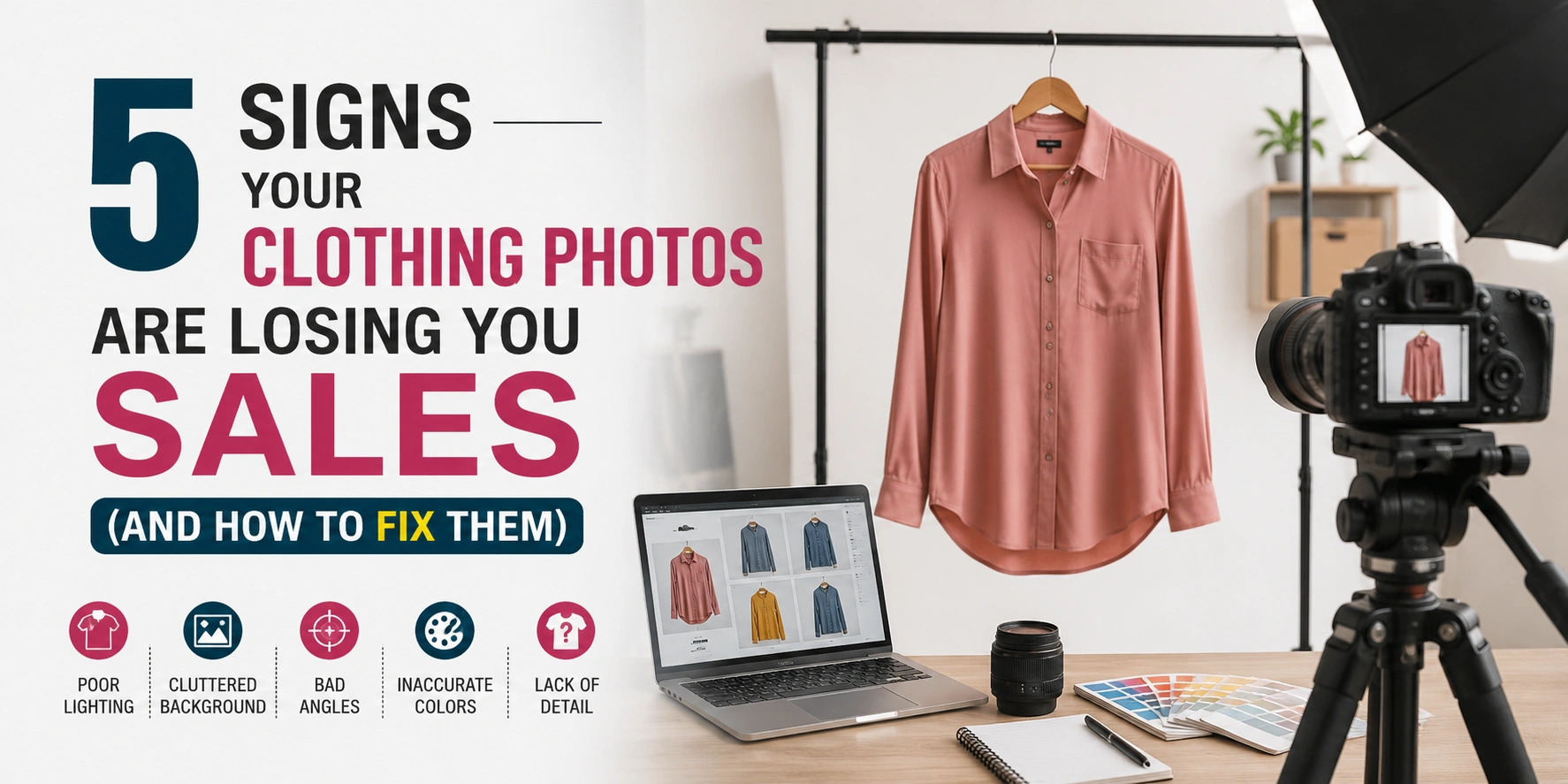
Below are five specific signs that your clothing images are quietly working against you—not generic "improve your photos" advice, but symptoms particular to garments, plus what to do about each one.
The 5 Signs:
Sign 1: Buyers Can't Tell What the Fabric Feels Like
Flip through your own catalogue and ask one question honestly: could a stranger tell the difference between your cotton kurti and a polyester one, just from the photo? If every garment looks like a flat, slightly shiny shape with no visible weave, thread, or texture, you have a fabric problem — not a garment quality problem, but a photography problem.
Fabric is one of the two or three things a buyer is actually trying to evaluate when they zoom in on a listing. Chiffon should look like it moves. Cotton should show a visible weave. Wool or khadi should read as textured, not flat. Embroidery, prints, and fabric finish (matte cotton vs. a silk sheen) all communicate quality signals that a buyer uses to justify the price. When none of that comes through, two things happen: buyers undervalue the garment relative to its actual quality, and the ones who do buy are more likely to feel the item "looked different" on arrival.
The fix: This is almost entirely a lighting problem, not a camera problem. Flat, shadowless lighting kills texture. A controlled studio setup with directional light (even a single well-placed softbox at an angle) reveals weave and surface detail that flat, on-camera-flash lighting flattens out completely. Add at least one genuine macro/close-up shot per garment showing fabric texture and stitching — not just the wide shot.
Sign 2: Your Colours Shift Between the Listing and the Delivered Garment
Colour accuracy is arguably the single most return-triggering photography mistake in clothing e-commerce. Multiple return-reason studies place colour mismatch as the second-most common cause of apparel returns, behind fit — and unlike fit, colour mismatch is almost entirely preventable, because it's a camera calibration and lighting-temperature issue, not a customer expectation issue.
The classic failure pattern: a navy shirt photographed under warm indoor tungsten lighting reads as black or greenish on screen. A cream fabric photographed under cool white light reads as a stark, clinical white. The buyer orders based on what they see, the courier delivers what actually exists, and the mismatch becomes a 1-star review that says "colour completely different from the photo," even though the garment itself was fine.
Clothing Photography in Delhi
Lohar Studio provides professional clothing photography in Delhi for fashion brands, garment sellers, e-commerce businesses, expor...
Explore Clothing Photography in DelhiThe fix: White balance and colour calibration have to happen at the point of shoot, not be "fixed later in editing" — editing can nudge a colour, but it can't invent accurate colour information that was never captured. A studio with consistent, calibrated lighting (and ideally a colour checker card used during setup) removes this problem at the source. If you're auditing your own catalogue, pull your "different colour than expected" return reasons for the last quarter — a spike in one specific colour family (navy, maroon, and dark green are common offenders) usually points directly at a lighting/white-balance issue in that shoot, not a supplier problem.
Sign 3: There's No Fit Context — Just a Flat Garment Floating on White
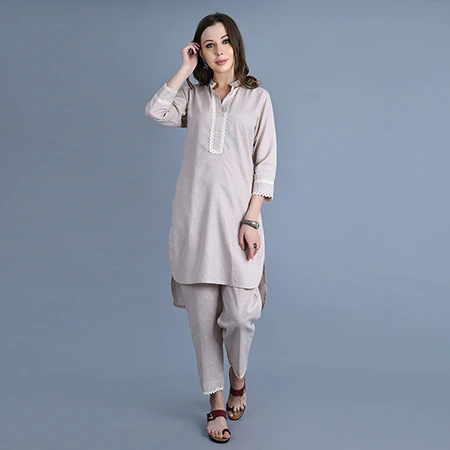
A white-background flat lay or hanger shot tells a buyer almost nothing about how the garment actually sits on a body: how a kurti falls at the hem, whether a dress clings or flows, how a blazer's shoulders sit, whether a shirt runs slim or relaxed. For any garment where fit and drape genuinely matter to the purchase decision — which is most clothing outside of basic utility items — a flat-lay-only catalogue is asking the buyer to imagine the single hardest thing to imagine from a static image.
This is precisely why platforms with mandatory model-image requirements for apparel exist in the first place, and why marketplace data consistently shows model images out-clicking flat lay or ghost-mannequin-only images in the fashion category. Buyers aren't being picky — they're trying to solve the fit problem the retailer didn't solve for them.
The fix: At minimum, add one model shot per garment (or per garment style, if budget is tight and you're covering variants) showing front, and ideally a 3/4 or back angle. Where a full model shoot genuinely isn't feasible for every SKU, ghost mannequin photography is the next-best option for structured garments (shirts, blazers, kurtas) because it shows the garment's real three-dimensional shape rather than a flat silhouette — it's not a substitute for a model shot on drape-heavy fabric, but it solves the "what shape is this garment" problem for tailored pieces.
Sign 4: Your Catalogue Looks Like It Was Shot by Five Different People
Look at your product grid or your Instagram feed as a whole, not one image at a time. Does the lighting, background tone, framing, and colour grading feel consistent from garment to garment — or does every third product look like it came from a different shoot, a different phone, a different day?
Inconsistency doesn't just look unpolished; it actively signals low effort and undermines trust in a purchase where the buyer already has to take a leap of faith on fit and fabric. A catalogue with matched white balance, consistent crop ratios, and the same background across every SKU reads as a real brand. A catalogue with visibly different lighting per batch reads as a reseller assembling images from wherever they could get them — even if every individual photo is technically "fine."
The fix: This is a process problem, not a per-photo problem, which is why it's the hardest of the five to catch by looking at any single image. Audit your last three months of new listings side by side. If framing, background tone, or exposure drifts noticeably between shoots, standardise your shoot brief — same background, same camera settings baseline, same crop template — before your next batch, rather than treating every new shoot as a fresh creative decision.
Sign 5: You're Publishing One Angle Per Garment
A single front-facing shot is the minimum viable listing image, not a complete one. For apparel specifically, the questions a single image can't answer are exactly the questions that drive returns: What does the back look like? Is there a zip, buttons, or a print detail on the reverse? What does the fabric look like up close? Is there a size reference — is this an oversized fit or true-to-size?
.webp)
Best Fashion Photographer in Delhi
Your fashion images are doing a job — selling a product, building a portfolio, running a campaign. If they are not doing tha...
Explore Best Fashion Photographer in DelhiListings with a limited image count consistently underperform richer listings in click-through and conversion, and for clothing the gap tends to be wider than in other categories precisely because the "unknowns" (fit, drape, back detail, fabric close-up) are more numerous than for, say, a kitchen gadget.
The fix: Build a minimum shot list per garment style before the shoot, not during it: front, back, one detail/fabric close-up, and — for anything with drape or fit sensitivity — a model or ghost mannequin shot. Six well-planned angles convert better than sixteen redundant ones, so the goal is coverage of genuine unknowns, not raw image count.
What This Is Actually Costing You
None of these five signs show up as one dramatic failure. A listing with flat fabric texture, slightly off colour, no model shot, inconsistent framing, and only one angle doesn't crash — it just quietly underperforms every similar listing that gets these things right, on every single visit, indefinitely, until someone reshoots it.
Given that apparel return rates run well above other categories, and that fit and colour mismatch alone are widely cited as the cause behind the large majority of those returns, the honest way to think about clothing photography is less "does this look nice" and more "how much of my current return rate is actually a photography problem in disguise." For most sellers who haven't audited this specifically, the answer is: more than they think.
A Quick Self-Audit
Before your next shoot or reshoot, pull up your live listings and check:
- Can you tell the fabric type from the photo alone, without reading the description?
- Does the colour match what arrives in hand — have you checked recent "colour different" return comments against specific SKUs?
- Is there at least one model or ghost mannequin shot per style with genuine fit/drape relevance?
- Do your last three shoots look visually consistent side by side?
- Does every garment have at least front, back, and one detail shot?
If two or more of these come back as "no," photography is a live, fixable factor in your current conversion and return numbers — not a cosmetic afterthought.
How Lohar Studio Approaches This
Lookbook Fashion Catalogue Photoshoot Services
Lookbook Fashion Photography plays a crucial role in shaping how your fashion brand is perceived. Whether you are launching a new...
Explore Lookbook Fashion Catalogue Photoshoot ServicesAt Lohar Studio, every clothing photoshoot is planned around these exact five failure points before a single frame is taken: lighting calibrated for fabric texture, colour-accurate setups, model or ghost mannequin coverage decided per garment type, a standardised shoot brief for catalogue consistency, and a fixed shot list per piece so nothing critical gets missed. It's the same process whether the order is 10 hero pieces or a 400-piece seasonal catalogue.
Top 10 FAQs:
1. What's the single biggest photography mistake for clothing sellers?
Colour inaccuracy is usually the most damaging because it's almost entirely preventable (it's a lighting/calibration issue) and it directly drives "different from the photo" returns — one of the costliest return reasons because the garment itself was never actually defective.
2. Do I need a model for every single garment, or just some?
Not every SKU needs a full model shoot. Structured, drape-sensitive garments (dresses, sarees, flowy kurtas, ethnic wear) benefit most from a model shot. Simpler, structured items like formal shirts or blazers can perform well with ghost mannequin photography instead, which is usually faster and cheaper per piece.
3. Can editing fix a colour that was shot wrong?
Only partially. Editing can nudge a close colour, but it can't reconstruct accurate colour information that the camera never captured under bad lighting. Correct white balance and colour calibration at the point of the shoot will always outperform trying to fix it afterward.
4. How many images does a single clothing listing actually need?
There's no fixed universal number, but as a working minimum: front, back, one fabric/detail close-up, and a model or ghost mannequin shot where fit matters. Beyond that, additional angles help only if they answer a genuine unanswered question — redundant angles add less value than people assume.
5. Is ghost mannequin photography a substitute for a model shoot?
.webp)
Model Photography in Delhi
Two very different people search for "model photography in Delhi." One is a model — someone building a portfolio to sub...
Explore Model Photography in DelhiNot fully. Ghost mannequin shows a garment's structured shape well, which works for tailored pieces, but it can't show drape, movement, or how fabric falls on a body the way a model shot can. For drape-heavy fabrics, a model shot answers questions ghost mannequin simply can't.
6. How do I know if my return rate is a photography problem specifically?
Pull your return reasons for the last quarter and look for patterns tied to "colour different," "not as pictured," or "didn't expect this fit" clustering around specific SKUs or colour families. If those reasons dominate over defect-related returns, photography is very likely a contributing factor.
7. Does catalogue consistency actually affect sales, or is it just aesthetic?
It affects trust, which affects conversion. A visually inconsistent catalogue signals amateur operation to a buyer who is already taking a risk on fit and fabric sight-unseen — even when each photo is technically acceptable.
8. How often should a clothing catalogue be reshot?
There's no fixed interval, but if your current images are more than a year or two old, or if return reasons increasingly cite mismatch with photos, that's a stronger signal than any calendar-based rule.
9. Is this worth fixing for a small catalogue, or only large sellers?
It matters arguably more for small catalogues — with fewer SKUs, each listing carries proportionally more weight in your overall revenue, so fixing photography issues on your core styles has an outsized impact compared to a 500-SKU catalogue where any single listing matters less.
10. What should I prioritise first if I can't reshoot the whole catalogue at once?
Start with your highest-traffic SKUs and whichever specific colours or styles show up most often in "different from photo" return comments — that's where the current photography is most actively costing you money, and where a fix pays back fastest.
If you're looking to enhance your brand’s presence on leading e-commerce platforms like Amazon, Flipkart, Myntra, Meesho, TataCliQ, Snapdeal, and Ajio, Lohar Studio is your go-to destination. Our team specializes in delivering high-quality images for fashion items, footwear, automotive products, medical photography, business headshots, and corporate shoots. We serve Delhi, Noida, Gurgaon, Faridabad, and Ghaziabad, offering professional results that boost conversions and elevate your brand’s image. Get in touch today at +91 9312070458 or visit us at A1/58, 1st Floor, Sector 6 Rd, Pocket 1, Sector 6A, Rohini, Delhi, 110085, to schedule your next shoot!

Written from hands-on experience shooting for 4000+ brands - practical, field-tested photography advice, not just theory.