

Industrial Photography in Delhi
Thousands of manufacturing companies across Delhi NCR still use dark, blurry mobile phone images on their websites, brochures, and...
Explore Industrial Photography in DelhiFactory & Industrial Photography in Faridabad
Faridabad is not a new industrial city — it is Delhi NCR's oldest and most deeply established heavy manufacturing hub, built...
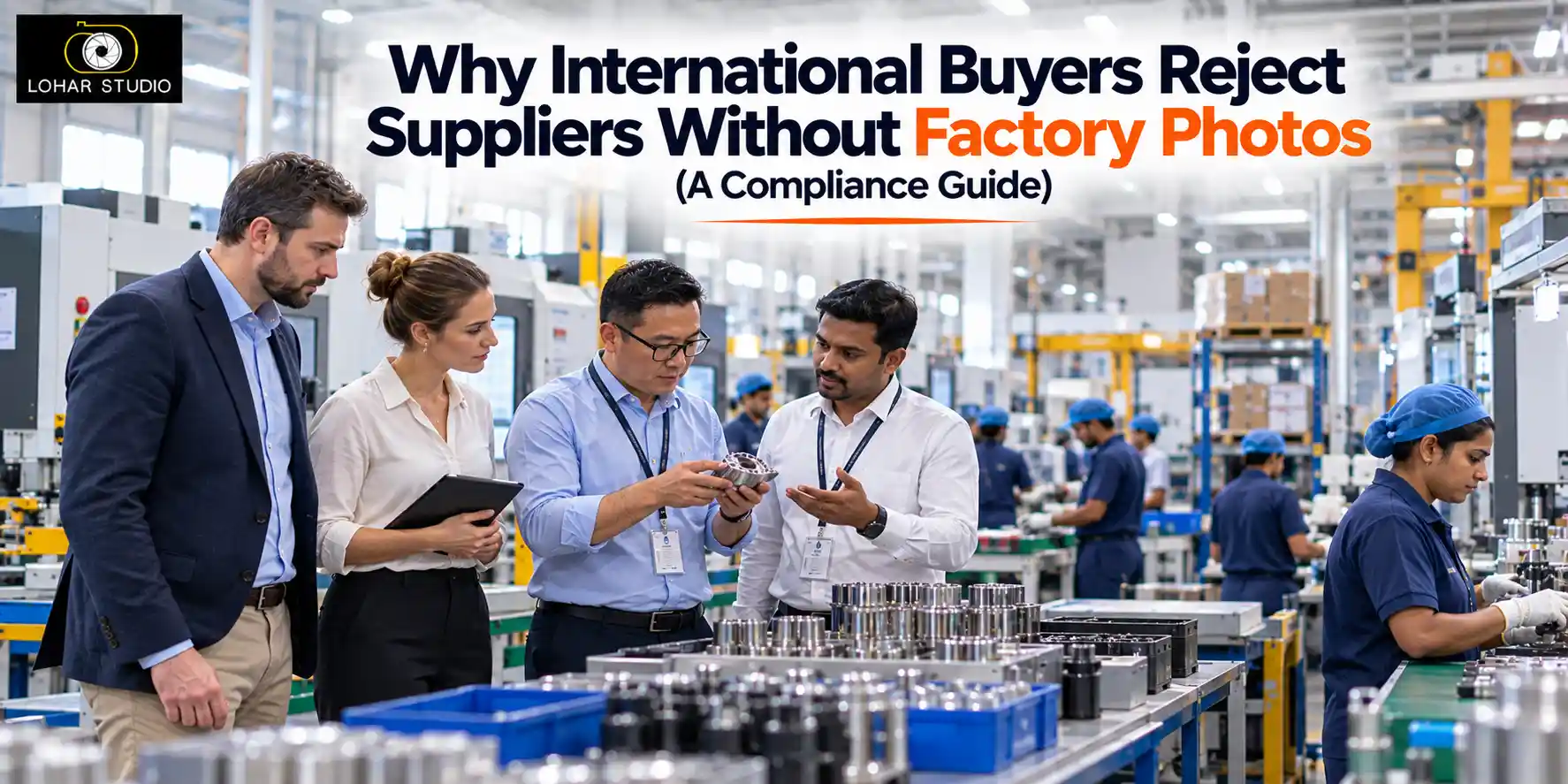
Explore Factory & Industrial Photography in FaridabadInternational buyers routinely reject manufacturers without ever sending an inquiry — they simply close the tab. Missing or inadequate factory photos are one of the most common triggers for this "silent rejection," because photos are one of the few pieces of low-effort, verifiable evidence a buyer can check before committing time to a conversation. Without genuine photos of your production floor, machinery, and facility, buyers can't distinguish you from a trading company posing as a manufacturer — and in global sourcing, that uncertainty alone is often enough to remove you from consideration entirely.
If you're a manufacturer trying to win international buyers, here's exactly why professional photography matters more than most suppliers realize, and what buyers are actually checking for.
The "Silent Rejection" Problem Most Manufacturers Never See
Before a buyer ever sends an inquiry, they typically run through a quiet, unspoken checklist — reviewing your website, your listing, and your available documentation to decide whether you're even worth contacting. If something looks off or incomplete, most buyers don't ask questions or flag the concern. They simply close the tab and move to the next supplier on their list.
This is the part that makes missing factory photos so costly: you never see the rejection happen. There's no email asking "can you send factory photos?" — the inquiry simply never arrives. For manufacturers wondering why international traffic isn't converting into inquiries despite decent visibility, this silent, invisible filtering is very often the real reason.
Why Factory Photos Are a Core Part of Buyer Due Diligence
International buyers, particularly those sourcing from unfamiliar markets, have learned to be cautious for a specific reason: platform verification badges and polished company profiles don't actually confirm manufacturing capability. Verification badges on B2B platforms typically only confirm that a company paid for a membership tier and submitted basic business documents — not that they actually operate the production capacity they claim.
This gap is exactly why buyers rely on visual evidence as an additional, independent check. Photos or video walkthroughs of an actual production floor give a buyer indirect but meaningful insight into real capacity, machine types, and workflow — information that a text-based listing or a paid verification badge simply can't provide on its own.
Manufacturer vs. Trading Company: What Photos Prove
One of the most common risks in international sourcing is a supplier claiming to be a manufacturer while actually operating as a trading company or middleman with no real production facility. Buyers actively watch for signals of this mismatch, and a lack of genuine factory photos is one of the clearest red flags:
- A supplier claiming to be a "factory" but showing no machinery photos, or only generic stock-style images
- A listed factory address that doesn't visually match what's shown in available photos
- Contradictions between claimed production capability and the actual scale or equipment visible in available imagery
Genuine, specific factory photography is one of the simplest ways to remove this doubt entirely — it's difficult to convincingly fake a real production floor with real machinery and real staff, which is exactly why buyers treat it as meaningful evidence.
What International Buyers Specifically Look For in Factory Photos
- Actual machinery and equipment, matching the scale and type of production the supplier claims to offer
- Real production floor context, not just isolated product shots that could belong to any facility
- Consistency with claimed capacity — a "large-scale factory" claim should be visually supported by matching floor space and equipment, not a small workshop-style setup
- Staff and workflow in action, which reinforces that the facility is operational and genuinely running production, not simply staged for a one-time photo
- Clean, well-maintained, and organized conditions, which buyers often associate with better quality control and operational discipline
Common Red Flags That Get Suppliers Rejected
- No factory or machinery photos at all, relying entirely on product photography and text claims
- Photos that appear generic, stock-sourced, or inconsistent with the specific products or capacity claimed
- A significant mismatch between the number of SKUs or product categories listed and the scale of facility shown
- Photos that look staged for a single event rather than reflecting a genuinely active, ongoing operation
- No visual documentation at all for export-relevant compliance areas — safety measures, quality control stations, or packaging processes
Verification Badges Aren't Enough — Why Buyers Still Want Photos
Even suppliers with paid verification badges on major B2B platforms still face buyer scrutiny, because experienced international buyers know these badges have real limitations. A verification badge typically confirms business registration and basic documentation — it does not independently confirm production capacity, actual product quality, or operational scale.
This is precisely why factory photography remains essential even for verified suppliers: it's the visual layer of evidence that platform badges and paperwork alone can't provide. Buyers use it to screen and shortlist suppliers before moving on to deeper steps like factory audits or trial orders, making it one of the earliest and highest-leverage trust signals in the entire sourcing process.
What a Compliance-Ready Factory Photo Set Should Include
- Exterior and entrance shots, confirming the facility's real location and scale
- Full production floor shots, showing machinery, layout, and active workflow
- Close-up equipment and machinery photos, matching the specific production capability being claimed
- Quality control and inspection stations, if applicable, demonstrating a structured quality process
- Packaging and dispatch area photos, relevant to buyers evaluating export readiness and logistics capability
- Staff working in context, reinforcing that the facility is genuinely operational, not a one-time staged setup
- Certifications displayed within the facility, where applicable, tying compliance documentation to visual proof
How Factory Photos Support the Larger Verification Process
Factory photography isn't a replacement for full supplier due diligence — it's typically the first, lowest-effort filter buyers use before investing more time. A common buyer verification sequence looks like this:
- Initial screening — reviewing available photos, documentation, and claims to decide whether a supplier is worth contacting at all
- Document verification — business registration, certifications, and export licenses, checked against issuing authorities
- Trial order or sample evaluation — testing product quality and how the supplier handles a real, smaller transaction
- Factory audit — for higher-value or long-term relationships, an in-depth, often third-party evaluation of the facility itself
Missing or weak factory photography risks elimination at the very first step — before a buyer ever gets to evaluate your actual product quality, pricing, or capability, which is what makes it such a high-leverage, low-cost investment relative to its impact.
Common Mistakes Manufacturers Make With Factory Photography for Export
- Relying entirely on product photography while completely skipping facility and machinery photos
- Using outdated photos that no longer reflect current equipment, certifications, or facility conditions
- Shooting only a few generic-looking angles instead of a comprehensive set covering production, quality control, and dispatch
- Treating factory photography as a one-time task rather than updating it as equipment, certifications, or facility conditions change
- Assuming a platform verification badge alone is sufficient, without backing it up with genuine visual documentation
Building Your Factory's Photo Documentation
- Plan a shot list covering exterior, production floor, machinery, quality control, and dispatch areas before booking a shoot
- Prioritize accuracy over polish — buyers are looking for genuine, verifiable evidence, not an overly staged or stock-style presentation
- Update your photo set whenever equipment, certifications, or facility conditions change meaningfully
- Pair your photography with matching documentation (certifications, registration details) so the visual and paper trail reinforce each other
FAQs
1. Why do international buyers reject suppliers without factory photos?
Because photos are one of the few low-effort ways buyers can verify actual production capability before investing time in a conversation — without them, buyers can't distinguish a genuine manufacturer from a trading company.
2. Is a B2B platform verification badge enough to win international buyers?
No — verification badges typically confirm business registration and basic documentation, not actual production capacity or quality, which is why buyers still look for genuine factory photography.
3. What's the biggest red flag in factory photography that causes rejection?
A mismatch between claimed production capacity and what's actually visible in photos — such as claiming large-scale manufacturing while only showing a small workshop setup.
4. What should a compliance-focused factory photo set include?
Exterior shots, full production floor images, close-up machinery photos, quality control stations, packaging/dispatch areas, and staff working in context.
5. Do buyers actually reject suppliers without ever contacting them?
Yes — this "silent rejection" is common; buyers often review available evidence and simply move to the next supplier without ever sending an inquiry.
6. How often should factory photography be updated for export purposes?
Whenever equipment, certifications, or facility conditions change meaningfully — outdated photos can misrepresent your current actual capability.
7. Can good factory photos replace the need for a factory audit?
No — photos serve as an early screening tool; higher-value or long-term buyer relationships typically still involve a more in-depth factory audit later in the process.
8. Does product photography alone satisfy what international buyers look for?
No — buyers specifically look for facility and machinery photos separate from product shots, since these demonstrate actual production capability rather than just the finished product.
9. How can factory photos help distinguish a real manufacturer from a trading company?
Genuine, specific photos of an actual production floor and equipment are difficult to convincingly fake, making them a meaningful signal that a supplier is a real manufacturer rather than a reseller.
10. What's the most cost-effective first step for manufacturers targeting export buyers?
Investing in a comprehensive, accurate factory photo set — it's a relatively low-cost step that directly affects whether buyers even reach the inquiry stage.
Ready to build a compliance-ready factory photo set for your export buyers?
[Talk to Lohar Studio] about your facility and production process — on-location industrial photography is typically priced as a day rate (₹14,999–₹59,999, depending on scope and location), covering everything international buyers look for before they'll even send an inquiry.
Factory & Industrial Photography in Gurgaon
Gurgaon (Gurugram) is unlike any other industrial area in NCR. It is the region's corporate-industrial city, where auto-ancillary...
Explore Factory & Industrial Photography in GurgaonFactory & Industrial Photography in Noida
Noida is not just another Delhi-adjacent industrial area — it is a planned city with a distinct industrial identity built ar...
Explore Factory & Industrial Photography in NoidaIf you're looking to enhance your brand’s presence on leading e-commerce platforms like Amazon, Flipkart, Myntra, Meesho, TataCliQ, Snapdeal, and Ajio, Lohar Studio is your go-to destination. Our team specializes in delivering high-quality images for fashion items, footwear, automotive products, medical photography, business headshots, and corporate shoots. We serve Delhi, Noida, Gurgaon, Faridabad, and Ghaziabad, offering professional results that boost conversions and elevate your brand’s image. Get in touch today at +91 9312070458 or visit us at A1/58, 1st Floor, Sector 6 Rd, Pocket 1, Sector 6A, Rohini, Delhi, 110085, to schedule your next shoot!

Written from hands-on experience shooting for 4000+ brands - practical, field-tested photography advice, not just theory.