


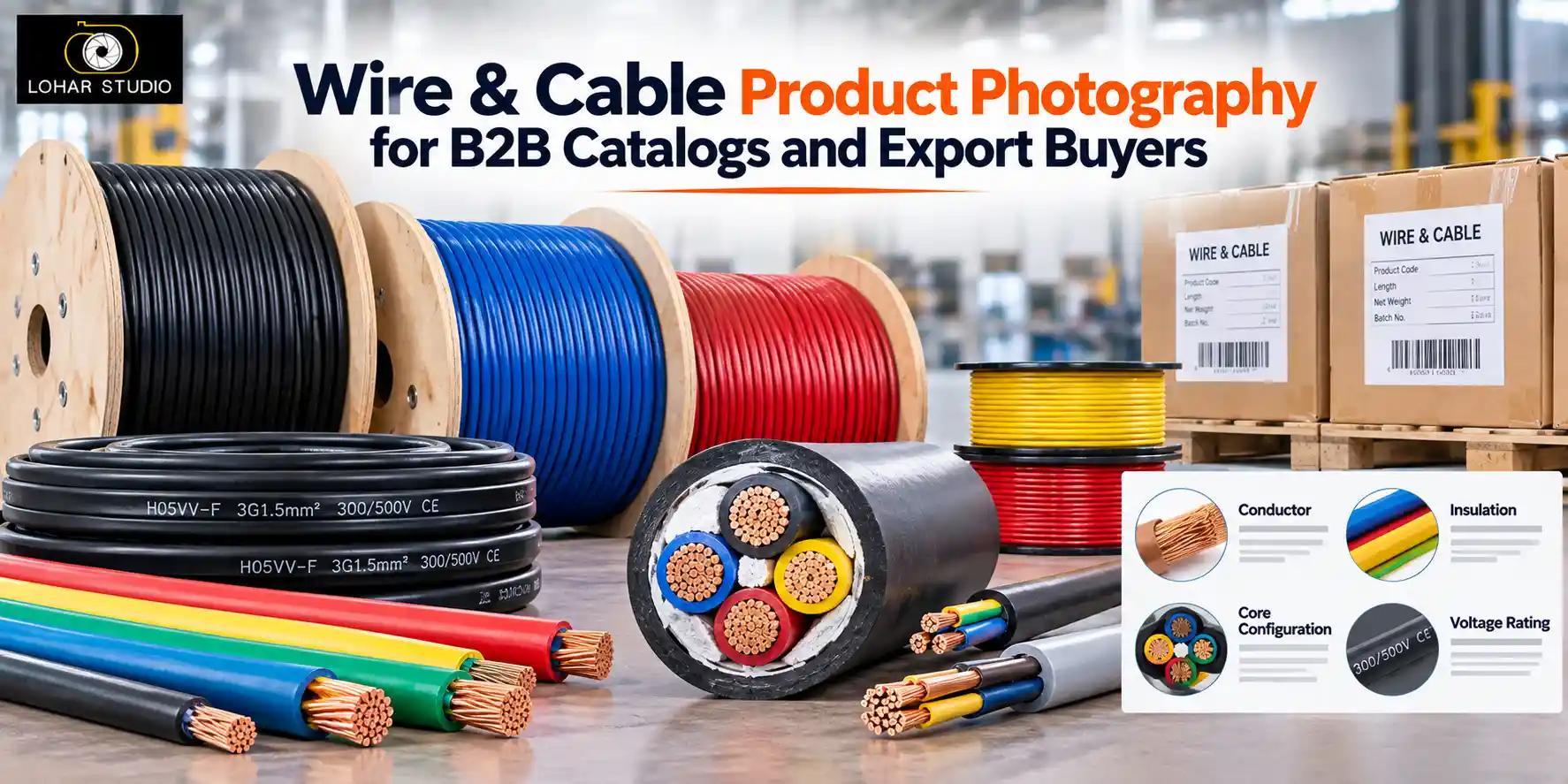
Wire and cable photography needs to do what most product photography doesn't—prove technical specifications, not just show appearance. A single cable often looks nearly identical to a dozen competing products from the outside, so the images that actually help buyers decide are the cross-section shot (showing conductor and insulation layers), clear color-coding and marking visibility, and technical infographic overlays displaying gauge, voltage rating, and conductor material. For export buyers, packaging, reel labeling, and documentation-ready imagery matter as much as the product shot itself, since they evaluate compliance and shipment readiness alongside the product.
If you manufacture or distribute wire and cable products, here's what your catalog photography actually needs to include to support B2B and export sourcing decisions.
Why Wire and Cable Photography Is Different From Standard Product Photography
Most product photography sells on appearance — style, color, finish. Wire and cable buyers, particularly B2B and export buyers, are evaluating something photography doesn't naturally show: technical construction. Two cables can look visually identical from the outside while differing significantly in conductor material, insulation thickness, core configuration, and voltage rating — details that determine whether a product actually fits a buyer's application.
This means cable photography has to work harder than typical product photography, combining standard product presentation with technical documentation. A clean hero shot alone tells a buyer almost nothing useful; it's the supporting technical images — cross-sections, markings, and spec overlays — that actually support a sourcing decision.
The Cross-Section Shot: Your Most Important Image
For wire and cable products, a clear cross-section image is arguably more important than the standard product hero shot, since it's the one image that directly shows what a buyer actually needs to evaluate: conductor construction, insulation layers, and overall build quality.
- Cut a clean, precise cross-section — a ragged or crushed cut edge misrepresents the actual layer structure and makes the shot far less useful
- Use macro photography with strong, even lighting to clearly separate and distinguish each layer — conductor strands, inner insulation, outer sheath
- Shoot straight-on, perpendicular to the cut face, avoiding an angled shot that distorts the true proportions of each layer
- Include a scale reference where possible, so buyers can judge actual dimensions rather than relying on stated specs alone
For multi-core cables, showing the cross-section clearly enough to count and identify individual conductors is particularly valuable, since core configuration is one of the most commonly checked specs in B2B sourcing.
Photographing Insulation Color Coding and Marking

Industrial Photography in Delhi
Thousands of manufacturing companies across Delhi NCR still use dark, blurry mobile phone images on their websites, brochures, and...
Explore Industrial Photography in DelhiColor coding and printed markings on cable insulation carry real technical meaning — they're not just cosmetic. Buyers use them to verify conductor identification, voltage class, and compliance markings, which makes accurate, legible photography of this detail genuinely important:
- Ensure color accuracy in your lighting and camera calibration, since color-coded conductors (commonly used to identify phase, neutral, and earth conductors) need to be photographed with true, unshifted color for buyers to verify correctly
- Capture printed text and markings sharply and legibly — manufacturer branding, standard compliance codes, and voltage ratings printed along the cable sheath should be readable in the image, not blurred or too small to make out
- Photograph markings in a straight, unrolled section of cable where the text isn't distorted by the natural curve of a coiled or spooled section
Spool, Coil, and Reel Presentation
Wire and cable products are rarely sold as a single straight piece — they're typically presented on spools, coils, or reels, which adds its own photography considerations:
- Show the full spool or reel clearly, including any labeling on the reel itself (length, weight, product code), since this is often the actual unit buyers are purchasing and expecting to receive
- Include a close-up of the reel label or coil tag, since this is frequently how buyers verify they're looking at the correct product variant among a catalog of similar-looking options
- Photograph coiled cable neatly wound, since a loosely or messily coiled presentation can unintentionally signal poor handling or quality control, even when the product itself is fine
Building Technical Infographic Overlays for Spec-Driven Buyers
Because wire and cable purchasing decisions are so spec-driven, infographic-style images that overlay key technical data directly onto product photos are especially valuable for this category:
- Display core specifications directly on the image — conductor material (copper or aluminum), gauge or cross-sectional area, voltage rating, and temperature rating — so buyers can confirm fit at a glance without needing to cross-reference a separate spec sheet
- Use clear, simple diagrams for core configuration, particularly useful for multi-core or multi-conductor cables where a labeled diagram communicates structure faster than a written description
- Keep technical overlays clean and uncluttered, prioritizing the specs that matter most for sourcing decisions rather than cramming every possible data point into one image
What Export Buyers Specifically Look For in Cable Catalog Images
International and export-focused buyers bring additional scrutiny beyond standard B2B sourcing, since they're also evaluating compliance and cross-border logistics:

Corporate Headshot Photography
Looking for professional corporate headshot photography in Delhi? You are in the right place. At Lohar Studio, we shoot busin...
Explore Corporate Headshot Photography- Standards and compliance marking visibility — clear photography of any stamped or printed compliance codes (relevant international or regional standards) supports a buyer's own compliance review process
- Consistent, professional presentation across a full product range, which signals a supplier capable of handling larger, more complex export orders — not just a single small-batch product
- Packaging and reel format clarity, since export buyers need to plan shipment logistics around actual product presentation — reel size, weight, and packing format directly affect freight planning
- Clear differentiation between similar-looking product variants, since copper versus aluminum, or subtly different insulation types, need to be visually and technically distinguishable in the catalog to avoid quotation errors
Packaging and Export Documentation Photography
For export-oriented catalogs, photography extends beyond the product itself into packaging and shipping presentation:
- Photograph export packing formats — wooden drums, steel-tyred reels, or export-specific one-way drums — since packaging type directly affects a buyer's shipping and handling planning
- Include shipping mark and label photography, showing how product identification, quantity, and destination marking appear on the actual packed unit
- Show palletized or containerized loading examples where relevant, giving buyers a realistic sense of how the product will actually arrive
Common Mistakes in Wire and Cable Product Photography
- Skipping the cross-section shot entirely, relying only on an exterior product photo that tells buyers little about actual construction
- Cutting a rough, uneven cross-section, which misrepresents layer structure and looks unprofessional
- Inaccurate color reproduction on color-coded insulation, risking buyer confusion about conductor identification
- Blurred or illegible printed markings, making compliance and spec verification difficult for the buyer
- Inconsistent photography style across a large catalog, making it harder for buyers to visually compare similar products at a glance
Building a Complete Image Set for a Cable Catalog
- A clean hero shot of the product, whether coiled, spooled, or as a cut length
- A precise, well-lit cross-section shot showing all construction layers clearly
- A close-up of printed markings and color coding for identification and compliance verification
- A reel or spool label close-up, where applicable
- A technical infographic overlay displaying key specs (conductor material, gauge, voltage rating, core configuration)
- Export packaging and shipping mark photography, for catalogs targeting international buyers
FAQs
1. Why is the cross-section shot so important for wire and cable photography?
Because it's the one image that directly shows conductor construction and insulation layers — information a standard exterior product shot can't communicate, and which is central to a buyer's sourcing decision.
Factory & Industrial Photography in Faridabad
Faridabad is not a new industrial city — it is Delhi NCR's oldest and most deeply established heavy manufacturing hub, built...
Explore Factory & Industrial Photography in Faridabad2. Does color accuracy really matter for cable photography?
Yes — color-coded insulation carries real technical meaning (phase, neutral, earth identification), so inaccurate color reproduction in photos can create genuine buyer confusion.
3. What should be included in a technical infographic overlay for cable products?
Core specifications like conductor material, gauge or cross-sectional area, voltage rating, and core configuration, displayed clearly and without cluttering the image.
4. How should spools and reels be photographed for a B2B catalog?
Show the full reel clearly along with any labeling (length, weight, product code), plus a close-up of the label itself, since buyers often rely on this to confirm the correct product variant.
5. What extra photography do export buyers need compared to domestic B2B buyers?
Export buyers typically also look for clear compliance marking visibility, export packaging formats, and shipping mark photography to support their own logistics and compliance planning.
6. What's the most common mistake in wire and cable product photography?
Skipping the cross-section shot entirely and relying only on an exterior product image, which fails to show the construction detail buyers actually need to evaluate.
Factory & Industrial Photography in Gurgaon
Gurgaon (Gurugram) is unlike any other industrial area in NCR. It is the region's corporate-industrial city, where auto-ancillary...
Explore Factory & Industrial Photography in Gurgaon7. How should printed markings on cable insulation be photographed?
Sharply and legibly, ideally on a straight, unrolled section of cable, so branding, compliance codes, and ratings printed on the sheath are clearly readable.
8. Does packaging photography matter for cable catalogs?
Yes, especially for export buyers, since packaging format (drum type, reel size) directly affects their shipping and handling planning.
9. Can one photography style work for both copper and aluminum cable products?
The photography approach can stay consistent, but color and labeling need to clearly differentiate between materials and variants, since visually similar cables can have significantly different specifications.
10. Why does catalog photography consistency matter for larger cable product ranges?
A consistent, professional presentation across a full range signals a supplier capable of handling larger and more complex orders, and makes it easier for buyers to visually compare similar products.
Building a technical catalog for your wire and cable products?
[Talk to Lohar Studio] about your product range — on-location or in-studio industrial photography is typically priced as a day rate (₹14,999–₹59,999, depending on scope), covering everything from cross-section detail to export-ready packaging shots.
If you're looking to enhance your brand’s presence on leading e-commerce platforms like Amazon, Flipkart, Myntra, Meesho, TataCliQ, Snapdeal, and Ajio, Lohar Studio is your go-to destination. Our team specializes in delivering high-quality images for fashion items, footwear, automotive products, medical photography, business headshots, and corporate shoots. We serve Delhi, Noida, Gurgaon, Faridabad, and Ghaziabad, offering professional results that boost conversions and elevate your brand’s image. Get in touch today at +91 9312070458 or visit us at A1/58, 1st Floor, Sector 6 Rd, Pocket 1, Sector 6A, Rohini, Delhi, 110085, to schedule your next shoot!

Written from hands-on experience shooting for 4000+ brands - practical, field-tested photography advice, not just theory.