


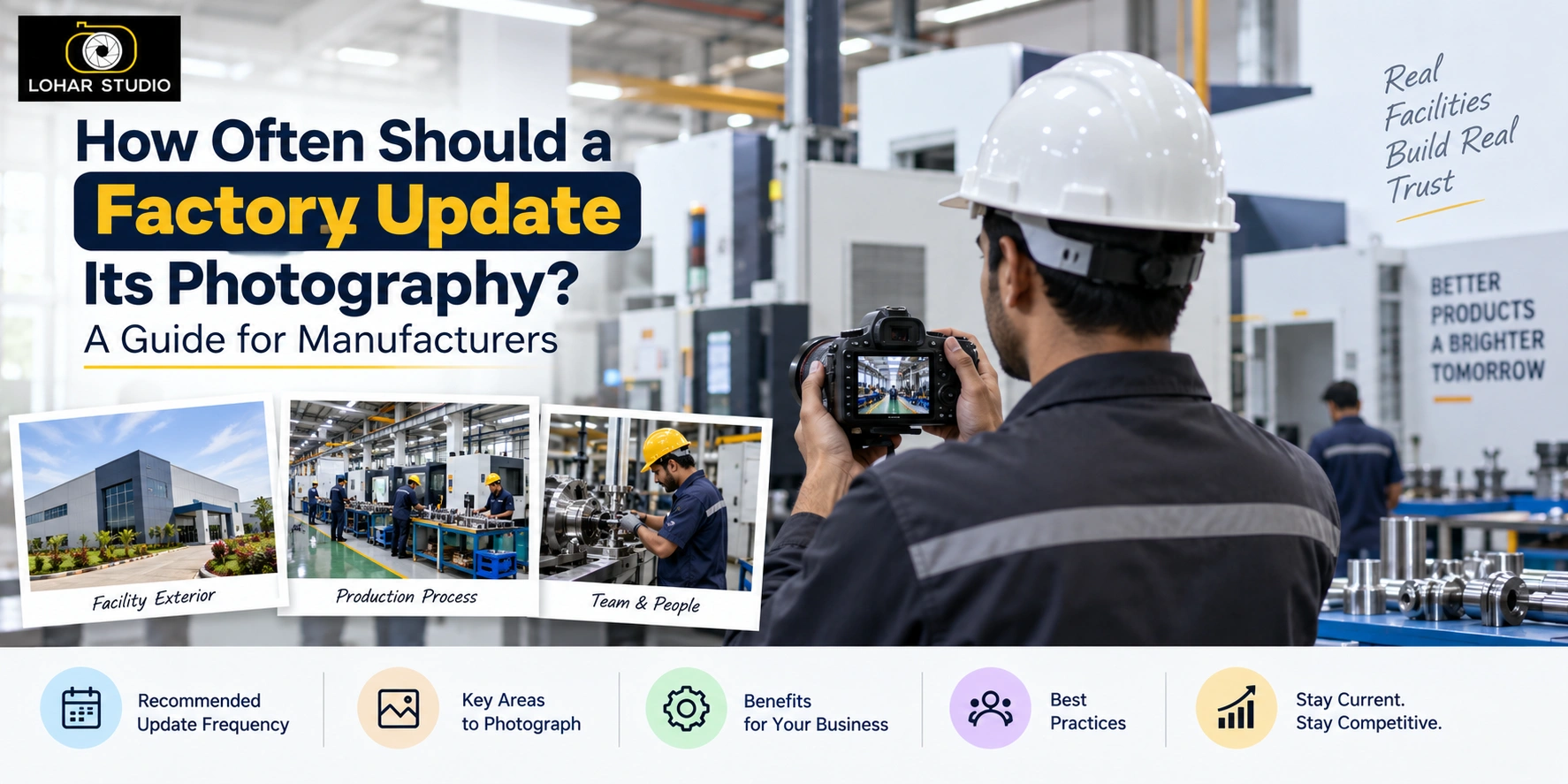
As a general baseline, manufacturers should refresh their factory product photography every 2–3 years. But calendar timing matters less than trigger-based updates — new equipment installations, facility renovations, new certifications, product line changes, or a rebrand should all prompt an immediate photography refresh regardless of when the last shoot happened. Outdated photography is one of the most overlooked credibility risks in B2B manufacturing marketing, since technical buyers evaluating a significant purchase notice mismatched or stale imagery immediately — and it quietly signals that a company hasn't kept pace, even when the actual operation has.
If you're wondering whether it's time to update your factory's visuals, here's how to decide based on more than just the calendar.
Why Photography Age Matters More for Manufacturers Than Most Realize
In B2B manufacturing, photography is doing more work than most companies give it credit for — it's often the first tangible impression a prospective client or buyer forms before any conversation happens. Buyers evaluating a significant capital purchase or a long-term supplier relationship are specifically looking for visual proof of a clean, modern, well-run facility. When that photography is outdated — showing old equipment that's since been replaced, staff attire that's changed, or a facility layout that no longer matches reality — it creates a quiet but real credibility gap.
This matters even more than it might seem, because technical buyers tend to notice generic or dated imagery immediately, and the association runs both ways: if the photography looks outdated or generic, buyers often unconsciously assume the operation itself might be too, even when that's not true at all.
The General Guideline: Every 2–3 Years as a Baseline
For a factory or manufacturing facility with no major operational changes, a 2–3 year refresh cycle is a reasonable baseline. This accounts for:
- Gradual wear and change in the facility's appearance that accumulates even without major renovations
- Shifts in industry visual standards — what looked modern and professional a few years ago can start to feel dated as design and photography trends move on
- The natural need to keep marketing materials, tender documents, and your website looking current rather than visibly aged
That said, this baseline is a starting point, not a rule to follow rigidly — the more important signal is whether something has actually changed on the ground.
Trigger-Based Updates: When You Should Refresh Regardless of Schedule
Several specific events should prompt an immediate photography update, independent of how long it's been since your last shoot:
Industrial Photography in Delhi
Thousands of manufacturing companies across Delhi NCR still use dark, blurry mobile phone images on their websites, brochures, and...
Explore Industrial Photography in DelhiNew equipment or machinery installed. If your process or production line has changed, your photography should reflect that — buyers researching your capability need to see what you actually operate with today, not what you had two or three years ago.
Facility renovation or expansion. A new section, updated flooring, improved safety infrastructure, or an expanded floor plan should all be reflected in updated imagery, since this is often part of what you're trying to communicate to prospective clients.
New certifications or compliance achievements. ISO certifications, safety awards, or other compliance milestones are trust signals buyers actively look for — pairing these with current facility photography reinforces the credibility they're meant to convey.
Product line changes. If you've added, modified, or discontinued product lines, your photography needs to match your current actual offering, not a version of your catalog that's since evolved.
A rebrand or visual identity update. If your company has updated its brand colors, logo, or overall visual identity, existing photography — especially anything showing branded signage or uniforms — needs to be refreshed to stay consistent.
Preparing for a specific tender or major RFP. Before a significant bid or proposal, it's worth confirming your visual materials represent your current best capability, since this is often exactly the moment your photography is doing the most persuasive work.
Visible outdated elements in current photos. Old safety gear standards, visibly dated technology, or staff who are no longer with the company appearing in current marketing materials are all signals it's time for an update, regardless of the calendar.
Signs Your Factory Photography Is Overdue for an Update
- Your website or catalog still shows equipment you no longer use
- Prospective clients or partners have commented on outdated-looking visuals
- Your photography predates a significant facility change, certification, or rebrand
- You're relying partly on stock photography to fill gaps in your actual facility imagery
- It's been more than 2–3 years since your last professional shoot, with no major changes tracked in between
What Happens When Manufacturers Delay Updating Photography
The cost of delaying a photography refresh is rarely obvious in the short term, which is exactly why it tends to get deprioritized. But the impact compounds:
Industrial Photography in Sonipat
Lohar Studio provides professional industrial photography in Sonipat for auto ancillary manufacturers, steel and metal fabrication...
Explore Industrial Photography in Sonipat- Reduced credibility with technical buyers, who are specifically trained to notice inconsistencies between what's shown and what's real
- Weaker tender and RFP submissions, where visual proof of current capability directly supports the written proposal
- A mismatch between actual capability and perceived capability, where a genuinely modern, well-equipped facility is undersold by photography that no longer represents it accurately
- Reliance on generic stock imagery to fill the gap, which technical buyers recognize immediately and which actively undermines trust rather than building it
What a Photography Refresh Should Include
A complete manufacturer photography refresh typically covers:
- Facility and shop floor shots, showing your current layout, cleanliness, and scale
- Equipment and process shots, capturing your actual current machinery and production process in action
- Product hero shots, updated to reflect your current catalog and any new product lines
- Team and operator shots, showing real staff following current safety protocols and PPE standards
- Drone or aerial shots, if relevant, to convey the scale of larger facilities
- Certification and compliance visual proof, where applicable, paired with facility imagery to reinforce trust signals
Building a Photography Update Plan
Rather than treating photography as a one-time project, it's worth building it into your ongoing marketing and operations planning:
- Set a baseline review date — roughly every 2–3 years — to formally assess whether an update is needed
- Track trigger events as they happen — new equipment, certifications, or facility changes — and flag them for photography planning rather than waiting for the baseline review
- Budget photography into major projects — when planning a facility expansion or new equipment installation, build a photography update into that project's budget and timeline from the start
- Keep a shot list on file from your previous shoot, so updates can focus specifically on what's changed rather than needing to plan an entirely new shoot from scratch each time
Common Mistakes Manufacturers Make With Photography Timing
- Treating photography as a one-time expense rather than an ongoing part of maintaining brand credibility
- Waiting until a major tender deadline to realize the photography is outdated, leaving no time for a proper shoot
- Updating product catalog photography while leaving facility and equipment shots untouched, resulting in an inconsistent overall impression
- Filling gaps with stock photography instead of budgeting for an actual facility update, which technical buyers can usually recognize immediately
FAQs

Corporate Headshot Photography
Looking for professional corporate headshot photography in Delhi? You are in the right place. At Lohar Studio, we shoot busin...
Explore Corporate Headshot Photography1. How often should a factory update its photography?
A 2–3 year baseline is reasonable for facilities without major changes, but trigger events — new equipment, certifications, renovations — should prompt an update regardless of timing.
2. What triggers should prompt an immediate photography update?
New equipment installations, facility renovations, new certifications, product line changes, and rebrands are all strong signals that photography needs refreshing right away.
3. Does outdated factory photography really affect buyer trust?
Yes — technical B2B buyers evaluating significant purchases specifically look for current, accurate visual proof of capability, and outdated or generic imagery can undermine that trust even when the actual operation is strong.
4. Should product photography and facility photography be updated on the same schedule?
Ideally yes — updating one while leaving the other outdated creates an inconsistent overall impression across your marketing materials.
5. Is it worth updating photography before a major tender or RFP?
Yes — this is often one of the highest-impact moments for current photography, since visual proof of capability directly supports your written proposal.
6. What should a complete factory photography refresh include?
Industrial & Factory Photography in Bawal
Lohar Studio provides professional industrial photography in Bawal for manufacturers in the HSIIDC Industrial Estate — auto...
Explore Industrial & Factory Photography in BawalFacility and shop floor shots, equipment and process shots, updated product hero shots, current team and operator shots, and certification-related imagery where applicable.
7. Is stock photography an acceptable substitute for outdated factory photos?
Not really — technical buyers often recognize generic stock imagery immediately, and it can undermine credibility rather than support it.
8. How much does industrial photography typically cost?
On-location industrial photography is generally priced as a day rate, often ranging from roughly ₹14,999 to ₹59,999 depending on location, scope, and setup complexity.
9. Does a facility renovation always require new photography?
If the renovation changes what's visible in existing photos — layout, equipment, safety features — then yes, an update is worth planning as part of the renovation project.
10. What's the risk of never updating factory photography?
Over time, a growing gap forms between your actual capability and how it's represented, which can quietly weaken tender submissions, buyer trust, and overall brand credibility.
Time to update your facility's photography?
[Get in touch with Lohar Studio] to plan an on-location shoot around your current equipment, certifications, and facility — pricing is based on scope and location, typically as a day rate.
If you're looking to enhance your brand’s presence on leading e-commerce platforms like Amazon, Flipkart, Myntra, Meesho, TataCliQ, Snapdeal, and Ajio, Lohar Studio is your go-to destination. Our team specializes in delivering high-quality images for fashion items, footwear, automotive products, medical photography, business headshots, and corporate shoots. We serve Delhi, Noida, Gurgaon, Faridabad, and Ghaziabad, offering professional results that boost conversions and elevate your brand’s image. Get in touch today at +91 9312070458 or visit us at A1/58, 1st Floor, Sector 6 Rd, Pocket 1, Sector 6A, Rohini, Delhi, 110085, to schedule your next shoot!

Written from hands-on experience shooting for 4000+ brands - practical, field-tested photography advice, not just theory.