

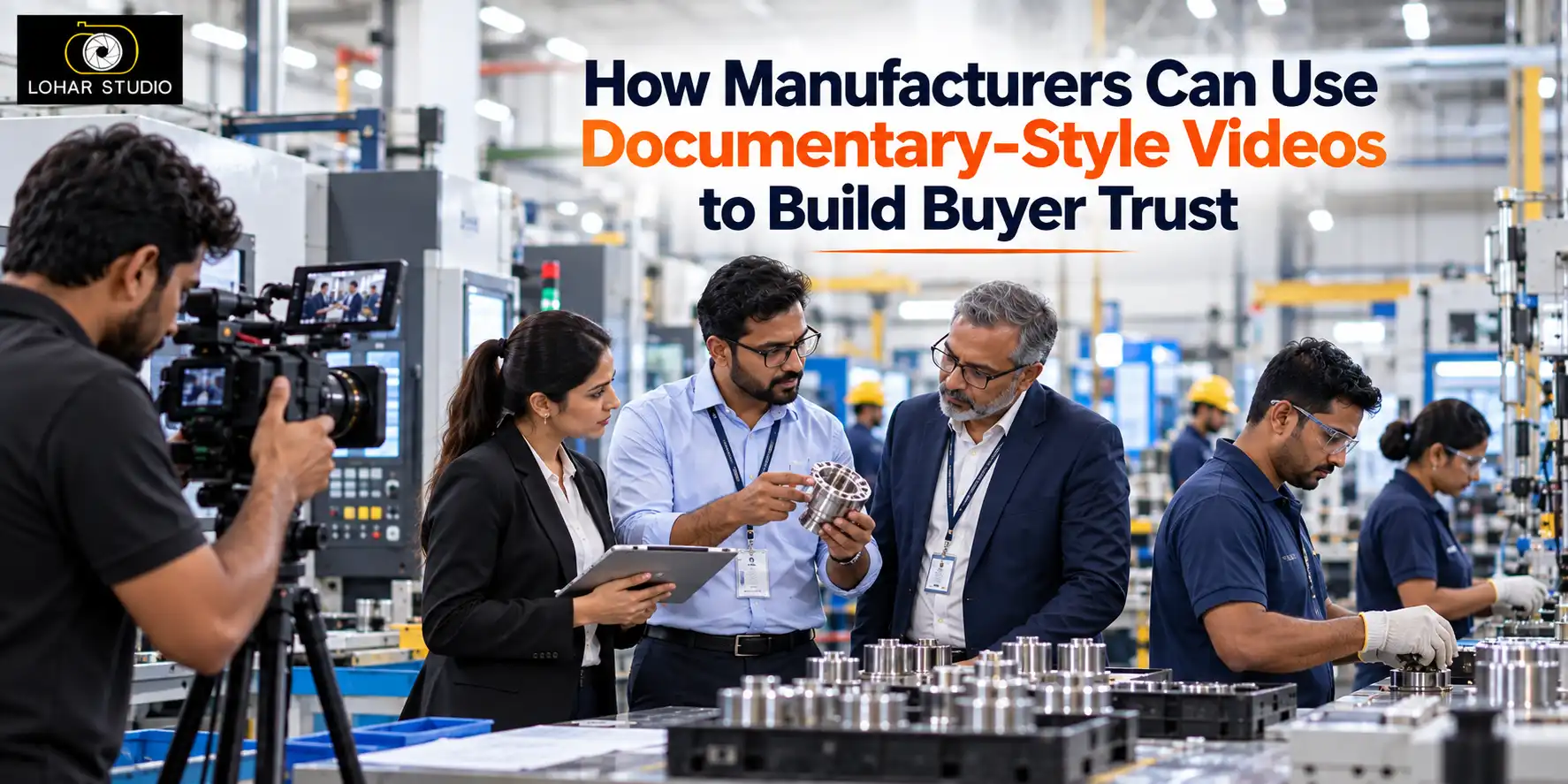
Documentary-style video works for manufacturers because it looks like evidence, not marketing. A raw, unpolished walkthrough of an actual production line — real employees, real machinery, visible imperfections — builds more buyer trust than a heavily produced corporate video with scripted narration and stock music. This matters because most B2B buyers now research independently and form their trust judgment before ever speaking to a salesperson: your video is often doing the job a sales conversation used to do, which is exactly why authenticity now matters more than production polish.
If you're a manufacturer trying to build credibility with buyers who'll never visit your facility in person, here's how documentary-style video does that work for you.
Why Video Is Doing the Job Sales Used to Do
Buyer behavior in industrial and manufacturing sourcing has shifted significantly. The large majority of B2B buyers now watch video specifically to help inform purchase decisions, and most prefer to do independent research before ever reaching out to a salesperson. More than half of industrial buyers report making up their mind before any direct interaction with the manufacturer at all.
This means your video content is often functioning as the first meeting — shaping trust, or doubt, long before your sales team gets a chance to make its case. If that content feels generic, overproduced, or disconnected from what's actually happening on your factory floor, buyers notice immediately, and the trust-building opportunity is lost before a conversation even starts.
What Makes a Video "Documentary-Style" (And Why It's Different)
Documentary-style content is defined by what it isn't as much as what it is. It isn't a scripted corporate video with a professional voiceover and polished background music. It's closer to raw footage — an engineering team mid-discussion, a genuine quality-check moment, a founder walking through how a problem actually gets solved — captured with visible imperfection rather than edited into a flawless narrative.
This distinction matters because buyers have grown skeptical of anything that reads as pure marketing copy. Certifications get repeated across competitor websites in nearly identical language, and polished claims about "ethical sourcing" or "quality commitment" have become easy to say and hard to verify. A genuine walkthrough of an actual production line — shot with real employees and a slightly unpolished feel — reads as evidence rather than assertion, which is precisely the psychological shift that makes this format so effective.
Why Polish Can Actually Hurt Trust
This is the counterintuitive part many manufacturers get wrong: in 2026, an overly polished video can actually work against you. The moment content feels like a commercial — perfect lighting, scripted lines, an obviously staged tour — buyers' guard goes back up, because it stops looking like proof and starts looking like the same marketing material every competitor produces.
Corporate Event Photography in Delhi
A company's website, LinkedIn, and marketing decks often carry outdated or amateur photos long after the office, team, or leadersh...
Explore Corporate Event Photography in DelhiThe format that performs best sits closer to a documentary clip than an advertisement — real production moments, natural conversation, and a "messy middle" that shows the actual process rather than only a clean before-and-after. This doesn't mean video quality doesn't matter at all — poor technical quality (bad audio, shaky, unusable footage) still damages trust — but the content should feel observed rather than performed.
Three Types of Documentary Videos Manufacturers Should Consider
- Process and product-focused documentaries. These take viewers behind the scenes into the actual detail, precision, and expertise involved in production — particularly effective for manufacturing and technical brands that need to justify quality and pricing through visible proof of craftsmanship and process control.
- People and culture-focused documentaries. These focus on the team — workplace environment, shared values, and how the organization actually operates day-to-day — helping buyers (and potential employees) understand what working with or for the company genuinely looks like.
- Customer-success-focused documentaries. These center the buyer's own outcomes, showing how a product or partnership improved a real customer's operations or business performance, which builds credibility precisely because it's grounded in a real, verifiable outcome rather than a generic claim.
Most manufacturers benefit from starting with the process-focused format, since it directly addresses the most common buyer objection — "can I actually trust this company's stated capability?" — before expanding into culture or customer-success content later.
What to Capture in a Documentary-Style Factory Video
- Genuine production line footage, showing your actual current process rather than a staged, cleaned-up version
- Real employees in natural working moments, not posed or scripted for the camera
- Quality control and inspection steps, showing how issues are actually caught and handled, not just claimed
- Specific, credible details — tolerances, certifications, lead times — displayed as on-screen text or graphics rather than narrated, since text overlays let viewers absorb technical specifics without relying entirely on spoken explanation
- Unscripted moments of problem-solving, if possible — an engineering discussion, a founder addressing a real production challenge — since these moments carry more credibility than any scripted equivalent
Where Documentary Video Fits in the Buyer Journey
Documentary-style content isn't just a top-of-funnel awareness tool — it earns its place across the buyer journey:
- Early stage: builds category credibility by showing genuine expertise in motion, rather than simply claiming it in website copy
- Mid-funnel: answers the specific objections a sales deck or spec sheet can't — how something actually gets built, and who's accountable when an issue arises
- Later stage: functions as a trust asset a procurement team can reference during a longer vendor evaluation process, sometimes well after the video was first published
This staged relevance is part of why documentary content tends to outperform typical brand videos over time — it isn't disposable content for a single campaign, but a reusable trust asset that keeps proving its value across multiple buyer touchpoints.
360 Degree Product Photography in Delhi
Lohar Studio offers professional 360 product photography services in Delhi, helping brands and businesses create interactive and i...
Explore 360 Degree Product Photography in DelhiHow to Structure a Manufacturing Trust Video
- Open by naming the buyer's actual problem — the specific challenge your manufacturing capability solves — rather than opening with a generic company introduction
- Show the capability directly — machinery, process, people, and relevant certifications — as visible proof rather than a spoken list of claims
- Let real, natural moments carry the story, rather than scripting every scene into a flawless sequence
- Close with a specific, funnel-appropriate next step, not a generic "contact us" — the right call to action depends on where this video sits in the buyer's decision process
Common Mistakes Manufacturers Make With Video Content
- Over-producing the footage to the point where it reads as a commercial rather than genuine process documentation
- Scripting every moment, removing the natural, unscripted quality that makes documentary-style content credible
- Focusing only on finished products, when buyers specifically want to see how and where something was actually made
- Treating video as a one-time marketing asset rather than a reusable trust resource across the buyer journey
- Ignoring basic technical quality — poor audio or unusable footage still damages trust, even within a documentary approach
Getting the Most Value From One Shoot
A single, well-planned documentary-style shoot can produce far more than one final video:
- Repurpose raw footage into shorter clips for social media, sales enablement material, or retargeting campaigns, rather than letting an unscripted walkthrough or QA session expire as a single social post
- Build a library across visit types — process footage, team moments, customer interactions — that can be recombined into different videos for different buyer stages over time
- Pair video with your existing factory photography (facility, machinery, certifications) so your visual trust-building assets reinforce each other across formats
FAQs
1. What makes a video "documentary-style" versus a standard corporate video?
Documentary-style video prioritizes raw, authentic footage — real employees, natural moments, visible imperfection — over scripted narration and polished production, since this reads as evidence rather than marketing.

Industrial Photography in Delhi
Thousands of manufacturing companies across Delhi NCR still use dark, blurry mobile phone images on their websites, brochures, and...
Explore Industrial Photography in Delhi2. Why does polish sometimes hurt trust in manufacturing videos?
Overly polished content can feel like a commercial rather than proof, and buyers who've grown skeptical of marketing claims often trust a genuine, less-produced walkthrough more than a flawless corporate video.
3. Do B2B buyers actually watch video before contacting a manufacturer?
Yes — most B2B buyers now research independently and watch video content to help inform purchase decisions before ever speaking to a salesperson.
4. What should a manufacturing trust video actually show?
Genuine production line footage, real employees in natural working moments, quality control steps, and specific technical details like tolerances or certifications shown as on-screen text.
5. What types of documentary videos work best for manufacturers?
Process and product-focused documentaries showing craftsmanship and precision, people and culture-focused videos showing team and workplace, and customer-success documentaries showing real buyer outcomes.
6. Where does documentary video fit in the buyer's decision process?
It works across the journey — building early category credibility, answering mid-funnel objections a sales deck can't, and serving as a reference trust asset during later-stage vendor evaluation.
Commercial Photography in Delhi
If your business needs high-quality images that sell, attract clients, or build brand recognition, you need a professional commerc...
Explore Commercial Photography in Delhi7. Can one documentary-style shoot be reused across multiple pieces of content?
Yes — raw footage can be repurposed into shorter clips for social media, sales enablement, and retargeting, extending the value of a single shoot well beyond one final video.
8. Does video quality still matter if the goal is an authentic, unpolished feel?
Yes — while scripted polish can hurt trust, basic technical quality (clear audio, usable footage) still matters, since poor quality itself can signal risk to buyers.
9. How is documentary-style video different from a standard factory tour video?
A standard factory tour with a voiceover script can still feel like an advertisement; true documentary-style content is closer to raw, observed footage without a heavily scripted narrative.
10. Should manufacturers use video instead of factory photography, or alongside it?
Alongside it — video and photography serve complementary roles, and pairing both gives buyers multiple forms of visual proof across different touchpoints in their research process.
Ready to build documentary-style video content for your factory?
[Talk to Lohar Studio] about your production process and buyer objections — we offer both video and photography, and can help you plan a shoot that captures genuine, trust-building footage rather than another generic corporate video.
If you're looking to enhance your brand’s presence on leading e-commerce platforms like Amazon, Flipkart, Myntra, Meesho, TataCliQ, Snapdeal, and Ajio, Lohar Studio is your go-to destination. Our team specializes in delivering high-quality images for fashion items, footwear, automotive products, medical photography, business headshots, and corporate shoots. We serve Delhi, Noida, Gurgaon, Faridabad, and Ghaziabad, offering professional results that boost conversions and elevate your brand’s image. Get in touch today at +91 9312070458 or visit us at A1/58, 1st Floor, Sector 6 Rd, Pocket 1, Sector 6A, Rohini, Delhi, 110085, to schedule your next shoot!

Written from hands-on experience shooting for 4000+ brands - practical, field-tested photography advice, not just theory.