

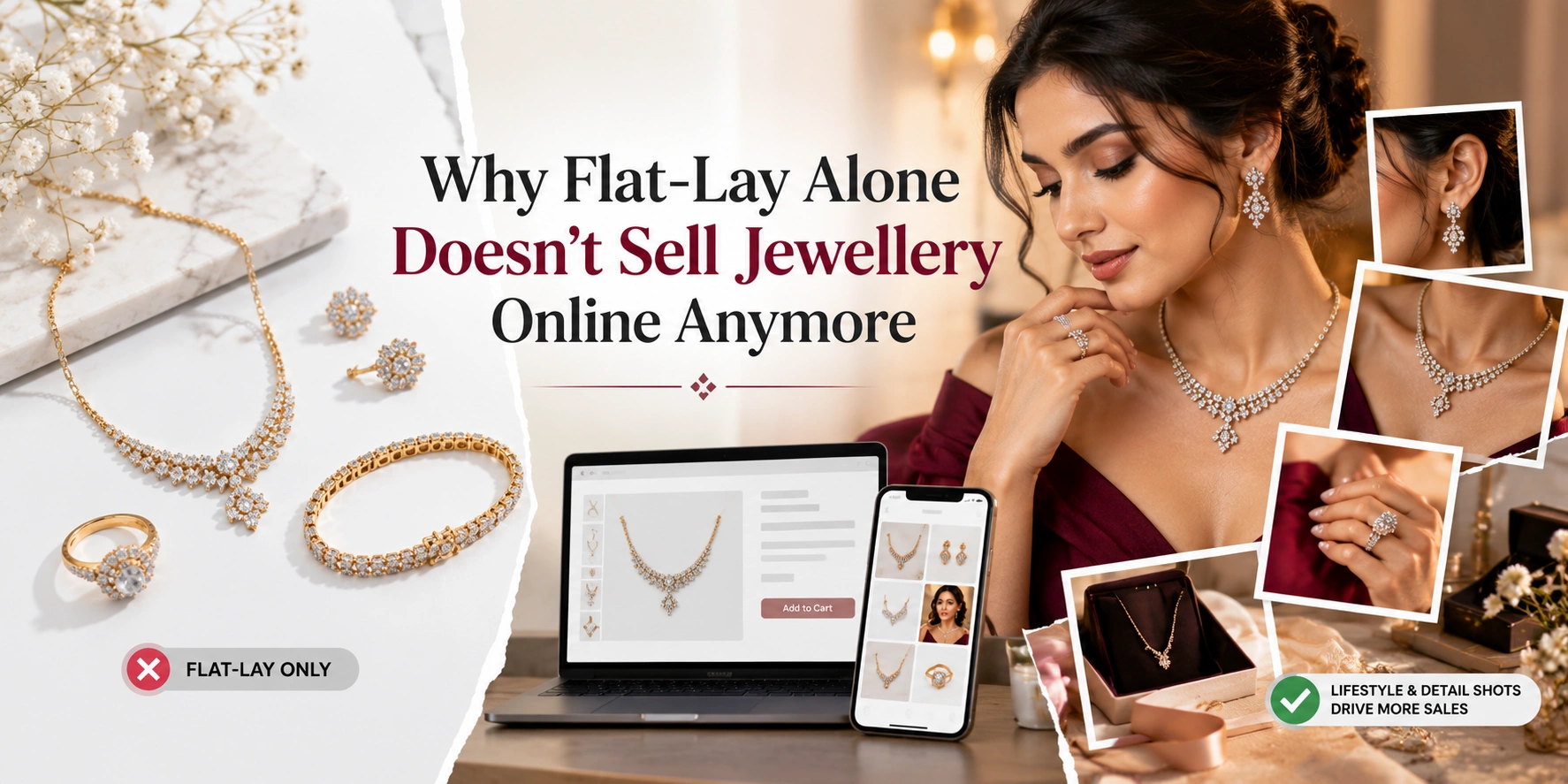
Flat-lay photography alone no longer converts well for jewellery because it can't answer the questions buyers actually have — how big is this ring really, how does this necklace fall against skin, what does the craftsmanship look like up close? A recent industry survey of over 1,000 jewellery ecommerce sellers found that 82% now mix three to five photography styles per listing — combining a clean hero shot, macro detail, and on-model or lifestyle context — because relying on a single flat-lay image consistently underperforms against listings that show scale, drape, and worn context.
If your jewellery catalog still relies on flat lay as the only format, here's exactly why that's likely costing you conversions, and what to add instead.
The Problem With Flat-Lay-Only Jewelry Photography
Flat lay used to be the default for jewellery photography, and for a long time, it was enough — a clean, symmetrical overhead shot on a neutral background. But buyer expectations have shifted, and a single flat-lay image now leaves too many real purchase questions unanswered:
- How big does this ring actually look on a hand?
- How does this necklace drape and sit against skin — does it lie flat or curve naturally?
- What does the craftsmanship look like up close — is the setting clean, is the finish high quality?
- How does the metal or stone catch light in a way that matches what I'd expect in person?
A flat lay, shot from directly above on a static surface, simply can't answer these questions the way a buyer needs — and for a category where the entire purchase decision has to happen through a screen, that gap has become significantly more costly to ecommerce jewellery brands than it used to be.
What Flat Lay Does Well
To be fair, flat lay isn't obsolete — it still plays an important role in a complete jewellery image set. It offers:
- Clean, consistent symmetry, which works especially well for pieces where design detail and shape are the primary selling point
- Cost efficiency, since it doesn't require model booking or additional styling
- A strong hero image, particularly for pendant, ring, or earring pieces where an overhead angle shows the design clearly
The issue isn't that flat lay is a bad format — it's that using it as the only format is what's actually losing sales.
Why Flat-Lay Alone Falls Short for Jewelry Specifically
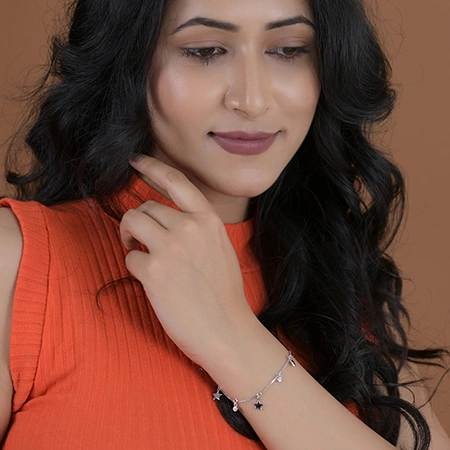
Jewellery Model Photography
Lohar Studio provides professional jewellery model photography — jewellery shot worn on a live model, not flat-lay or produc...
Explore Jewellery Model PhotographyNo scale reference. A ring photographed alone on a flat surface gives no real sense of size. Without a hand, a coin, or another familiar reference point, buyers are left guessing — and uncertainty about size is one of the most common reasons for hesitation and returns in jewellery ecommerce.
No drape or fall demonstration. Necklaces and bracelets are designed to move with the body. A necklace laid flat looks lifeless and doesn't show how it actually curves and falls when worn — information that matters directly to the buying decision.
Missing craftsmanship detail. Fine jewellery buyers often evaluate quality closely — setting precision, finish, stone clarity — details a standard flat-lay shot, taken from a consistent overhead distance, typically doesn't capture at the resolution needed to build trust.
No worn context for style and fit. Buyers often want to picture how a piece looks against skin tone, alongside an outfit, or in everyday wear—something a flat lay, by definition, cannot show.
What Today's Best-Converting Jewelry Listings Actually Include
Industry data reflects this shift clearly: the same 1,000+ seller survey found that the large majority of jewellery sellers have moved to a mixed image strategy, typically combining a white-background hero shot, macro close-up detail, and either an on-model or styled lifestyle shot within the same listing — rather than relying on any single format alone. This isn't a stylistic trend so much as a direct response to what actually converts: buyers responding to detailed, multi-angle proof of quality and scale over a single static image, however clean.
The Five Images Every Jewelry Listing Needs
- A clean hero shot — typically white background, showing the piece clearly and consistently, serving as your primary marketplace listing image
- A macro detail shot — close enough to show setting quality, stone clarity, engraving, or fine metalwork that builds trust in craftsmanship
- A clasp or finish detail shot — particularly important for necklaces and bracelets, where buyers want reassurance about build quality and durability
- An on-model or in-hand scale shot — giving a real, relatable sense of size against a hand, wrist, ear, or neck
- A styled lifestyle image — showing the piece in a natural, wearable context, helping the buyer picture it as part of their own look
Together, these five shots directly answer the questions a single flat-lay image leaves open — size, drape, quality, and styling context — which is exactly why listings built around this mix consistently outperform flat-lay-only catalogs.
Category-Specific Considerations
Rings need an in-hand or finger scale shot more than almost any other category, since ring sizing uncertainty is one of the most common causes of jewellery returns.
Jewellery Photography for Flipkart
At Lohar Studio, we specialize in jewellery photography for Flipkart, helping sellers showcase gold, diamond, silver, and fashion...
Explore Jewellery Photography for FlipkartNecklaces benefit most from an on-model neck shot showing drape and length — a flat-laid chain simply can't demonstrate how it falls and sits once worn.
Earrings need to be shown both laid flat for symmetry and worn on a model or hung naturally, to show their actual drop and movement — a detail that a flat overhead shot alone misrepresents.
Bracelets and bangles benefit from an in-hand or wrist shot showing fit and how multiple pieces (if stacked or layered) sit together.
Why Buyers Hesitate Without These Additional Shots
Jewellery is a category where buyers can't touch, hold, or try on the product before purchasing — their entire confidence in the purchase comes from the visual information provided. When that information is limited to a single flat-lay angle, buyers are left to fill in the gaps around size, quality, and fit themselves, which tends to increase hesitation, abandoned carts, and post-purchase returns when the product doesn't match what they'd imagined.
How Often Should You Refresh Your Jewelry Photography
Nearly half of jewellery sellers surveyed refresh their product images at least once a quarter to keep conversion rates from declining over time — a signal that jewellery photography isn't a one-time investment but an ongoing part of maintaining listing performance, particularly as buyer expectations around image detail continue to rise.
Common Jewelry Photography Mistakes Beyond Flat Lay
- Using only one flat-lay angle per SKU, with no macro or scale shot included
- Inconsistent lighting between the hero shot and detail shots, making the listing feel disjointed
- Skipping an on-model or in-hand shot specifically for rings, where sizing uncertainty is highest
- Over-editing stones or metal to look brighter or larger than the actual product, which increases returns when the item arrives looking different from the photos
What to Ask Your Studio For
- A complete image set per SKU — hero, macro detail, and on-model or scale shot — rather than a single flat-lay image
- Category-specific formats: in-hand shots for rings, on-model neck shots for necklaces, worn or hung shots for earrings
- Consistent lighting and color accuracy across the full image set, so metal and stone tones don't shift between shots
- A realistic, accurate representation of the product, avoiding over-editing that could increase returns
FAQs
Jewellery Photography for Amazon
At Lohar Studio, we specialize in jewellery photography for Amazon, helping sellers showcase gold, diamond, silver, and fashion je...
Explore Jewellery Photography for Amazon1. Why doesn't flat-lay photography work well for jewellery anymore?
Because it can't show scale, drape, or worn context — information buyers increasingly expect before making a jewellery purchase online.
2. What images should a jewellery listing include besides a flat lay?
A macro detail shot, an on-model or in-hand scale shot, and a styled lifestyle image, in addition to a clean hero shot.
3. Why is a scale reference important for ring photography specifically?
Size uncertainty is one of the most common reasons for jewellery returns, and an in-hand shot gives buyers a realistic sense of how the ring actually looks worn.
4. Do necklaces need on-model photography?
Yes — a necklace laid flat doesn't show how it drapes and falls when worn, which is important information for the buying decision.
5. How many photography styles do most successful jewellery sellers use per listing?
Industry data shows the majority of sellers now use three to five photography styles per listing, combining hero, macro, and on-model or lifestyle shots.
6. Is flat lay photography still useful for jewellery at all?
Jewellery Photography in Delhi
Lohar Studio provides professional jewellery photography in Delhi for gold jewellery brands, diamond jewellers, silver jewellery e...
Explore Jewellery Photography in DelhiYes — it remains a strong choice for the primary hero image and for showing design symmetry, but it works best as one part of a complete image set, not the only format.
7. How often should jewellery product photos be updated?
Many sellers refresh their images at least quarterly, since keeping photography current is linked to maintaining conversion rates over time.
8. Does over-editing jewellery photos increase returns?
Yes — making a stone or metal appear larger or brighter than reality often leads to disappointment and returns when the actual product doesn't match expectations.
9. What's the biggest photography gap for earrings specifically?
Earrings are often only shown flat for symmetry, missing their natural drop and movement, which a worn or hung shot demonstrates more accurately.
10. Can better jewellery photography reduce return rates?
Yes — providing accurate scale, detail, and worn-context images helps set correct buyer expectations, which is directly linked to fewer size- and quality-related returns.
Ready to build a complete image set for your jewellery catalog?
[Talk to Lohar Studio] about moving beyond flat lay — we'll help you plan the hero, macro, and on-model shots your listings actually need to convert.
If you're looking to enhance your brand’s presence on leading e-commerce platforms like Amazon, Flipkart, Myntra, Meesho, TataCliQ, Snapdeal, and Ajio, Lohar Studio is your go-to destination. Our team specializes in delivering high-quality images for fashion items, footwear, automotive products, medical photography, business headshots, and corporate shoots. We serve Delhi, Noida, Gurgaon, Faridabad, and Ghaziabad, offering professional results that boost conversions and elevate your brand’s image. Get in touch today at +91 9312070458 or visit us at A1/58, 1st Floor, Sector 6 Rd, Pocket 1, Sector 6A, Rohini, Delhi, 110085, to schedule your next shoot!

Written from hands-on experience shooting for 4000+ brands - practical, field-tested photography advice, not just theory.