


Quick Answer: Heavily embroidered and zari-work lehengas are one of the most technically demanding categories in product photography — metallic threads reflect light unpredictably, and dense embellishment creates depth that flattens under standard lighting. Gold/silver tones are notoriously difficult to reproduce accurately. Getting these shoots right requires diffused, angled lighting to control reflections, careful exposure to preserve both fabric texture and embroidery details, and a format strategy (white background, ghost mannequin, catalogue, or lifestyle) matched to each piece's specific needs. For premium lehenga brands, this isn't a nice-to-have — it's the difference between images that do justice to genuine craftsmanship and images that flatten it into a generic sparkle.
If you're a premium lehenga seller in Delhi or nearby, here's exactly why this category is harder to shoot than standard apparel, and what to look for in a studio that can actually handle it.
Why Zari and Heavy Embroidery Are the Hardest Fabric Type to Photograph
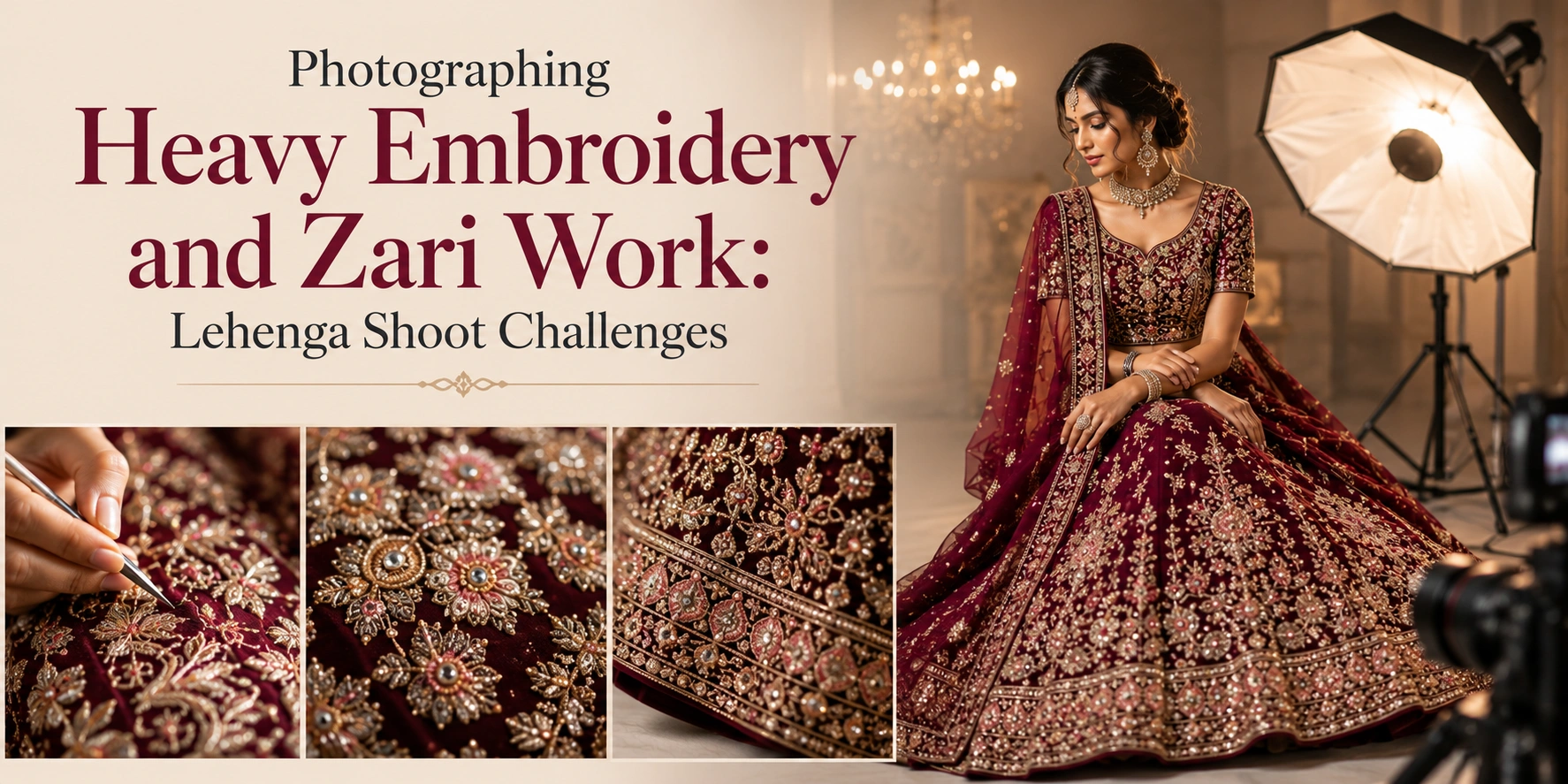
Most apparel photography challenges come down to color and fit. Heavy embroidery and zari work add a third, much harder problem: reflectivity combined with dimensional texture. Metallic threads — whether real zari, zardozi with gold or silver wire, or dabka's coiled metallic thread — don't behave like fabric under lighting. They behave more like small, irregular mirrors, each catching and bouncing light at a different angle depending on the stitch direction and the embellishment's shape.
This creates two conflicting problems at once: light strong enough to show the embroidery's raised, dimensional quality often creates harsh, distracting glare on the metallic threads, while light soft enough to avoid glare can flatten the embroidery until it loses its dimensional richness entirely. Getting both right — sparkle without glare, dimension without harshness — is what separates a studio that understands this category from one that's simply pointing a standard lighting setup at an unusually shiny fabric.
Understanding What You're Actually Shooting
Not all embellishment behaves the same way under a lens, which is why a studio genuinely experienced in this category thinks about technique before lighting setup, not the other way around.
- Zardozi — dense, raised embroidery using gold or silver metallic threads, wire, sequins, and beads, typically on heavier fabrics like silk or velvet. Its raised, three-dimensional quality means lighting needs to reveal depth without letting the metallic elements blow out into pure white highlights.
- Gota work — flattened metallic ribbon woven into trims and motifs. Because it sits more on the surface than zardozi's built-up texture, it reflects more evenly but can still catch harsh directional light as a hard glare line.
- Dabka and sitara work — coiled wire thread and sequins that create a scattered, glittering effect. These need lighting that reads as sparkle rather than a blown-out cluster of white highlights.
- Mina work — enamel-style gold embroidery, often used in combination with other zari techniques, requiring careful attention to color temperature to keep the gold tone accurate rather than shifting warm or cool under different lights.
Recognizing which technique — or combination — is on a given piece changes the lighting approach before the shoot even starts. This is exactly the kind of judgment call that separates a studio comfortable with standard apparel from one that specializes in heavily embellished ethnic wear.

The Core Lighting Challenge: Controlling Metallic Reflection Without Losing Detail
The standard fix for reflective materials — soft, diffused lighting — is necessary but not sufficient here. A few techniques matter specifically for zari and heavy embroidery work:
Bridal Lehenga Photoshoot Services
Lohar Studio provides professional lehenga photography in Delhi for bridal boutiques, ethnic fashion brands, e-commerce sellers, w...
Explore Bridal Lehenga Photoshoot ServicesAngled, cross-directional lighting helps reveal the raised, dimensional quality of embroidery rather than flattening it with a single frontal light source. Light coming from the side catches the texture and shadow of raised threadwork the way it would be seen in person.
Diffusion without losing shimmer. The goal isn't to eliminate reflection — a lehenga's shimmer is part of its appeal and part of what a buyer is paying for. The goal is controlling where that reflection appears, so it reads as intentional sparkle rather than a distracting hotspot that obscures the embroidery pattern underneath it.
Multiple exposure checks across the same piece. Because embellishment density often varies across a single lehenga — heavier at the border, lighter through the body — a single exposure setting rarely serves the whole piece equally well. Experienced studios check exposure across different embellishment zones, not just the overall frame.
Polarizing techniques to manage glare on the most reflective elements, particularly on pieces combining metallic thread with sequins or mirror work, where uncontrolled glare is most likely to obscure fine detail.

White Background Shoots for Heavy Embroidery Lehengas
For marketplace listings and primary catalogue images, a clean white background is usually mandatory — but it's also where reflection control matters most, since there's no styled environment to distract from an exposure mistake. The lighting setup needs to isolate the garment cleanly while still preserving embroidery detail at the resolution buyers will zoom into, particularly for high-value pieces where shoppers expect to inspect craftsmanship closely before purchasing.
Creative and Lifestyle Shoots for Embellished Lehengas
Beyond the standard catalogue image, premium lehenga brands typically need styled, aspirational imagery — on a model, in a considered setting — that communicates occasion-wear appeal rather than just product specification. This is where lighting decisions get more creative: warmer, more directional lighting can enhance the richness of gold zari work in a way that feels intentional and editorial, as long as color accuracy for the actual product page image is still handled separately. Mixing formats — a true-to-fabric hero shot for the listing, alongside a more atmospheric lifestyle shot for campaigns and social content — is standard practice for brands that want both accurate representation and aspirational appeal.
Catalogue Photography for Embroidery-Heavy Collections
For a full seasonal collection, the challenge shifts from getting one piece right to keeping an entire embellished catalogue visually consistent. Since embellishment density, metallic tone, and fabric type can vary significantly piece to piece, a studio needs a repeatable lighting process that adapts consistently across dozens of pieces — not a setup that has to be substantially reworked for every single garment. This is where studio experience specifically with heavy embroidery categories shows: a process built for standard apparel often breaks down when applied uniformly across a zardozi-heavy collection.
Fashion / Model Photography for Flipkart
Lohar Studio provides professional Flipkart fashion & model photography for sellers and brands listing on Flipkart India. If y...
Explore Fashion / Model Photography for Flipkart
Ghost Mannequin for Zari and Zardozi Work
Ghost mannequin photography — showing a garment's true shape without a visible model — is more difficult with heavily embellished pieces than with standard apparel, for a specific reason: dense embroidery and embellishment often add real physical weight and stiffness to the fabric, which changes how it drapes and holds shape compared to lighter garments. A mannequin setup needs to account for this, since a lehenga skirt heavy with zardozi work won't fall the same way a plain fabric skirt would.
This is also where compositing detail matters most — interior necklines, blouse closures, and embellished borders often need to be captured and composited back in with more care than a simpler garment would require, since these details are exactly what a premium buyer is evaluating closely.
Color Accuracy for Gold and Metallic Tones
Gold and silver tones are among the hardest colors to reproduce accurately in photography, since even small shifts in white balance or exposure can make a warm antique-gold zari read as a flat, generic yellow — or make silver zari pick up an unwanted color cast from the surrounding studio environment. For a premium lehenga brand, this isn't a minor detail: metallic tone accuracy is often central to how a buyer perceives whether a piece uses genuine zari versus a cheaper imitation, and inaccurate color representation can directly undercut a premium positioning.
Common Mistakes Studios Make With Heavy Embroidery Shoots
- Using standard apparel lighting setups without adjusting for metallic reflection, resulting in blown-out highlights that obscure embroidery detail
- Over-diffusing to the point where the embellishment's dimensional texture and shimmer are lost entirely
- Inconsistent color temperature across a catalogue, making gold tones shift noticeably from piece to piece
- Treating ghost mannequin the same way for heavy and light garments, without accounting for how embellishment weight changes drape
- Rushing exposure decisions on a single overall reading, missing detail loss in the most heavily embellished zones of the garment
What Premium Lehenga Brands Should Look for in a Studio
- A portfolio that specifically includes heavily embellished ethnic wear — not just general apparel or western wear
- A clear understanding of the difference between zardozi, gota, dabka, and mina work, and how each affects lighting decisions
- Experience across multiple formats (white background, ghost mannequin, styled lifestyle, and full catalogue consistency), since premium collections rarely need just one
- A process for maintaining color and lighting consistency across a full collection, not just strong single-piece results
Why This Matters for Premium Lehenga Sellers in Delhi
Delhi and the surrounding NCR region remain one of India's strongest hubs for premium and bridal lehenga craftsmanship, with deep access to zardozi and zari artisans. For brands built on this level of craftsmanship, photography that flattens or misrepresents that detail directly undercuts the investment made in the embroidery itself — a buyer evaluating a premium, heavily embellished piece is often comparing photographs zoomed in closely, and inaccurate or flattened detail reads as a lower-quality product, regardless of the actual craftsmanship underneath.
Fashion and Model Photoshoot for Amazon
Lohar Studio provides professional Amazon fashion & model photography specifically for sellers listing on Amazon India. If you...
Explore Fashion and Model Photoshoot for AmazonFAQs
1. Why is photographing zari and zardozi work harder than standard apparel photography?
Metallic threads and dense embellishment reflect light unpredictably and add dimensional texture, requiring careful angled lighting to avoid both harsh glare and flattened detail — challenges standard apparel lighting setups aren't built to handle.
2. What lighting technique works best for heavily embroidered lehengas?
Diffused, cross-directional lighting that reveals texture and controls reflection without eliminating the fabric's natural shimmer is the standard professional approach.
3. Is ghost mannequin photography suitable for heavy zardozi lehengas?
It can work, but heavy embellishment adds real weight that changes how the fabric drapes, so it requires more careful handling and compositing than lighter garments.
4. Why does gold zari sometimes look dull or flat in photos?
Inaccurate white balance or exposure can flatten metallic tone, making genuine zari read as a generic yellow — precise color calibration during the shoot is essential to avoid this.
5. Should heavily embellished lehengas be shot differently for white background versus lifestyle images?
Yes — white background shots prioritize accurate, true-to-fabric representation for listings, while lifestyle shots can use warmer, more directional lighting for aspirational appeal, provided a true-color image is also captured separately.
Fashion and Model Photography for Myntra
Lohar Studio provides professional Myntra fashion & model photography for apparel brands, private labels, and sellers listing...
Explore Fashion and Model Photography for Myntra6. How do studios keep color consistent across a full embroidered collection?
Through a repeatable, calibrated lighting process adapted consistently across pieces — rather than rebuilding the setup individually for each garment, which risks inconsistent color and exposure across the catalogue.
7. Does the type of embellishment (zardozi vs. gota vs. dabka) change the photography approach?
Yes — each reflects and catches light differently, so recognizing the specific technique before shooting helps determine the right lighting angle and exposure approach.
8. Why do detail shots matter so much for premium embroidered lehengas?
Premium buyers often zoom into images to evaluate craftsmanship closely, so losing fine embroidery detail in photography can misrepresent the quality of genuine handwork.
9. Can heavy embroidery be shot well without professional studio lighting?
It's genuinely difficult — the reflectivity and texture involved typically require controlled, adjustable lighting that basic setups aren't built to manage without significant trial and error.
10. What should a premium lehenga brand check before booking a studio for an embroidery-heavy shoot?
Ask specifically to see their portfolio with heavily embellished ethnic wear, not just general apparel, and confirm their experience across the formats you need — white background, ghost mannequin, catalogue, and lifestyle.
Shooting a premium, heavily embellished lehenga collection?
[Talk to Lohar Studio] about your collection's specific embroidery and embellishment work — we'll walk you through how we approach lighting, format mix, and color accuracy for zari and zardozi-heavy pieces, whether you're based in Delhi or nearby NCR.
If you're looking to enhance your brand’s presence on leading e-commerce platforms like Amazon, Flipkart, Myntra, Meesho, TataCliQ, Snapdeal, and Ajio, Lohar Studio is your go-to destination. Our team specializes in delivering high-quality images for fashion items, footwear, automotive products, medical photography, business headshots, and corporate shoots. We serve Delhi, Noida, Gurgaon, Faridabad, and Ghaziabad, offering professional results that boost conversions and elevate your brand’s image. Get in touch today at +91 9312070458 or visit us at A1/58, 1st Floor, Sector 6 Rd, Pocket 1, Sector 6A, Rohini, Delhi, 110085, to schedule your next shoot!
Written from hands-on experience shooting for 4000+ brands - practical, field-tested photography advice, not just theory.