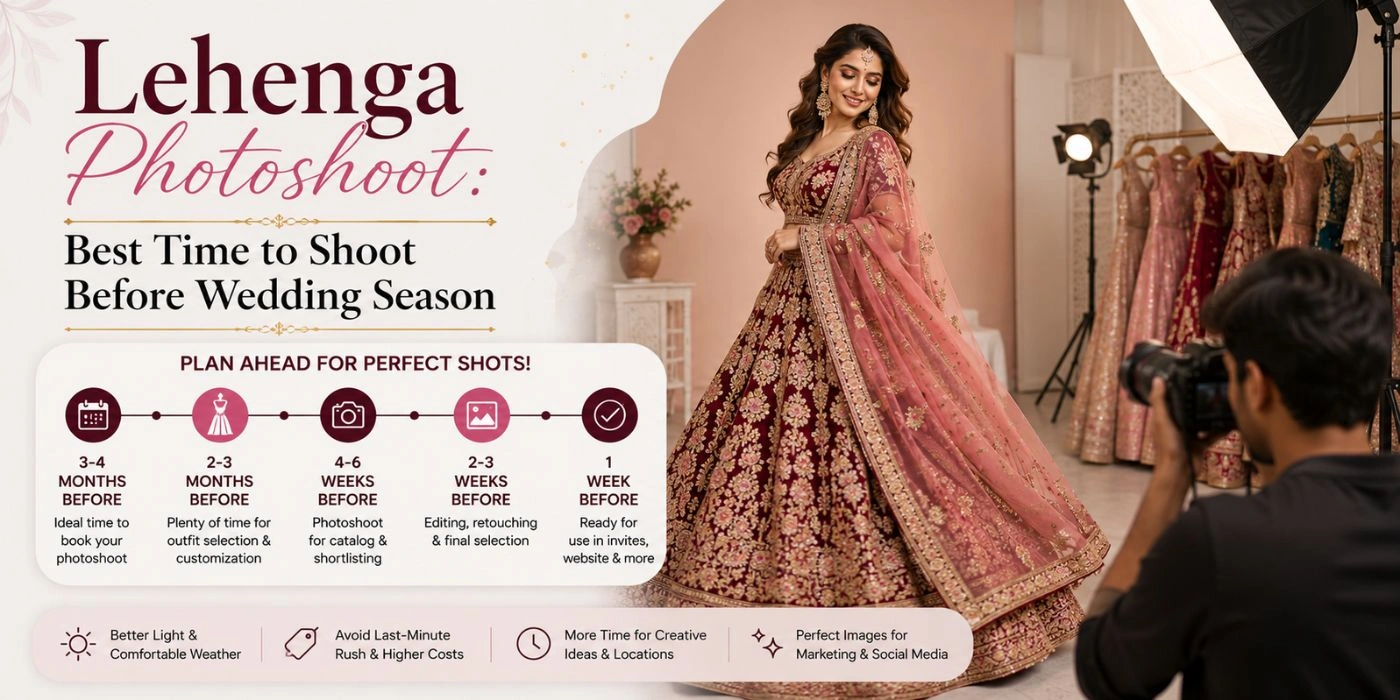



If you've already worked out your shoot timeline — see our guide on planning a lehenga photoshoot before wedding season — the next problem is harder to solve with a calendar. A lehenga is one of the most technically demanding garments to photograph well: it's heavy, layered, often heavily embellished, and most of what makes it valuable — the embroidery, the drape, the way the skirt moves — is exactly what a flat, static product photo struggles to show.
This guide covers the technical side: lighting, draping, embroidery details, movement shots, and posing, so your lehenga listings show what buyers are actually paying for rather than a stiff, catalogue-flat version.
Lighting Setup for Lehenga Photography
Lehengas are usually shot in rich, warm tones — maroon, gold, deep red, wine — and generic lighting flattens exactly the colours that make these pieces sell. A few things matter more here than in most garment photography:
- A four-light softbox setup covering the front, back, and sides, plus a dedicated detail light, provides even coverage across a garment this large without losing edge definition.
- Colour-calibrate for warm tones. Maroon and gold shift easily under the wrong colour temperature — lock white balance with a grey card before the session rather than correcting by eye afterward.
- Silk behaves differently to cotton or georgette. Silk has a natural sheen that reflects light in a way that photographs beautifully when lit correctly, but turns into blown-out hot spots under direct, undiffused light. Diffuse heavily, and angle lights to catch the sheen rather than fight it.
- Neutral backdrops let the lehenga's colour carry the frame — busy or warm-toned backgrounds compete with the garment instead of supporting it.
Capturing Embroidery Detail Without Losing the Bigger Picture
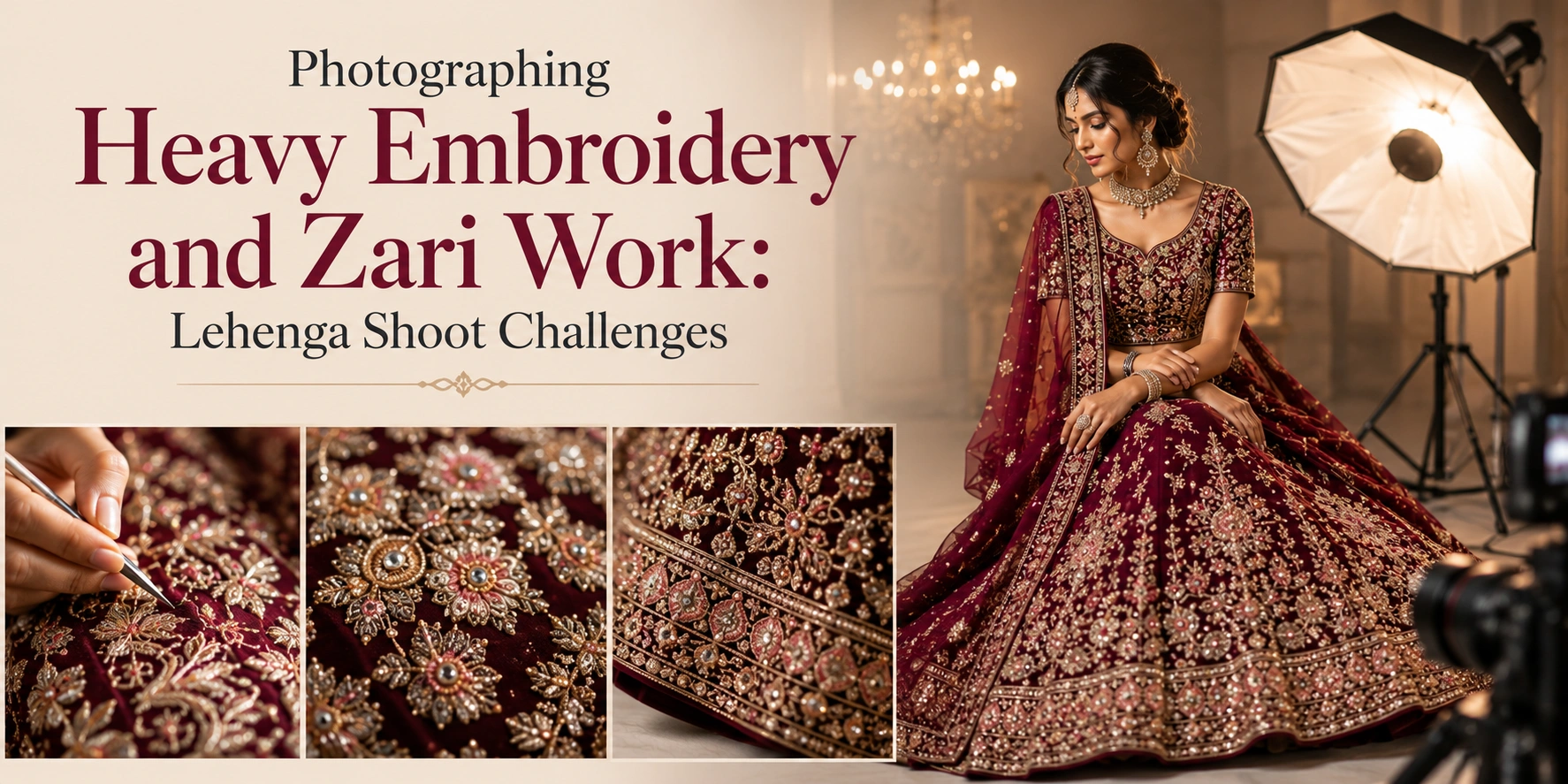
Embroidery, zari, and handwork are often the actual reason a buyer chooses one lehenga over another — and they're consistently the first thing lost in a wide, full-body shot. A complete lehenga shot list needs both:
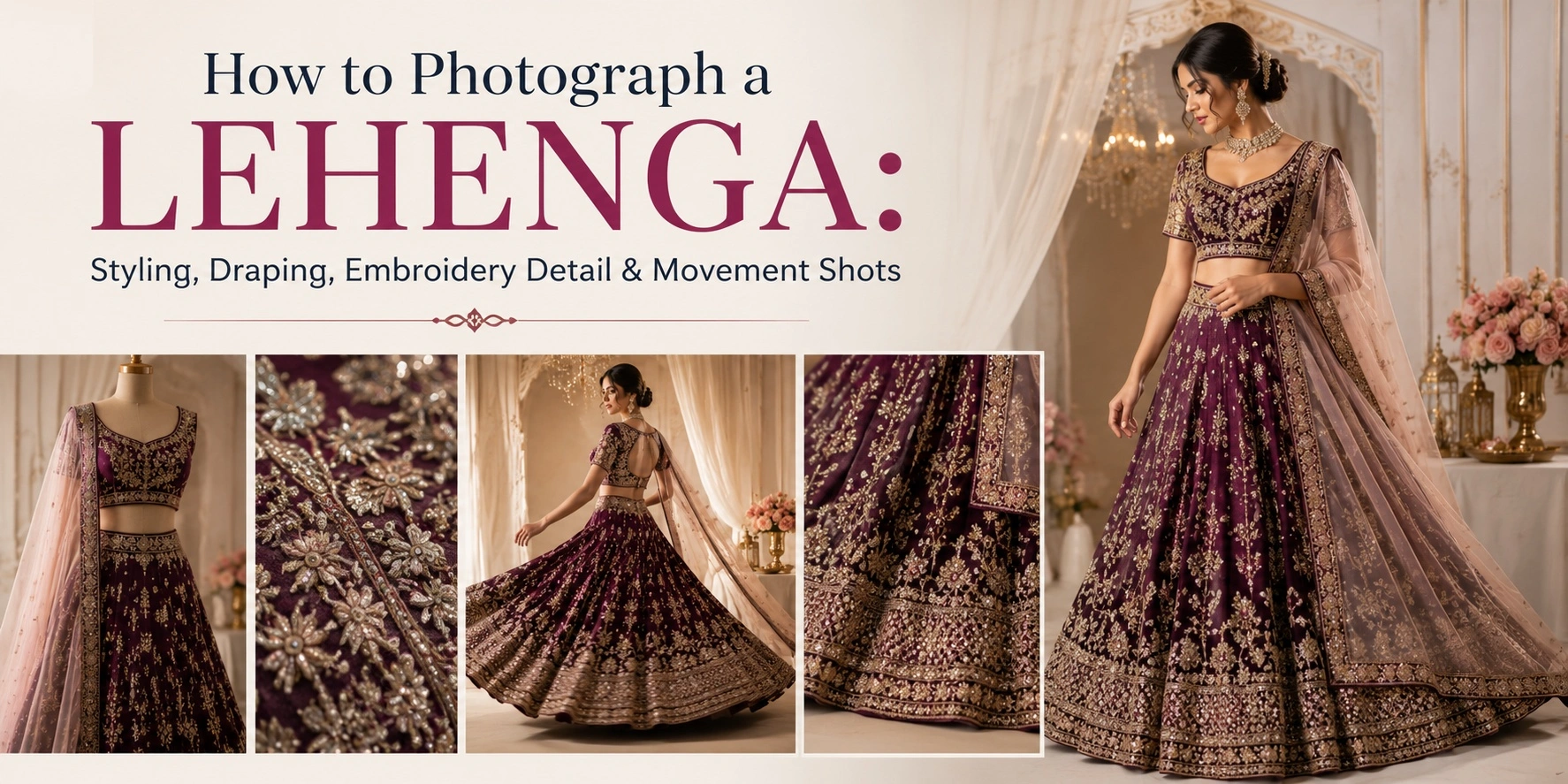
- Full-length hero shots that show the silhouette, colour, and overall design.
- Dedicated macro detail shots of embroidery, borders, and handwork — shot close enough that thread work, stone-setting, and fabric texture are actually visible, not implied.
Check embroidery and fabric for loose threads or snags before shooting — crease-free, defect-free garments photograph cleaner and cut down retouching time significantly, which matters more on a heavily worked lehenga than almost any other garment category.

Draping and Dupatta Styling for Photos
Bridal Lehenga Photoshoot Services
Lohar Studio provides professional lehenga photography in Delhi for bridal boutiques, ethnic fashion brands, e-commerce sellers, w...
Explore Bridal Lehenga Photoshoot ServicesThe dupatta is usually where a lehenga shoot succeeds or falls flat. A few things to get right:
- Position the dupatta to show its embroidered border clearly — draped carelessly, the most detailed part of the fabric ends up hidden in a fold.
- Give it a gentle lift rather than laying it flat. A dupatta with a small amount of movement — a light breeze from a fan, or a toss caught mid-motion — reads as natural and elegant. Laid completely flat, it looks staged and lifeless.
- Try more than one drape style per SKU where budget allows — over-the-shoulder and front-pleated drapes show the same dupatta differently, and different buyers respond to different styling.
Movement and Twirl Shots That Don't Look Staged
A twirl or spin shot shows off a lehenga's volume and flare in a way a static standing shot can't — this is one of the highest-converting shot types for lehenga listings specifically, because it's the closest an image can get to showing how the garment will actually move when worn.
To get it right without it looking forced:
- Shoot in continuous burst mode through the motion, not a single timed frame — the right moment is usually a fraction of a second into or out of the spin, not at its peak.
- A slightly faster shutter speed freezes the movement crisply; too slow and the skirt blurs in a way that reads as a mistake rather than intentional motion.
- A small fan providing consistent airflow gives the dupatta and lower layers of the skirt gentle, repeatable movement between takes, rather than relying on the model tossing it each time.
Posing for a Lehenga's Silhouette
Because a lehenga's value is largely in its volume and layering, posing matters more here than for flatter garments:
- A seated pose with the skirt spread out — sitting on the floor or a low seat and fanning the lehenga around — shows the full flare and detailing in one frame, something a standing shot can't capture as completely.
- Three-quarter standing angles show the silhouette and drape better than a straight-on frontal shot, which tends to flatten the garment's shape.
- Accessory and hair placement matter to the frame — jewellery, hairstyle, and dupatta position all affect how balanced the final image looks, and are worth directing before the shoot, not adjusting between every frame.

Fashion and Model Photoshoot for Amazon
Lohar Studio provides professional Amazon fashion & model photography specifically for sellers listing on Amazon India. If you...
Explore Fashion and Model Photoshoot for AmazonOn-Model, Ghost Mannequin, or Flat Lay for a Lehenga Catalogue?
Unlike simpler garments, this decision has a real quality trade-off for lehengas specifically:
- On-model is close to essential for lehengas — it's the only format that shows drape, movement, and how multiple layers (skirt, blouse, dupatta) work together as an outfit. Worth the added cost for hero pieces and bridal-focused SKUs.
- Ghost mannequin gives a consistent, marketplace-standard look for bulk catalogues, but flattens the sense of volume that makes a lehenga's skirt distinctive — better suited to simpler, less voluminous pieces.
- Flat lay works for budget or fast-turnaround catalogues but loses the most information of the three — generally the weakest choice for anything bridal or heavily embellished.
Shooting Heavily Embellished vs Simpler Lehengas Differently
A bridal piece loaded with zari, stones, and dense embroidery needs more time per SKU: more detail shots, more careful lighting to avoid glare off metallic thread and stone work, and more retouching for stray threads or reflections. A simpler georgette or cotton lehenga with light embroidery can move through a shot list faster, with fewer macro shots needed and less risk of blown-out highlights from metallic work. Planning shot counts and time per SKU around embellishment level — rather than treating every lehenga the same — keeps a bulk shoot on schedule without shortchanging the pieces that need the extra attention.
How Many Angles Does a Lehenga Listing Need?
At minimum: one full-length front hero shot, one back shot (dupatta and blouse back detail matter as much as the front on a lehenga), one three-quarter angle, one macro embroidery/detail shot, and — where budget allows — one movement/twirl shot. Bridal or premium SKUs benefit from a seated spread shot as well. Listings relying on a single frontal shot consistently under-represent what a lehenga actually looks like worn and moving.
Getting the Prep Right Before the Shoot
More than most garments, a lehenga shoot's quality is decided before the camera comes out: steam or press every layer to remove transit and storage creases, check embroidery and beadwork for loose threads or damage, and confirm blouse fit if it's being shot on-model. Time spent here saves multiples of that time in retouching afterward.
A lehenga shot well — drape intact, embroidery legible, some sense of how it moves — does more to convert a buyer than any amount of copy describing the fabric or workmanship. If you'd rather have this handled end-to-end, our team shoots bridal and festive lehengas for Delhi NCR and outstation brands regularly — see our catalog of fashion photography services or book a slot directly. And if you're still working out your shoot timeline for the season, start with our lehenga shoot planning guide.
Fashion / Model Photography for Flipkart
Lohar Studio provides professional Flipkart fashion & model photography for sellers and brands listing on Flipkart India. If y...
Explore Fashion / Model Photography for FlipkartFrequently Asked Questions
1. What lighting setup works best for lehenga photography?
A four-light softbox setup covering front, back, side, and a dedicated detail light, with white balance locked using a grey card to keep warm tones like maroon and gold accurate rather than shifting under mixed lighting.
2. How do you photograph embroidery detail so it doesn't look flat?
Shoot dedicated macro close-ups of embroidery, borders, and handwork separately from the full-length hero shot — a wide shot alone can't show thread work or stone-setting clearly enough for buyers to judge quality.
3. What's the best way to style a dupatta for photos?
Position it so the embroidered border is visible rather than folded away, and give it gentle movement — a light breeze from a fan or a caught toss — rather than laying it completely flat, which tends to look staged.
4. How do you get movement or twirl shots without them looking staged?
Shoot in continuous burst mode through the motion rather than a single timed frame, use a shutter speed fast enough to keep the movement crisp, and use a fan for consistent, repeatable airflow on the dupatta and skirt between takes.
5. Does silk lehenga fabric need different lighting than other fabrics?
Clothing Photography in Delhi
Lohar Studio provides professional clothing photography in Delhi for fashion brands, garment sellers, e-commerce businesses, expor...
Explore Clothing Photography in DelhiYes — silk's natural sheen reflects light in a way that looks rich when diffused correctly but creates blown-out hot spots under direct, undiffused light. Heavier diffusion and careful light angling matter more for silk than for cotton or georgette.
6. On-model, ghost mannequin, or flat lay — what's best for a lehenga catalogue?
On-model is close to essential for lehengas since it's the only format showing drape and movement — worth prioritising for bridal and hero SKUs. Ghost mannequin works for simpler, bulk-catalogue pieces; flat lay is fastest but shows the least information, generally not ideal for bridal wear.
7. What poses work best for showing off a lehenga's full silhouette?
A seated pose with the skirt spread out shows the full flare and detailing in one frame; three-quarter standing angles show drape and shape better than a straight-on frontal shot, which tends to flatten the silhouette.
8. How do you prep a lehenga before a shoot to minimise retouching?
Steam or press every layer to remove creases, check embroidery and beadwork for loose threads or damage, and confirm blouse fit ahead of time if shooting on-model — issues caught before the shoot are far faster to fix than in post-production.
9. How many images or angles does a lehenga listing need per SKU?
At minimum: full-length front, back, a three-quarter angle, a macro embroidery detail shot, and ideally a movement or twirl shot. Bridal and premium SKUs benefit from an additional seated, spread-skirt shot.
10. Should heavily embellished and simpler lehengas be shot differently?
Yes — heavily embellished pieces need more detail shots, more careful lighting to avoid glare off metallic thread and stone work, and more retouching time. Simpler lehengas move through a shot list faster with fewer macro shots needed.
If you're looking to enhance your brand’s presence on leading e-commerce platforms like Amazon, Flipkart, Myntra, Meesho, TataCliQ, Snapdeal, and Ajio, Lohar Studio is your go-to destination. Our team specializes in delivering high-quality images for fashion items, footwear, automotive products, medical photography, business headshots, and corporate shoots. We serve Delhi, Noida, Gurgaon, Faridabad, and Ghaziabad, offering professional results that boost conversions and elevate your brand’s image. Get in touch today at +91 9312070458 or visit us at A1/58, 1st Floor, Sector 6 Rd, Pocket 1, Sector 6A, Rohini, Delhi, 110085, to schedule your next shoot!
Written from hands-on experience shooting for 4000+ brands - practical, field-tested photography advice, not just theory.