


When selling shoes online, customers cannot physically touch, try on, or examine the product before placing an order. They depend on product images to understand its appearance, design, material, proportions, and overall style.
This raises an important question for footwear brands and online sellers: should you photograph shoes individually against a clean background, or show them on a model?
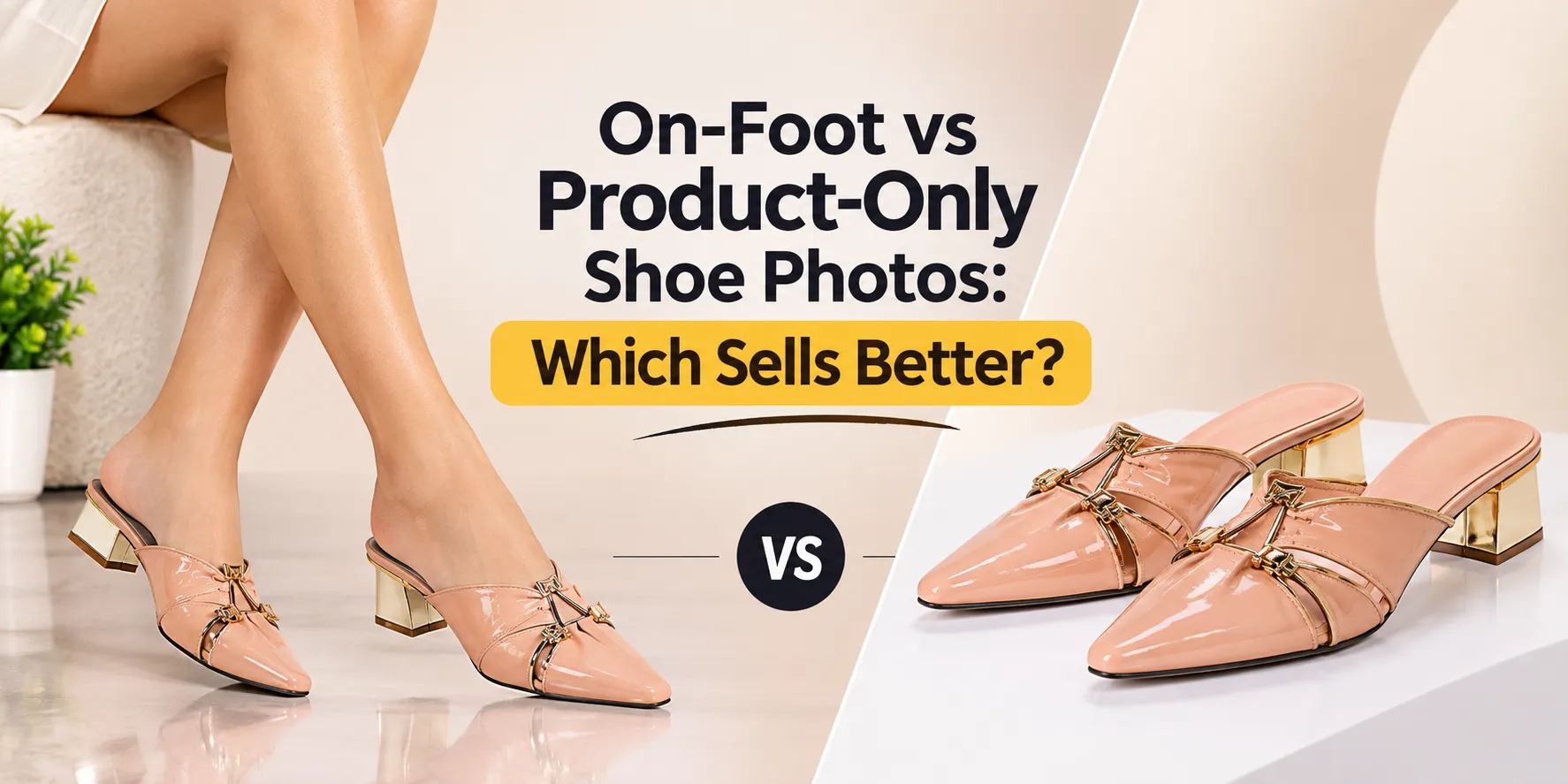
Both approaches serve different purposes. Product-only images help customers inspect the actual shoe, while on-foot shoe photography shows how the footwear looks when worn and styled. Choosing the right combination can make your product listing more informative and help shoppers make confident buying decisions.
For online footwear sellers, the goal shouldn't be to choose one photography style for every product. It should be to understand which image communicates the most useful information at each stage of the customer's buying journey.
What Is the Difference Between On-Foot and Product-Only Shoe Photos?
Before deciding which approach is more suitable, it is important to understand what each image style communicates.
What Are Product-Only Shoe Photos?
Product-only shoe photos show footwear without a model wearing it. The shoes are photographed individually or as a pair, depending on the intended image and marketplace requirements.

These images generally use a white, neutral, or carefully selected background to keep attention on the product.
They help shoppers examine:
-
Overall shoe shape and structure.
-
Material, texture, and surface finish.
-
Sole design and thickness.
-
Stitching, patterns, and decorative elements.
-
Heel height, straps, laces, and closures.
-
Front, side, rear, and top construction.
For example, a seller listing leather formal shoes can use product-only images to highlight the leather finish, stitching, sole construction, and overall silhouette.
What Is On-Foot Shoe Photography?
On-foot shoe photography shows footwear being worn by a model. Depending on the product and brand positioning, the image may show the feet and lower legs or include a larger portion of the model.
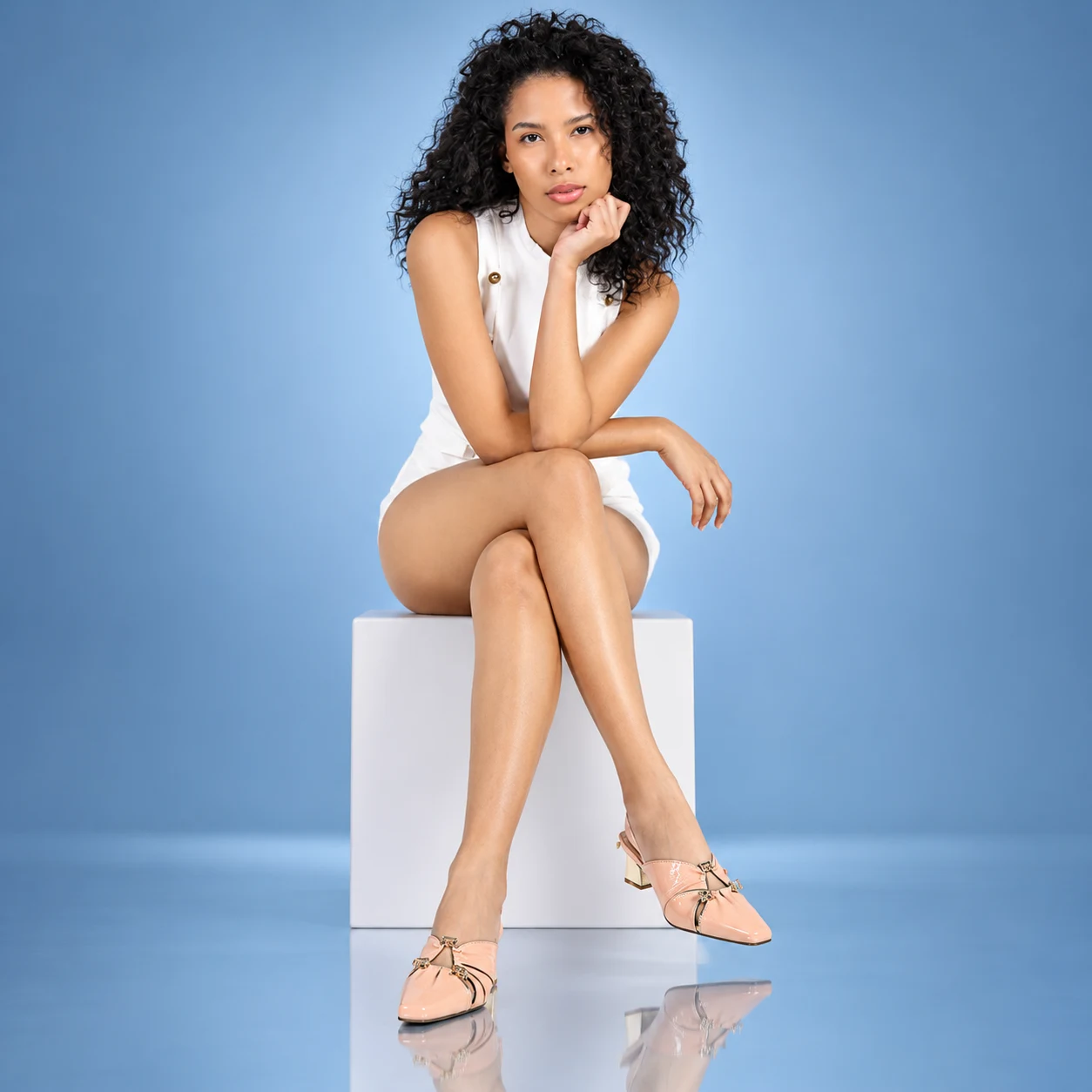
The purpose is to demonstrate how the shoes appear when worn rather than simply showing their standalone design.
These images can communicate:
-
How the shoe looks on the foot.
-
The visual proportions of the footwear.
-
How heels, sneakers or sandals complement an outfit.
-
Styling possibilities for different occasions.
-
The overall appearance of the product in a real-world setting.
For instance, a fashion footwear seller can show a pair of women's heels with a model wearing an outfit suitable for a party or formal occasion.
The main distinction is simple: product-only images explain the product itself, while on-foot images communicate its appearance and styling when worn.
On-Foot vs Product-Only Shoe Photos: Key Differences
Both image types can contribute to an effective online product listing, but their strengths are different.
| Comparison factor | Product-only images | On-foot images |
|---|---|---|
| Main purpose | Product inspection | Styling and appearance |
| Product visibility | High | Depends on framing |
| Material details | Easier to highlight | May require close-ups |
| Shoe construction | Clearly visible | Sometimes partially hidden |
| Wearing appearance | Not demonstrated | Clearly demonstrated |
| Styling inspiration | Limited | Strong |
| White-background listings | Highly suitable | Depends on platform rules |
| Fashion campaigns | Useful for product focus | Highly suitable |
| Marketplace galleries | Useful for product views | Useful as additional content where permitted |
| Brand storytelling | Product-focused | Lifestyle-focused |
Neither style is automatically better for every footwear category. The best choice depends on what customers need to understand before purchasing.
1. When Do Product-Only Shoe Photos Work Better?
Product-only images are particularly useful when the buyer needs to examine the shoe's design, construction and physical details.
A. When Product Details Influence the Purchase
Customers purchasing formal shoes, leather footwear, boots, or sports shoes may want to examine specific construction details.
A clean product photograph makes it easier to identify:
-
Leather or synthetic material.
-
Sole thickness and grip pattern.
-
Stitching quality.
-
Toe shape.
-
Heel construction.
-
Buckles, laces, and other design elements.
These details can be difficult to communicate through a full-body model photograph.
B. When Selling on Marketplaces
Marketplace listings often have specific requirements for their primary product images.
For example, Amazon India's footwear main-image guidance specifies a single shoe facing left at a 45-degree angle, with a pure white background and the product occupying at least 85% of the image area.
This makes a compliant product-only image an important starting point for Amazon footwear sellers. A model-worn photograph should not automatically replace the required main image.
Always check the current image policy for your product category and marketplace before uploading.
Check out Amazon footwear photography services.
C. When Managing Large Footwear Catalogues
Manufacturers and wholesale footwear sellers may have hundreds of designs, colours and sizes.
Product-only photography provides a consistent way to present these variations across a catalogue.
It also helps brands maintain visual consistency when updating their product listings or introducing new collections.
D. When Customers Need to Compare Similar Designs
Imagine selling three similar sneakers:
-
One with a mesh upper.
-
One with a synthetic leather upper.
-
One with a textured fabric finish.

Footwear Photographer in Delhi — Professional Shoes Photography & Photoshoot Services
Looking for a professional footwear photographer in Delhi? Lohar Studio specialises in high-quality shoe photography and footwear...
Explore Footwear Photographer in Delhi — Professional Shoes Photography & Photoshoot ServicesA product-only close-up can help customers distinguish these differences more clearly than a model photograph showing all three from a distance.
2. When Do On-Foot Shoe Photos Work Better?
Product details are important, but shoppers also want to imagine how footwear will look when worn.
This is where on-foot shoe photography becomes useful.
A. When Selling Fashion-Oriented Footwear
For fashion products, appearance and styling can be important purchase considerations.
On-foot images work particularly well for:
-
Women's heels and pumps.
-
Fashion sandals.
-
Casual sneakers.
-
Women's flats and ballerinas.
-
Men's casual shoes.
-
Ethnic footwear and festive collections.
Showing footwear on a model helps customers understand its visual appearance in a styling context.
B. When Shoe Proportions Matter
Some shoes look very different when photographed individually compared with how they appear on a person's feet.
For example, a chunky sneaker may look oversized in a standalone photograph. An on-foot image provides additional context about its proportions.
Similarly, high heels, ankle boots and strappy sandals benefit from photographs that show how their designs sit on the feet.
C. When Selling Through Your Own Website or Social Media
Your own ecommerce website gives you greater flexibility in arranging product galleries and brand storytelling.
On-foot photographs can be used for:
-
Product page secondary images.
-
Collection banners.
-
Fashion campaigns.
-
Social media advertisements.
-
Seasonal promotions.
-
Lookbooks and brand catalogues.
They help create a more complete visual experience beyond basic product inspection.
D. When Customers Need Styling Inspiration
A customer purchasing party heels, casual sneakers or ethnic footwear may want to understand what the product looks like with an outfit.
A well-planned model photograph can demonstrate the intended styling without requiring customers to imagine the complete appearance themselves.
However, styling should support the product rather than distract from it. The footwear should remain clearly visible.
3. Which Shoe Categories Benefit Most From Each Photography Style?
Different footwear categories have different visual requirements. A useful image strategy should consider the product's design, intended customer and selling platform.
1. Sneakers and Sports Shoes
Recommended combination: Product-only + on-foot images
Product-only images should communicate the sneaker's silhouette, sole pattern, upper material, laces and construction.
On-foot photographs can demonstrate how the sneaker looks with casual or sportswear outfits.
For performance-oriented footwear, close-ups of the outsole, cushioning and material construction can also be valuable.
2. Women's Heels and Pumps
Recommended combination: Product-only + on-foot images
Standalone images highlight heel shape, toe design, finish and decorative details.
On-foot images demonstrate the overall appearance, heel proportions and styling with dresses or occasion wear.
For premium heels, both views can contribute to a more complete product gallery.
3. Men's Formal Shoes
Recommended combination: Product-only first, on-foot as additional content
Formal footwear often requires detailed inspection of the upper material, sole, stitching, toe shape and finish.
A model wearing formal shoes with trousers can provide useful styling context, especially for premium or fashion-focused collections.
4. Sandals and Flats
Recommended combination: Both, depending on the design
Product-only images are useful for showing straps, sole construction, buckles and patterns.
On-foot photographs can communicate how the straps and overall design appear when worn.
This is especially helpful for sandals with distinctive styling or multiple straps.
5. Boots
Shoes and Footwear Photography For Flipkart
High-quality shoes / footwear product images hold a significant place in selling footwear on Flipkart. Professional photography le...
Explore Shoes and Footwear Photography For FlipkartRecommended combination: Both
Product-only images can show the boot's shaft, sole, heel, zips and construction.
On-foot photographs help communicate the boot's height and overall appearance when worn with different outfits.
6. Kids' Footwear
Recommended combination: Product-only images as the starting point
For children's footwear, product-only photographs help parents examine the design, sole, closure system and overall construction.
Additional contextual images can be considered where suitable and permitted by the relevant marketplace's policies.
Check out our kids' footwear photography services.
4. What Is the Ideal Image Sequence for an Online Shoe Listing?
Instead of choosing only one photography style, sellers should build a gallery in which every image answers a different customer question.
A practical shoe product gallery can contain the following images:
Image 1: Main Product Image
Show the shoe clearly against the appropriate background.
The product should be properly positioned, well-lit, sharp, and easy to identify in search results.
For Amazon footwear listings, follow the specific main-image rules rather than using a model photograph as the primary image.
Image 2: Side Profile
Show the complete side design to communicate the shoe's silhouette, sole thickness, and overall structure.
Image 3: Front or 45-Degree View
Help customers understand the toe shape, front design, and overall proportions.
Image 4: Rear and Sole View
Show the heel construction, outsole pattern, grip, and finishing details.
Image 5: Material and Detail Close-Up
Highlight stitching, texture, buckles, laces, fabric, cushioning, or other important features.
Image 6: On-Foot Model Image
Show how the footwear looks when worn.
Choose a suitable pose and framing so that the shoes remain the main subject.
Image 7: Lifestyle or Styling Image
Use a relevant setting or outfit to communicate the intended use of the footwear.
This sequence is a suggested gallery strategy, not a mandatory marketplace requirement. Some products may need fewer images, while complex or premium designs may benefit from additional views.
Baymard Institute's ecommerce usability guidance recommends providing at least three to five product images so customers can evaluate a product from different perspectives.
5. How to Choose the Right Photography Style for Your Selling Platform
The best image combination also depends on where you sell your footwear.
Amazon
Amazon has defined main-image requirements, including a white background and specific footwear presentation rules.
Start with a compliant standalone product image. Use additional images to communicate the shoe's other features and wearing appearance where permitted.
Do not assume that a model image suitable for a brand website will also qualify as an Amazon main image.
Flipkart
Check the current category-specific image specifications before preparing the final listing gallery.
A practical approach is to prioritise clear product views, consistent angles and accurate representation, with additional styling content where supported.
Myntra and Fashion-Focused Platforms
For fashion-oriented footwear, the visual appearance when worn can be particularly useful.
A combination of clean product views and model-worn photographs helps present both product construction and styling.
Always follow the current platform-specific requirements.
Meesho
Shoes and Footwear Photography For Myntra
The fast-paced world of e-commerce, especially in platforms like Myntra, is all about high-quality visuals. Professional photograp...
Explore Shoes and Footwear Photography For MyntraFor value-focused footwear listings, clear product presentation is important.
Use straightforward angles to communicate the actual design, colour, sole and material. Add contextual imagery where it improves understanding and is permitted.
Your Own Ecommerce Website
Your website provides the most flexibility.
You can arrange product-only images first and follow them with on-foot photographs, close-ups and lifestyle images.
The gallery should answer the customer's questions in a logical order without making them search for important product details.
6. Common Mistakes Footwear Sellers Should Avoid
Even when the photography style is correct, poor execution can reduce the usefulness of the images.
Using Only On-Foot Images
A model photograph may look attractive, but it might not show the sole, stitching, rear construction or material details.
Customers should not have to guess what the actual shoe looks like.
Using Only One Product Angle
A single side photograph cannot communicate every important feature.
Provide additional views of the front, rear, sole and other relevant details.
Hiding the Shoe With Clothing
Long trousers, dresses or other styling elements should not cover important parts of the footwear.
The product must remain the visual focus.
Using Incorrect Colours
Lighting and editing should preserve the actual product colour.
Excessive retouching can create a mismatch between the photograph and the delivered product.
Choosing Distracting Backgrounds
Backgrounds should support the product's appearance.
For marketplace images, follow the required background standards. For lifestyle photographs, choose settings that complement the footwear without overpowering it.
Repeating Almost Identical Images
Uploading several photographs from nearly the same angle does not necessarily provide additional information.
Each gallery image should communicate a different feature, view or use case.
7. How Can Footwear Sellers Find Out Which Images Perform Better?
There is no universal conversion percentage that proves on-foot photographs always outperform product-only images.
The result depends on the product category, price, customer expectations, platform, listing quality and the images being compared.
Instead of relying on assumptions, sellers can evaluate their image strategy using actual listing performance.
A. Compare Similar Products
Select comparable footwear products with similar pricing, audiences, and selling conditions.
Compare their image galleries and identify whether they use standalone views, model photographs, or a combination.
Avoid concluding unrelated products.
B. Monitor Click-Through Rate
The main product image influences how a listing is presented in search results.
Where platform analytics provide the necessary data, monitor impressions and clicks to understand whether changes to the primary image are associated with improved engagement.
C. Monitor Add-to-Cart Activity
Customers may click a listing but still hesitate before adding the product to their cart.
Additional product views can help identify whether shoppers are receiving enough visual information to evaluate the footwear.
D. Check Conversion Rate
Compare orders against relevant visits or sessions, using the same reporting method and time period.
An improvement after changing the image gallery can be useful evidence, but account for pricing, advertising, stock availability and other changes.
E. Examine Customer Questions and Returns
Shoes and Footwear Photography For Meesho
Do you sell on Meesho and want to have the best possible product photography for your footwear? Lohar Studio is your place! We pro...
Explore Shoes and Footwear Photography For MeeshoLook for repeated questions such as:
-
Is the sole thick or thin?
-
Does the shoe have a glossy or matte finish?
-
How does the footwear look when worn?
-
Is the actual colour the same as the listing image?
-
Does the shoe have a soft or structured upper?
These questions reveal which visual information is missing.
Return reasons can also highlight differences between customer expectations and the product they receive.
8. Should You Invest in Both Photography Styles?
For most footwear sellers with an established catalogue, using both approaches is a sensible long-term strategy.
However, the investment should match the product's sales potential and visual requirements.
For a new product with a limited budget, start with a clear set of standalone product images that communicate its design and construction.
Once the essential product views are covered, consider on-foot images for products where styling, proportions or wearing appearance can influence the buying decision.
For established brands and bestselling SKUs, a more complete gallery can include:
-
Clean standalone product images.
-
Multiple product angles.
-
Sole and material close-ups.
-
On-foot model photographs.
-
Lifestyle and styling images.
This creates a more informative product presentation without repeating the same information across every image.
9. Final Verdict: On-Foot or Product-Only Shoe Photos?
So, which sells better?
The answer depends on what the customer needs to see before purchasing.
Product-only photographs are generally the better starting point for communicating product details, maintaining catalogue consistency and meeting applicable marketplace main-image requirements.
On-foot photographs are valuable for demonstrating wearing appearance, proportions and styling.
For most online footwear businesses, the strongest strategy is not to choose one over the other. It is to use product-only images to establish product clarity and on-foot images to provide additional visual context.
The right image sequence makes the listing easier to understand and gives customers more useful information when making a purchase decision.
10. Frequently Asked Questions About On-Foot and Product-Only Shoe Photos
1. Are on-foot shoe photos better than product-only photos for online selling?
Neither is universally better. Product-only images help customers inspect the shoe's design, material and construction, while on-foot images demonstrate its appearance when worn. Using both can create a more informative product gallery.
2. Do footwear sellers need model photography for ecommerce listings?
Not for every product. Model photography is useful when wearing appearance, styling and proportions are important to the purchase decision. Basic product-only photographs should still communicate the actual footwear clearly.
3. Can I use a model-worn shoe image as the Amazon main image?
For standard footwear listings, Amazon India's footwear main-image guidance specifies a single shoe facing left at a 45-degree angle against a pure white background. A model-worn photograph should not replace this required presentation. Always check the latest category-specific rules.
4. How many images should I upload for one shoe product?
A practical starting point is five to seven useful images, including a main image, different angles, detail shots and an on-foot photograph where relevant. The exact number depends on the product, marketplace and available gallery slots.
5. Which footwear categories benefit most from on-foot photography?
Fashion sneakers, women's heels, sandals, flats, boots and occasion footwear can benefit from model-worn images because customers may want to understand their appearance and styling when worn.
6. Are white-background shoe images still important for online marketplaces?
Yes. White-background images remain important for marketplaces such as Amazon, where the main-image requirements specify a pure white background for standard footwear listings. Check the individual platform's current guidelines before uploading.
7. Do on-foot images help customers understand shoe size and fit?
They can provide visual context about the shoe's proportions and appearance on a foot. However, a photograph cannot establish an accurate size or guarantee fit. Include a clear size chart and relevant product measurements.
8. Should sneakers be photographed on a model or separately?
Both approaches can be useful. Standalone photographs communicate the sneaker's design, sole and material, while model-worn images demonstrate its appearance with sportswear or casual outfits.
9. What is the best image sequence for a shoe product listing?
Start with a compliant main product image, followed by side, front, rear, sole and detail photographs. Add an on-foot or lifestyle image to show how the footwear looks when worn.
10. How can I decide whether my shoe listings need more model photographs?
Review your product category, customer questions, listing engagement and conversion data. If customers understand the product details but still need styling context, an on-foot image may add useful information. Test changes on comparable products before updating your entire catalogue.
Need Professional Shoe Images for Your Online Store?
At Lohar Studio, we help footwear brands, manufacturers, D2C businesses and online sellers create product-focused visual content for ecommerce catalogues and marketplace listings.
From clean standalone shoe images and detailed product angles to model-worn and lifestyle photographs, the objective is to present each footwear design clearly and consistently.
Whether you sell sneakers, formal shoes, women's heels, sandals, boots, or casual footwear, your image requirements should match your product category and selling platform.
Explore our Footwear Photography Services to understand the available options.
If you're looking to enhance your brand’s presence on leading e-commerce platforms like Amazon, Flipkart, Myntra, Meesho, TataCliQ, Snapdeal, and Ajio, Lohar Studio is your go-to destination. Our team specializes in delivering high-quality images for fashion items, footwear, automotive products, medical photography, business headshots, and corporate shoots. We serve Delhi, Noida, Gurgaon, Faridabad, and Ghaziabad, offering professional results that boost conversions and elevate your brand’s image. Get in touch today at +91-9312070458 or visit us at A1/58, 1st Floor, Sector 6, Rohini, Delhi-110085, to schedule your next shoot!

Written from hands-on experience shooting for 4000+ brands - practical, field-tested photography advice, not just theory.