


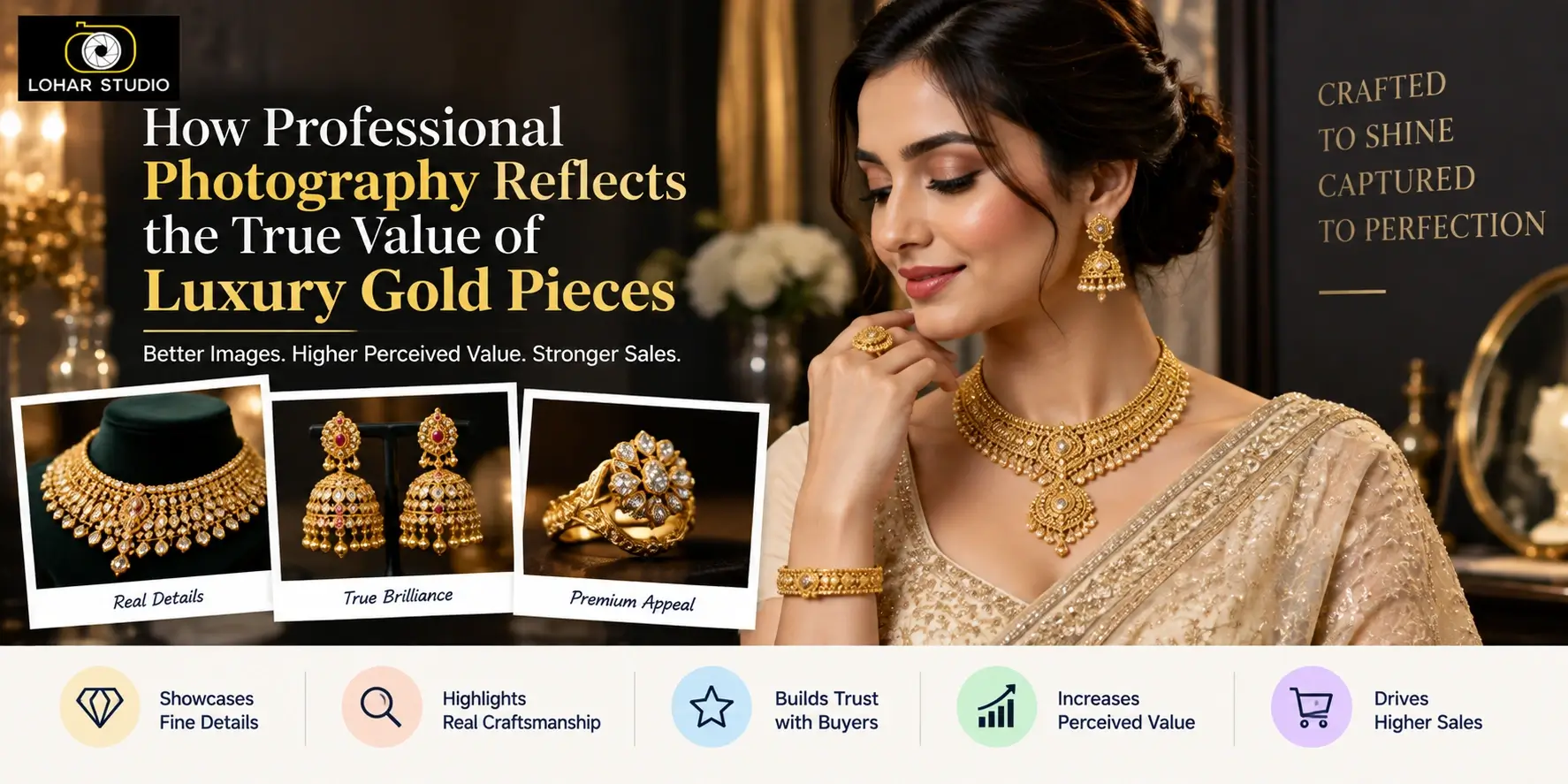
Quick Answer: For luxury gold jewelry, photography isn't a supporting detail — it's the primary way perceived value gets communicated, since buyers can't touch the metal, judge its weight, or see its true shine in person before purchasing. Accurate color reproduction of different gold purities, controlled reflection that preserves shine without glare, macro detail that reveals craftsmanship, and visual consistency across a collection all directly determine whether a piece photographs as genuinely premium or accidentally looks cheaper than it is. Get any of these wrong, and even exceptional craftsmanship can read as ordinary — or worse, mass-produced.
If you sell luxury gold jewelry, here's exactly how photography either protects or undermines the value you're actually offering.
Why Photography Determines Perceived Value More in Gold Jewelry Than Almost Any Other Category
In most product categories, a buyer forms their impression from multiple senses — they can touch fabric, feel weight, or try something on in a store. With fine gold jewelry sold online, photography is doing nearly all of that work alone. Buyers cannot feel the weight of an 18K gold bangle, judge the warmth of its tone in person, or see how light catches its finish — every one of those judgments has to be made from a photograph.
This is precisely why photography quality has an outsized effect on perceived value in this category specifically. Incorrect lighting, inaccurate white balance, or insufficient sharpness can make even genuinely high-quality craftsmanship look like a lower-end piece — and the reverse mistake matters too: if your pricing signals exclusivity but your photography doesn't match that positioning, buyers sense the disconnect even if they can't articulate exactly why.
The Color Accuracy Challenge: 24K, 22K, 18K, and 14K Gold Don't Look the Same
One of the most technically demanding aspects of gold jewelry photography is that different gold purities have genuinely different tones — 24K gold has a deeper, richer yellow than 18K, which itself looks different from 14K or rose gold alloys. Under inconsistent or poorly calibrated lighting, these distinctions blur, and a piece can end up looking like a different purity than it actually is.
This matters commercially, not just aesthetically. A buyer evaluating a 22K piece — common in Indian bridal and traditional gold jewelry — is specifically looking for the deeper, richer tone associated with that purity. If your photography flattens that tone into a generic yellow, you're not just producing a less attractive image; you're misrepresenting the actual product, which can affect buyer trust and increase the likelihood of returns or complaints when the item doesn't match expectations set by the photo.
Accurate color reproduction requires careful white balance calibration during the shoot itself — not something that can be reliably fixed afterward in editing without risking an artificial-looking result.
Controlling Reflection Without Losing Shine
Gold's polished, mirror-like surface creates a genuine technical challenge: too little control over reflection, and hotspots or glare wash out fine detail; too much diffusion, and the piece loses the shine and depth that make it look premium in the first place. The goal isn't to eliminate reflection — jewelry needs reflection to show shape and material quality — it's to control where and how that reflection appears, so it reads as intentional shine rather than a distracting flaw.
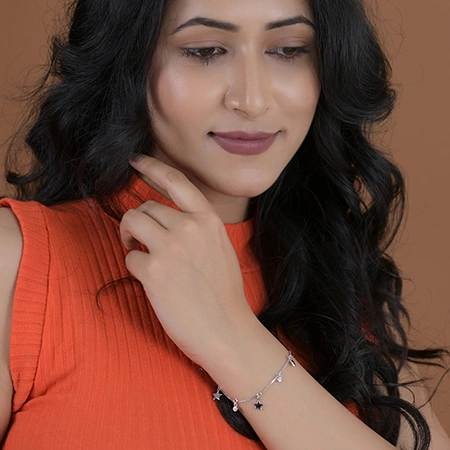
Jewellery Model Photography
Lohar Studio provides professional jewellery model photography — jewellery shot worn on a live model, not flat-lay or produc...
Explore Jewellery Model PhotographyThis typically means using soft, directional lighting — often through a lightbox or diffuser setup — combined with careful positioning to catch highlights along the piece's natural contours rather than letting them scatter unpredictably across the surface.
Macro Detail: Why Close-Ups Justify Premium Pricing
For any luxury product where craftsmanship is central to its value, detail photography isn't a nice-to-have addition — it's often the primary visual justification for premium pricing. A close-up revealing fine engraving, filigree work, a clean setting, or the precise finish of a clasp communicates information that no full-piece shot can convey.
This is especially true for gold jewelry with intricate handwork — temple jewelry, filigree, or antique-finish pieces — where the craftsmanship itself is a major part of what a buyer is paying for. Without a macro shot showing that detail clearly, buyers have no way to distinguish genuinely fine handwork from a simpler, mass-produced design, even when a real quality difference exists.
Styling and Background: What Actually Signals Luxury
A common misconception is that luxury automatically means dark backgrounds, dramatic shadows, and heavy styling — velvet trays, marble surfaces, golden reflections. These elements can work, but they don't automatically create a luxury impression, and used poorly, they can actively work against the product: a black background can look elegant but hide fine detail, and marble can distract from a delicate piece if not balanced carefully.
The more reliable principle is curation, not decoration — every styling element present should serve the piece, and anything that reads as ordinary, cluttered, or mass-produced has no place in the frame. A softer, cleaner approach — a complementary neutral tone, a single considered prop, minimal styling — often communicates premium quality more effectively than an overly ornate set that competes with the jewelry itself for attention.
Consistency Across a Collection: Building Brand Recognition
For a full collection, consistency in lighting, composition, and tone across every piece does more for brand perception than any single outstanding image. A recurring background material, a consistent color treatment, a signature styling choice — these details quietly signal a cohesive brand identity, making a collection instantly recognizable even when a single image is viewed out of context.
The opposite is equally true: a collection with inconsistent lighting, mismatched color tones, or varying styling approaches between pieces reads as scattered and undermines the sense of a considered, premium brand — regardless of how good any individual photo looks in isolation.
Jewellery Photography for Amazon
At Lohar Studio, we specialize in jewellery photography for Amazon, helping sellers showcase gold, diamond, silver, and fashion je...
Explore Jewellery Photography for AmazonDisplaying Purity and Hallmark Information
For gold jewelry sold in India, BIS hallmarking is a genuine trust signal buyers actively look for, and photography plays a role here too. A clear, well-lit macro shot of the hallmark stamp — showing purity and certification clearly — reassures buyers about authenticity in a category where trust is a significant part of the purchase decision. This detail shot deserves the same careful lighting and macro attention as any other craftsmanship close-up, since it's directly answering one of the most common buyer concerns in gold jewelry.
What Amateur or Rushed Photography Costs a Luxury Gold Brand
- Inaccurate color reproduction that misrepresents the actual purity or tone of the gold, creating a mismatch between the photo and the physical product
- Loss of texture and craftsmanship detail, flattening fine handwork into a generic-looking surface
- Inconsistent visuals across a collection, undermining the sense of a cohesive, premium brand
- Overedited stones or metal that look artificial, damaging credibility the moment a buyer notices the discrepancy
- Generic or cluttered styling that competes with the piece rather than supporting it, reducing rather than enhancing perceived value
Buyers may not consciously articulate any of these issues, but they feel the difference — and in a luxury category, that feeling is often the deciding factor between genuine interest and simply scrolling past.
Building a Complete Image Set for a Luxury Gold Piece
- A clean hero shot — accurate color, controlled reflection, on a considered but uncluttered background
- A macro detail shot — revealing craftsmanship, engraving, or fine handwork up close
- A hallmark or purity detail shot, particularly important for the Indian gold jewelry market
- An on-model or in-hand scale shot, giving buyers a real sense of size and how the piece sits when worn
- A styled or lifestyle image, placing the piece within a narrative — an heirloom on a velvet tray, a bracelet before a formal event — that reinforces its premium positioning
What to Look for in a Studio for Luxury Gold Photography
- A portfolio that specifically includes fine gold jewelry, not just general product photography — color accuracy across different purities is a distinct technical skill
- Evidence of macro photography capability, since detail shots are central to communicating craftsmanship
- A demonstrated understanding of reflection control specific to polished gold surfaces, not just general product lighting
- A consistent visual style across their existing collection work, showing they can maintain brand cohesion across a full catalog, not just single standout images
Top 10 FAQs
1. Why does photography matter so much for luxury gold jewelry specifically?
Jewellery Photography for Flipkart
At Lohar Studio, we specialize in jewellery photography for Flipkart, helping sellers showcase gold, diamond, silver, and fashion...
Explore Jewellery Photography for FlipkartBecause buyers can't touch, weigh, or see the true shine of the piece before purchasing, photography carries nearly the entire burden of communicating quality and value.
2. Do different gold purities actually look different in photos?
Yes — 24K, 22K, 18K, and 14K gold have genuinely different tones, and inconsistent lighting or white balance can blur these distinctions, misrepresenting the actual product.
3. Why is reflection control so important for gold jewelry photography?
Gold's polished surface behaves like a mirror — too little control creates distracting glare, while too much diffusion flattens the shine that makes the piece look premium.
4. Are dark backgrounds always the best choice for luxury jewelry photography?
Not necessarily — while they can look elegant, dark backgrounds can also hide fine detail; curated, considered styling matters more than simply choosing a dramatic backdrop.
5. Why do macro detail shots matter for luxury gold pieces?
They reveal fine craftsmanship — engraving, filigree, setting quality — that justifies premium pricing and that a full-piece shot alone can't communicate.
6. Should hallmark information be shown in product photography?
Jewellery Photography in Delhi
Lohar Studio provides professional jewellery photography in Delhi for gold jewellery brands, diamond jewellers, silver jewellery e...
Explore Jewellery Photography in DelhiYes, especially for the Indian market — a clear macro shot of the BIS hallmark reassures buyers about purity and authenticity, addressing a common trust concern directly.
7. Does visual consistency across a jewelry collection actually matter?
Yes — consistent lighting, tone, and styling across a collection builds brand recognition and reinforces a cohesive, premium identity, more than any single strong image can alone.
8. Can overediting hurt a luxury jewelry listing?
Yes — overedited stones or metal that look artificial can damage buyer trust the moment the discrepancy between photo and product becomes apparent.
9. What's the biggest mistake brands make with luxury gold jewelry photography?
Assuming heavy, dramatic styling automatically signals luxury, when in fact curated, uncluttered presentation combined with accurate color and reflection control is what actually builds a premium impression.
10. Does luxury gold jewelry need lifestyle or styled images in addition to standard product shots?
Yes — styled or narrative images (an heirloom piece on a velvet tray, jewelry worn before an occasion) help reinforce the emotional, aspirational positioning that pure product shots alone don't fully capture.
Photographing a luxury gold collection?
[Talk to Lohar Studio] about your collection's specific purity range and craftsmanship details — we'll plan color-accurate, macro-detailed photography that reflects the actual value of your pieces, not just their outline.
If you're looking to enhance your brand’s presence on leading e-commerce platforms like Amazon, Flipkart, Myntra, Meesho, TataCliQ, Snapdeal, and Ajio, Lohar Studio is your go-to destination. Our team specializes in delivering high-quality images for fashion items, footwear, automotive products, medical photography, business headshots, and corporate shoots. We serve Delhi, Noida, Gurgaon, Faridabad, and Ghaziabad, offering professional results that boost conversions and elevate your brand’s image. Get in touch today at +91 9312070458 or visit us at A1/58, 1st Floor, Sector 6 Rd, Pocket 1, Sector 6A, Rohini, Delhi, 110085, to schedule your next shoot!

Written from hands-on experience shooting for 4000+ brands - practical, field-tested photography advice, not just theory.