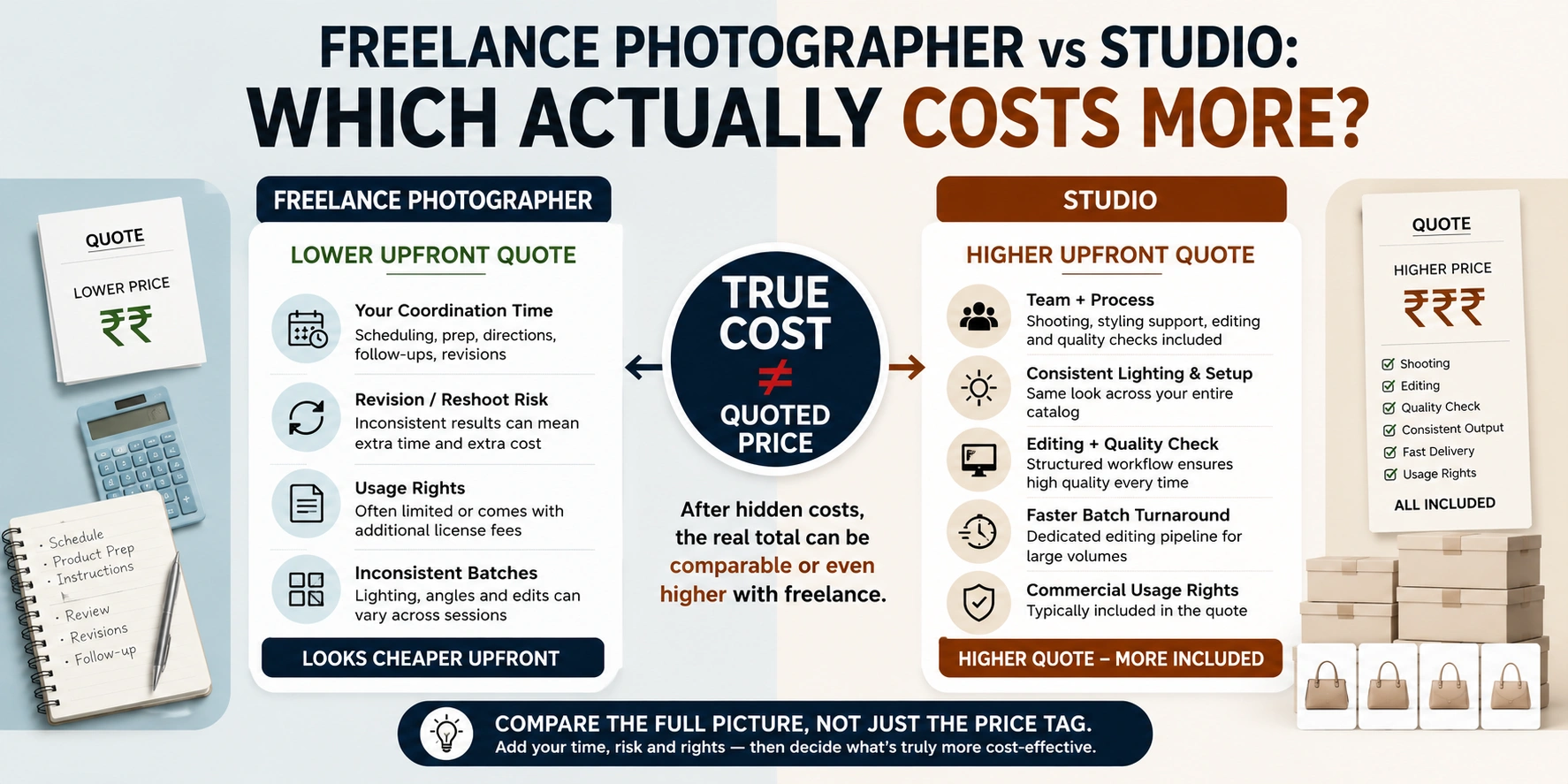



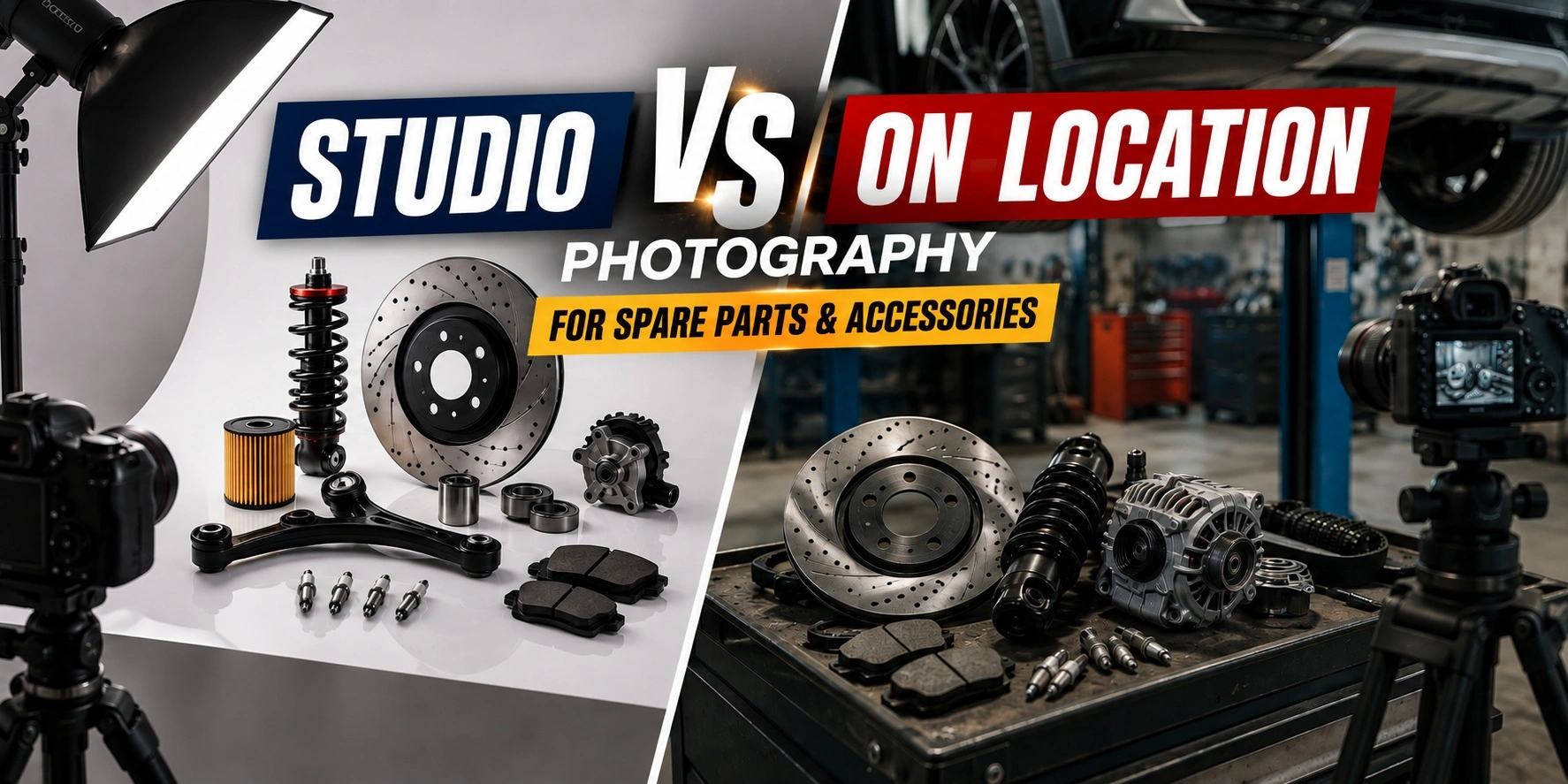
Quick Answer: For most spare parts and accessories, studio photography is the better choice — controlled lighting ensures accurate color and detail on reflective metal or plastic components, and consistency matters most when you're photographing dozens or hundreds of SKUs for a catalog. On-location photography is the better option when the part is too large to transport, needs to be shown installed in context (on a machine, vehicle, or piece of equipment), or when the buying decision depends on seeing scale and application rather than isolated product details.
If you're deciding how to shoot your spare parts catalog, here's how to make that call correctly for each type of product.
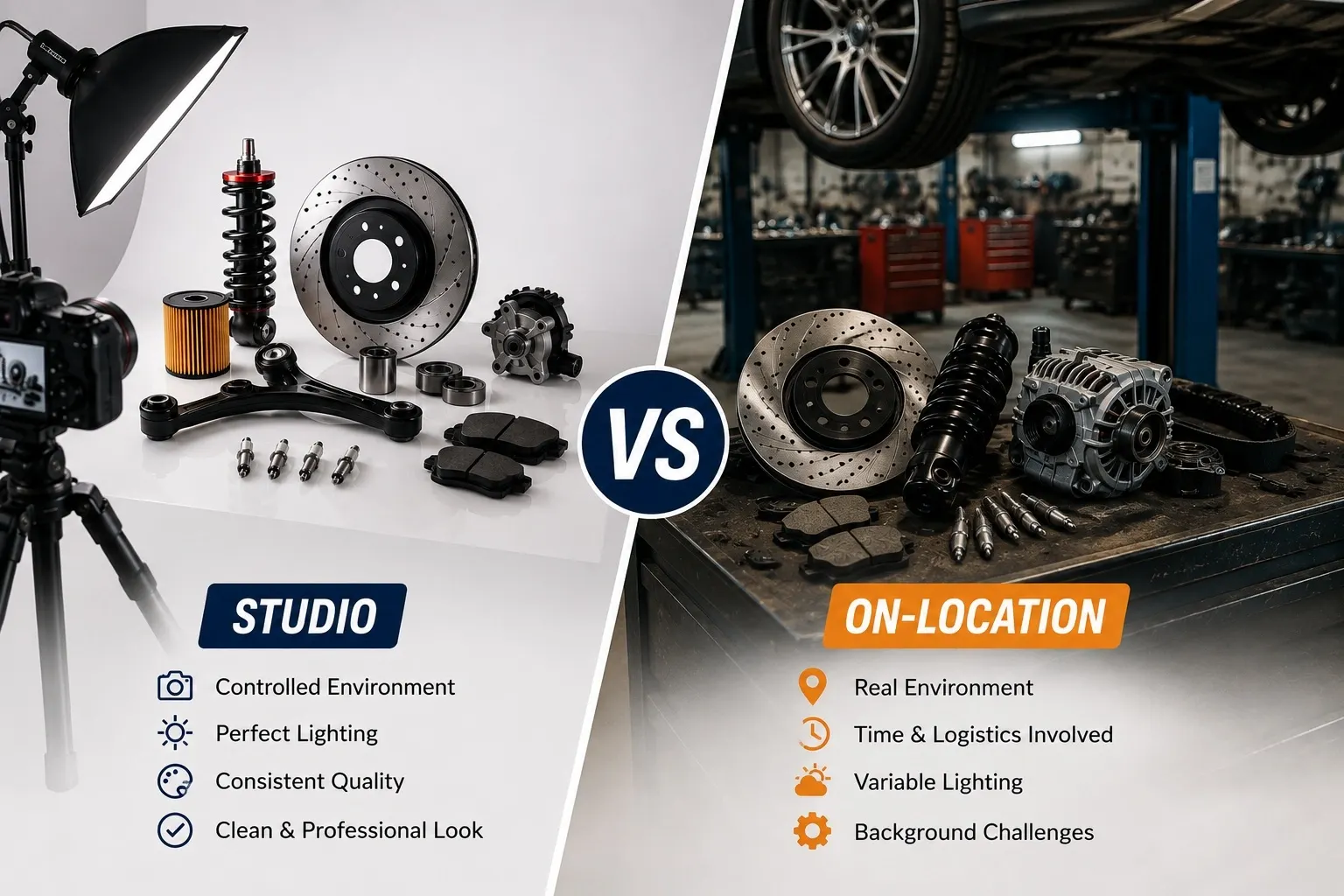
Quick Comparison: Studio vs On-Location for Spare Parts
| Factor | Studio | On-Location |
|---|---|---|
| Lighting control | Full control — consistent, glare-free results on reflective metal | Dependent on site conditions, harder to control glare and shadows |
| Best for | Small to mid-size parts, catalog consistency, ecommerce listings | Oversized parts, installed/in-context shots, heavy machinery |
| Catalog consistency | High — same setup across every SKU | Harder — lighting varies shoot to shoot |
| Logistics | Parts need to be shipped or brought in | Equipment and team travel to the part's location |
| Typical use case | Bulk spare parts catalogs, ecommerce listings, B2B product pages | Installed equipment, oversized machinery, application/context shots |
Why Studio Photography Works Best for Most Spare Parts
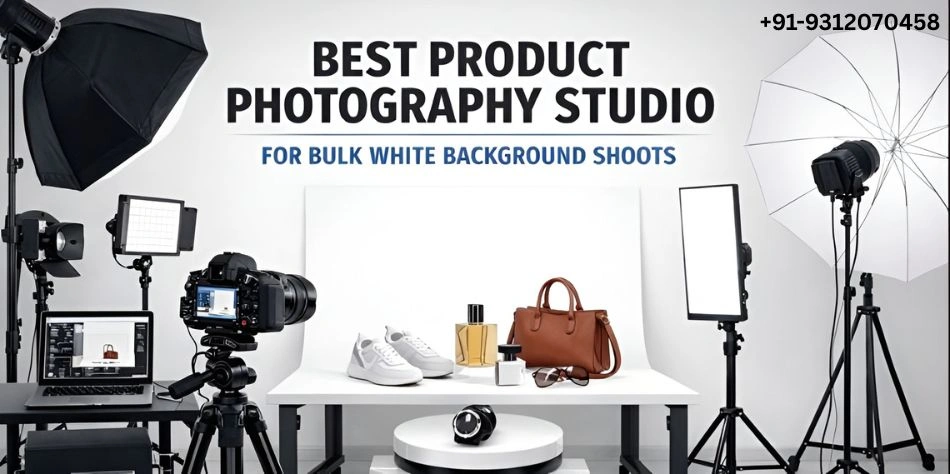
Product photography in general benefits strongly from a controlled environment, and this is especially true for spare parts, where consistent color accuracy across hundreds of SKUs is often the deciding factor for a B2B buyer comparing listings. A studio setup removes the variables that make on-location shoots unpredictable — no shifting daylight, no random shadows, no glare from unpredictable ambient lighting.
This matters even more for metal, chrome, or reflective spare parts, where controlling exactly how light hits the surface is the difference between a clean, accurate product image and one with distracting glare or washed-out detail. A studio setup lets the same lighting configuration be reused across an entire batch, which is what keeps a large spare parts catalog looking uniform — something buyers notice even if they can't articulate exactly why one listing feels more trustworthy than another.
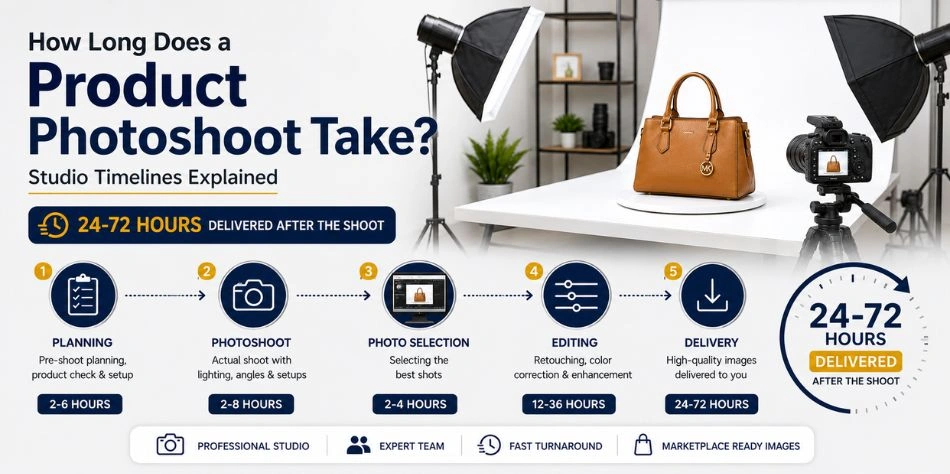
Studio shoots are also simply more efficient for high-SKU batches. Once lighting is dialed in, moving through dozens or hundreds of small to mid-size parts is significantly faster than repeating setup and teardown at multiple locations.
Automotive Photography for Amazon
Selling auto parts and car accessories on Amazon comes with a very specific photography problem. Amazon's image rules for the auto...
Explore Automotive Photography for AmazonWhen On-Location Photography Is the Right Call
On-location shoots make sense specifically when the part's context, scale, or installation is part of what the buyer needs to see or when transporting the item isn't practical.
Oversized or heavy machinery components. Large industrial parts that are difficult or expensive to transport are usually better photographed where they are, rather than shipped to a studio.
Installed or in-application shots. If a spare part needs to be shown fitted into a larger machine or system — demonstrating exactly how it's used — that context can only be captured on-site.
Equipment that can't be safely disconnected or moved. Some components are part of active installations that shouldn't be removed for a shoot, making on-location photography the only realistic option.
Scale demonstration. For parts where size relative to a larger system matters to the buyer's decision, on-site photography communicates that scale more naturally than an isolated studio shot.
The Trade-Offs You're Making Either Way
Choosing between studio and on-location isn't just a style decision — it comes with practical trade-offs worth planning for:
- Studio shoots require getting the part to the studio (shipping or drop-off) but deliver faster turnaround and easier catalog consistency across a large SKU count.
- On-location shoots eliminate transport concerns for large items but usually take longer per shoot due to setup, travel, and less predictable site conditions — which is why on-location industrial photography is typically priced as a day rate rather than per-photo, generally ranging from ₹14,999 to ₹59,999 per day depending on location, scope, and setup complexity.
Automotive Photography for Flipkart
Flipkart is India's largest value-commerce platform — and in its Cars & Bikes category, competition is fierce. Hundreds...
Explore Automotive Photography for FlipkartUnderstanding this trade-off upfront helps you budget and plan realistically instead of assuming one approach is simply "better" in every case.
How to Decide for Your Specific Catalog
- If most of your catalog is small to mid-size spare parts meant for an ecommerce listing or B2B product page, studio photography is almost always the more efficient and consistent choice.
- If you have a mix — smaller components alongside a few oversized or installed items — plan a hybrid approach: studio shots for the bulk catalog, with on-location shots reserved specifically for items that genuinely need site context.
- If your buyers care primarily about fit, application, or scale rather than isolated product detail, prioritize on-location shots even for parts that could technically be shot in studio.
- If your priority is catalog consistency across a large number of SKUs, default to studio photography unless a specific part genuinely requires on-site context.
Common Mistakes Brands Make With Spare Parts Photography
- Shooting an entire catalog on-location when most parts are small enough to be studio-shot far more efficiently
- Using inconsistent lighting across different on-location shoots, resulting in a catalog that looks mismatched from listing to listing
- Not accounting for glare on reflective or metal parts, leading to detail loss that a controlled studio setup would have avoided
- Assuming on-location is always cheaper, without factoring in day-rate pricing and per-shoot inefficiency compared to a batched studio session
Top 10 FAQs Related to Automotive Photoshoot
1. Is studio photography better than on-location for spare parts?
For most small to mid-size spare parts, yes — studio photography offers better lighting control, consistency, and efficiency across large SKU batches.
2. When should I choose on-location photography for spare parts?
When the part is too large to transport, needs to be shown installed in a larger system, or when scale and application context matter more than isolated product detail.
Automotive Product Photography
The automotive parts and accessories market in India is competitive. Whether you are selling wheel covers on Amazon, pitching a ty...
Explore Automotive Product Photography3. Does on-location photography cost more than studio photography?
Often yes — on-location industrial shoots are typically priced as a day rate (roughly ₹14,999–₹59,999 depending on scope), while studio shoots for smaller parts are usually more cost-efficient per SKU due to batching.
4. Why is studio lighting important for metal or reflective spare parts?
Controlled studio lighting prevents glare and washed-out detail that's common with unpredictable on-location lighting, which is especially important for chrome, metal, or polished components.
5. Can I mix studio and on-location shots in one catalog?
Yes — a hybrid approach is common, using studio shots for the bulk catalog and on-location shots specifically for oversized or installed items that need site context.
6. Does on-location photography work well for large machinery parts?
Yes — for oversized or difficult-to-transport components, on-location photography is usually the more practical and often the only realistic option.
7. How does catalog consistency differ between studio and on-location shoots?
Automotive Photography for Meesho
Meesho works differently from every other e-commerce platform. Its sellers are not brand owners running polished storefronts &mdas...
Explore Automotive Photography for MeeshoStudio shoots maintain consistent lighting and background across every SKU, while on-location shoots can vary shoot to shoot depending on site conditions, making large-scale consistency harder to achieve.
8. Is on-location photography necessary if I just want to show a part's size?
Not always — scale can sometimes be communicated with reference objects in a studio shot, but true installed-context scale is best captured on-location.
9. What's the most common mistake brands make when photographing spare parts?
Defaulting to on-location shoots for an entire catalog when most parts would be shot more efficiently and consistently in a studio.
10. How do I decide which parts need on-location shooting versus studio shooting?
Ask whether the part can be safely transported and whether its context, scale, or installation is essential to the buying decision — if not, studio photography is usually the more efficient choice.
Not sure which approach fits your spare parts catalog?
[Speak with Lohar Studio] about your product mix — we'll help you figure out which parts need on-location shooting and which can be efficiently batched in-studio.
If you're looking to enhance your brand’s presence on leading e-commerce platforms like Amazon, Flipkart, Myntra, Meesho, TataCliQ, Snapdeal, and Ajio, Lohar Studio is your go-to destination. Our team specializes in delivering high-quality images for fashion items, footwear, automotive products, medical photography, business headshots, and corporate shoots. We serve Delhi, Noida, Gurgaon, Faridabad, and Ghaziabad, offering professional results that boost conversions and elevate your brand’s image. Get in touch today at +91 9312070458 or visit us at A1/58, 1st Floor, Sector 6 Rd, Pocket 1, Sector 6A, Rohini, Delhi, 110085, to schedule your next shoot!

Written from hands-on experience shooting for 4000+ brands - practical, field-tested photography advice, not just theory.